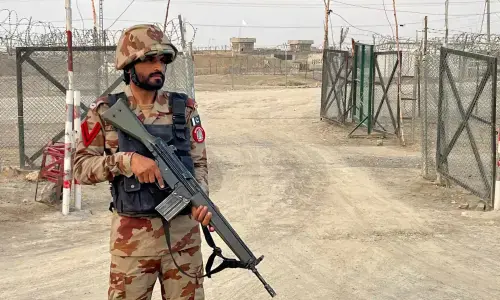
TWO major blasts on two consecutive days in Islamabad and Sibi have once more brought to the fore the helplessness of the state in the face of frontal assaults by militants. Both attacks involved soft targets — the Jaffar Express in Sibi and a vegetable market in the capital. The proscribed United Baloch Army, a separatist group, has claimed responsibility — reportedly as a response to security operations in different parts of Balochistan — for both incidents in which ordinary men, women and children died. While there is reason to doubt the veracity of the claim in the case of Islamabad, given that Baloch militants from various proscribed groups have so far limited their attacks to targets in Balochistan, if indeed the UBA is involved, it marks the advent of a dangerous trend: the war against the state by Baloch militants is being extended beyond provincial boundaries.
On the other hand, even though no claim has been forthcoming so far from religiously inspired militant groups, the possibility of one of them carrying out the Islamabad attack cannot be discounted. The outlawed TTP may have condemned the Islamabad blast, which took place a day before the Taliban-declared ceasefire ended. But going by other attacks that have occurred after the militants entered into talks with the government and that were claimed by extremist splinter groups, the likelihood remains that the market blast was the work of one of them. In fact in theory the attack could also be the handiwork of groups other than the Baloch militants or religious extremists.
In all this murkiness regarding the perpetrators and their motives, what is tellingly clear is the government’s inability to tackle militancy — from the first step of intelligence-gathering to coming up with measures to put an end to the growing violence in the country. No one in government is addressing the key questions regarding counterterrorism. Even the basics of counter-insurgency don’t appear right. For example, the National Counter Terrorism Authority— the front-line agency designed to deal with the terror threat — is tied up in legal wrangles and for all practical purposes is dormant. At the other end, the security establishment is not learning from its mistakes so that it could evolve an effective and cohesive counterterrorism strategy. The state is lurching from one incident to the other in confusion, which is not limited to strategy but also includes its muddled narrative regarding militancy. The state must now ask itself some hard questions: does the counterterrorism infrastructure have the capabilities to neutralise the threat, and if not what is being done to remedy this? In short, unless the state focuses on the terror threat with clarity, militants of various stripes will continue to run circles around it.