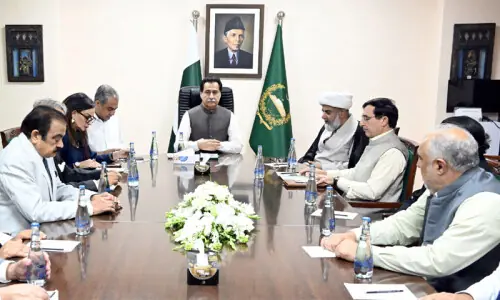
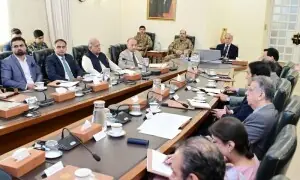
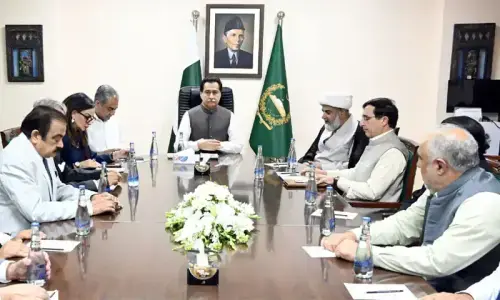
ISLAMABAD: The much talked about government-Taliban dialogue finally got under way here on Thursday after overcoming the initial snags as their negotiating teams met at the Khyber-Pakhtunkhwa House to pave the way for an agreement on ending violence that has claimed tens of thousands of lives.
The two sides importantly came out with a statement which they fondly called a joint statement even though it apparently had little in common. But a closer look at the statement read out by top TTP negotiator Maulana Samiul Haq can be revealing.
Broadly, the government’s team set a couple of conditions for the talks, while the TTP negotiators sought a few clarifications. But two points, one each by both sides, merit special attention.
One was about restricting any agreement reached through the dialogue to the “conflict-hit areas” – a condition by the government side, while the other from the TTP’s representatives was a guarantee about the authority/power of the government team for implementation of any agreement that may be reached.
The term “conflict-hit areas” was left vague and is assumed to mean tribal areas even though the TTP maintains its presence throughout the country and has carried out signature attacks everywhere.
The two clauses look innocuous, but in effect can set the parameters for a future deal.
The government’s insistence on setting the territorial jurisdiction of the agreement can be implied as its desire to make some concessions to the militant group, which it otherwise does not want to affect the mainland country.
TTP’s main agenda for the talks, as spelt out by Maulana Abdul Aziz, one of their negotiators, was enforcement of Sharia. “Without Sharia they wouldn’t accept the dialogue,” he had warned before the talks got under way.The TTP negotiating team underscores that is not the maximalist position, but a sine qua non.
The issue of Sharia was raised during the three-hour parleys where the TTP team put a lot of emphasis on the condition.
Interestingly enough the demand was not reflected in the statement. Some see the absence of the condition from the statement that virtually talked about everything inside the room as meaningful.
Even though some sources deny that the government had made up its mind on accepting the Sharia condition, it still has sought to define the area it might cede to the Taliban demand.
It would be too early to predict how this nascent process plays out over the next few weeks, but the perception out there is that a Swat-like deal, under which Maulana Sufi Mohammad’s demand for Sharia was accepted, is being worked out for the tribal areas as well – this time with Maulana Sufi Muhammad’s son-in-law Maulana Fazlullah, who heads the TTP.