0
0

ISLAMABAD: Speakers at a seminar here on Tuesday said police should be used as a main force in the fight against terrorism.
The seminar, “Countering terrorism and crime: role of police and prosecution” was organised by the Centre for Research and Security Studies at a local hotel.
In his opening remarks, senior journalist Imtiaz Gul said terrorism cases were registered against unknown people and in a few of the incidents police arrested the handlers and facilitators but they were released by courts due to the weak prosecution.
Similarly, the suspects arrested in connection with the 2009 Marriott Hotel attack case were also acquitted. In the terrorism cases, judges mostly remark that the prosecution failed to produce evidence, he added.
Afzal Ali Shigri, a former inspector general of police, said Pakistan was facing widespread terrorism and insurgency and the nation was dealing with enemies who were in the form of targeted groups and challenging the country’s unity.
These challenges need to be tackled at all levels: ideological, strategic, technical and developmental.
He added that the police had a vital role to play in the scenario.
The police need four major elements to carry out their role: alert, sensitisation, training and communication with the local people.
He said actionable intelligence had emerged recently but the police were still lacking the approach.
He said the police also needed to focus three major areas to counter terrorism: resourcing, reliable transportation and modern means of communication for exchange of information.
“The local population is used as a primary source of information for database and it can also be used for exhausting the sources of enemies,” he said. Mr Shigri stressed the need for creating a direct link between the police and the local population for sharing information.
Police should be given proper training to counter terrorism and equipped with latest weapons and security gadgets, he added.
Robet Periot, the author of Police in War Fighting, Insurgency, Terrorism and Violent Crime, said the basic function of the police was to protect the population.
It is a face of the government and acts as a belt support for the government. Law enforcement is an effective method for controlling terrorism and police should adopt a proactive role.
Relation and contact with the local population help the police counter terrorism, he said, adding police should also establish good relation with the public by ensure availability, responsibility and professionalism.
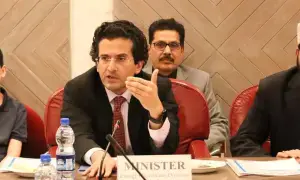
Former caretaker law minister Ahmer Bilal Soofi highlighted the role of the prosecution in fighting terrorism and problems faced by it which led to the acquittal of terrorists.
He said implementing international rules of law would ensure all essential elements of an efficient criminal justice system.
He said the use of force by military was a serious issue and was not encouraged but in a continued deteriorating situation there was no other option.
Hew as of the view that the police recruitments, appointments and promotions should be on merit.
A strong legislative support is needed for an effective prosecution service, he said, adding quality of prosecution should be improved and there should be an active support of the government for the department.
During the question-answer session, human rights activist Tahira Abdullah said the police should be given as much significance in all aspects, including budgetary allocations, as the military was being given in the country.
Huma Chughtai said there was a lack of trust among population and oversight of civil society towards the prosecution service.
Besides, forensic weakness is another problem, she added.