0
0

FAISALABAD: High resistant crops are need of the hour to fight climate changes as Pakistan is facing its worst impact and has been ranked eighth in climate change-hit countries.
The country’s temperature will have risen to 2.8 degree Celsius in day timings by 2070 that will heighten the food insecurity threat.
This was echoed at a seminar titled “Climate Changes Adaptation Strategies to Ensure the Food Security” organized by the University of Agriculture Faisalabad in collaboration with the Agriculture Model Inter-comparison and Improvement Project (AgMiP) here on Thursday.
Qamruz Zaman, former director-general of Pakistan Metrological Department, said that climate changes were not only posing a threat to environment but also creating development and farm production challenges.
He said farm scientists should play their role in developing the heat tolerant varieties to ensure the food security.
World Bank’s former chief economist Manzoor A Khan said we had failed to construct big dams for the last 40 years.
He said that climate changes were the manmade crisis, adding that the deforestation and heavy emission of smoke from factories were aggravating the situation.
Washington State University scientist Dr Gerrrit Hoogenboom said that joint efforts were needed to cope with the increasing carbon dioxide.
He called upon the world science community to expedite its efforts in this regard.
AgMip’s principal investigator and UAF Prof Dr Ashfaq Ahmad said the carbon dioxide was likely to increase from 390 to 571 ppm in the future.
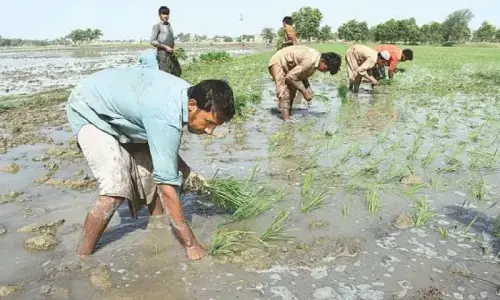
He said that climate changes could reduce wheat production by 14 per cent and rice yield by 15.2 per cent in the future. “We will have to adopt modern techniques in agriculture and enhance efforts to fight climate changes,” he said.
Dr Daniel Alderman from CIMMYT Global Wheat Production, Mexico, said they had trained at least 200 scientists in Pakistan. He said that joint efforts would address the issue and ensure the food security.
PMD deputy director-general Dr Ghulam Rasool said the last century saw one centigrade increase in temperature while another one degree increase was witnessed only in the first decade of the current century.
He said the temperature of the world could go up two centigrade by 2050.
UAF Vice-Chancellor Prof Dr Iqrar Ahmad said glaciers were melting causing floods while famine-like situation would emerge in the years to come.
He said the water scarcity was the major concern. “The country is dumping 80 per cent of the water into the sea while the remaining water is resulting in bringing Rs15 billion in the GDP through agriculture,” he said.