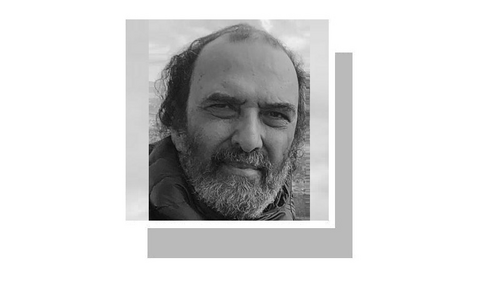
WHEN Mohammed Ali Talpur lost both his hands in an explosion some 40 years ago, he was in Balochistan’s Marri hills, miles away from anything resembling medical care. It took two doctors six days, including a plane trip to Quetta from Karachi and a camel ride into the mountains, to reach him. But this battle-scarred veteran warrior survived to tell the tale of being part of the Baloch insurgency of the 1970s.
Balochistan is presently in the grip of the fourth iteration of the insurgency that began almost immediately after Partition. Mr Talpur’s ardour for the cause – which he refers to as “the struggle” – has not dissipated with age, as illustrated when he joined the protest march by the Voice of the Baloch Missing People when they began the Karachi-Islamabad leg of their long trek from Quetta.
His intention was to accompany them until Hala but ill-health forced him out of the march after 16 days. Rolling up his shalwar he ruefully shows his swollen ankles and calves. “Walking 20 kilometres a day is no mean feat,” he says.
The marchers, who have just arrived at Larkana, stayed for three nights at his residence in Hyderabad, returning by vehicle every morning to the same spot where they had stopped walking the evening before.
Built in 1920, Mr Talpur’s house boasts magnificent original tile work floors and ceilings as well as rare Persian manuscripts. In one bedroom are two massive bundles of ajrak chadors. These were given to the protest marchers by well-wishers in the villages they passed through in Sindh.
Mr Talpur has close association with what was perhaps among the first ‘missing’ people’s cases in Pakistan. One of his fellow resistance fighters in the Marri hills was Dilip Das. In 1971, while travelling from Balochistan to Sindh, Dilip along with a Baloch companion, Sher Ali Marri, was picked up “by intelligence agencies” and never seen again.
“His mother, who lives in Karachi, is now 92 years old,” says Mr Talpur. “Even now, every time I see her she asks ‘How’s my Johnnie?’ (her nickname for Dilip). Although she hasn’t seen him since 1971, she believes maybe he’s still alive somewhere. There’s no closure for someone whose loved one has been disappeared by the state.”
Dilip, like Mr Talpur, was known as part of the London Group, a misnomer as far as the latter was concerned, given that he has never even been to London. This group, brought together by Mohammed Bhabha, comprised non-Baloch young men who left their studies in London in the early ‘70s to join the Baloch resistance. They included Najam Sethi, Ahmed Rashid, Rashed Rahman, and his younger brother Asad Rahman (who was known as Chakar Khan, and actually led some of the battles).
Mr Talpur was studying journalism at Karachi University in 1970 when he decided to give it up and join the rebels. But first he went to live for six months with a relative who was a doctor, learning what he could about treating illness, dispensing medication, and assisting with minor surgeries. The added skill proved useful, for after the explosives accident, he could not take part in the actual fighting.
He left Karachi on Oct 22, 1971 to join the fighters in the mountains where some of the London Group were already present.
Life as guerilla fighters wasn’t easy, particularly for young men from well-to-do urban backgrounds. “We lived rough,” recalls Mr Talpur. “There were no tents, no facilities. We lived under ledges, in small caves. The Marri areas produce food and Sibi wasn’t very far away, we would go there and get ration like gur, hand ground flour.” Perhaps it was their youthful idealism that gave them the strength to persevere.
The fighting only subsided with Bhutto’s ouster by General Zia who signed political settlements with some Baloch leaders.
However intense the emotions back then, the Balochistan situation has evolved and, according to Mr Talpur, there’s an essential difference between the insurgency of the ’70s and the ongoing one. “Before there were still reservations about independence, although that seed had been sown. Now the Baloch are fighting dedicatedly for independence. There’s no in between road for them.”