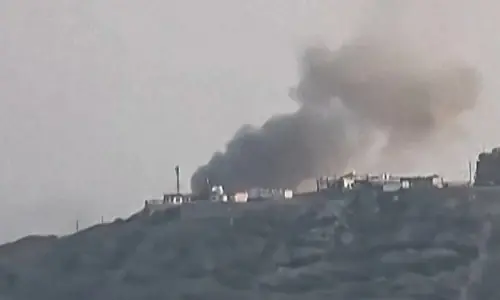
ISLAMABAD: It was the then President General (retired) Pervez Musharraf’s decision to launch a military strike on Islamabad’s Lal Masjid in July 2007 that more than anything else was responsible for the creation of Tehrik-i-Taliban Pakistan (TTP).
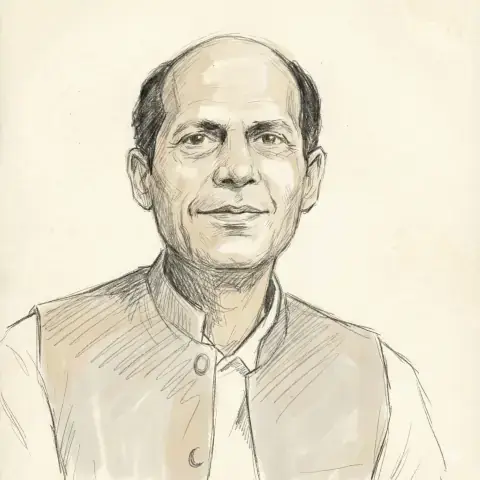
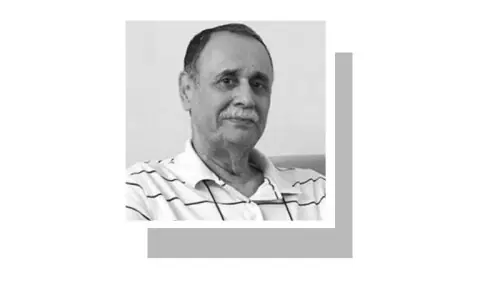
This was observed by the former High Commissioner to United Kingdom Professor Akbar S. Ahmed in his book Thistle and drone: America’s war on terror or war on tribal Islam launched here on Wednesday.
The book launch was organised by the Institute of Strategic Studies Islamabad (ISSI) which was followed by a public talk on a related theme ‘Relations between the centre and the provinces’.
The ceremony was presided over by the Adviser to the Prime Minister on National Security and Foreign Affairs Sartaj Aziz.
Mr Ahmed, in the book, states that although the Red Mosque was in Islamabad, 70 per cent of its madressah students were from Federally Administered Tribal Areas (Fata) and Khyber Pakhtunkhwa (KP).
Referring to the arrival of US forces in Afghanistan after the 9/11 attacks of 2001, the book maintains that it had an immediate widespread negative impact on Pakistan.
Thousands of people streamed across the border into Waziristan while fleeing US bombings. These included individuals being sought in connection with the 9/11 attacks on American soil which then disappeared into Fata, the book states.
“Given that so many Pakhtun tribes were related and lived on both sides of the international border that only existed on a map, it was inevitable that they would, as in the past, use it to their strategic advantage,” Mr Ahmed maintains in the book.
He adds that under intense American pressure for military actions in Fata, Pakistan broke the agreement with the tribes and launched a succession of large-scale military operations in Waziristan for the first time in the country’s history.
Way forward
The writer maintains that there was a need to discover means to resolve the conflict between the centre and the periphery. He adds that the war on terror needs to be concluded to ensure stability and peace, which were of paramount importance.
“In order for things to change, modern society needs to understand the context and history of conflicts and not impose an artificial external frame or ideology onto them,” Mr Ahmed maintains.
Given the response of Fata residents to the assault on its traditions and identity, the former high commissioner maintains that a federal model of governance with autonomous tribal peripheries was the clear solution.
“The centre also needs to create television and radio channels in the ethnic language, promote it in schools and colleges, and encourage members of the periphery to participate in the centre’s services and politics,” he said.
According to an excerpt of the book, “It is vital to stress the importance of deploying educated and understanding civil servants rather than the military in the administration of peripheries.
“The imposition of the military rule should be avoided at all costs. It sends the message that the periphery is not part of the nation but rather a fringe of troublemakers and outsiders that the government needs to defeat and punish.”