0
0

Balochistan impasse
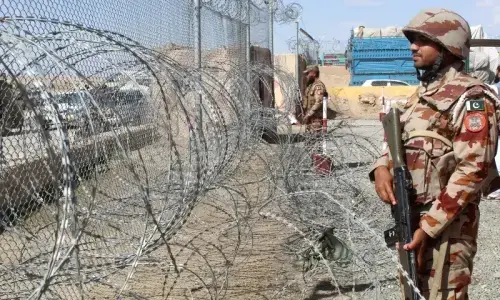
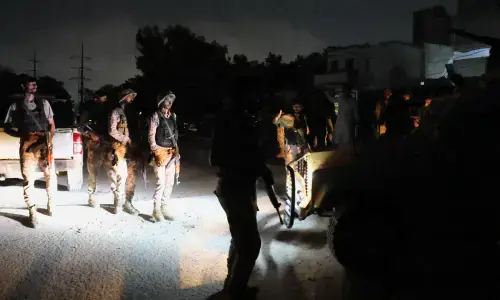
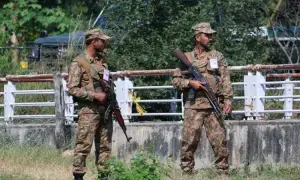
WITH the Balochistan situation showing no signs of abating, acts of terrorism continue and one can detect a new sense of defiance in the utterances of some Baloch sardars. On Sunday, landmines exploded in four places, killing 10 people, including five levies. Saturday also saw its usual quota of terrorist acts, including explosions in public places, a bomb blast at a policeman’s home and rocket attacks on the Frontier Constabulary in Dera Bugti. The most deadly incident — on Sunday — gives an idea of the thinking of those who are behind the current wave of attacks, for this one was aimed at a group of a gas company officials going to an exploration area. When their vehicle blew up, killing six people, tribesmen from nearby hills fired on them. Obviously this was a well-planned attack and shows that those who took part in this action were well trained. Later, a caller told a newspaper that the mine had been planted by the Balochistan Liberation Army. Sadly, the victims of a mine that exploded in the Kohlu area injured seven children, besides killing three people. Another man was killed when his tractor blew up in the Jaffarabad area.
The government denies that an army operation is going on in Balochistan and insists that it is taking action only against terrorists and criminals. Whatever the nature of the operation, the truth is that the government has failed to normalize the situation, acts of terrorism seem to be increasing and those behind them appear to have plenty of arms. A greater cause of concern is the militancy to be seen in what some sardars have to say. In an interview with the New York Times, Mr Akbar Bugti sounded defiant and said the government had to negotiate with the sardars, for if they were removed from the scene, it would have “a heck of a time from the younger generation, because they are more extreme”. The Marri chief said the Musharraf government offered “peanuts” when it came to Baloch rights. Mr Bugti’s grandson claimed that he commanded 2,000 fighters, that a similar number were available with the Marris and that they had supporters among civilians throughout the province. The Bugti and Marri chiefs, however, left the possibility of negotiations open. Similarly strong views were expressed at a public rally in Quetta by Mr Akhtar Mengal, chief of the Balochistan National Party, while referring to Balochistan’s resources. He challenged the government’s right to launch development plans in the province and said only the Baloch had this right.
It is time both sides realized that force will not solve the problem. While the sardars must shun acts of violence that kill more civilians than security men, the government, too, must give priority to the political process. Since the sardars have left open the possibility of talks, the government must respond and address Baloch grievances. It is true the Baloch sardars consider the province’s natural resources their own property, and they are utterly indifferent to the welfare of the people, whom they treat as mere chattel. But they cannot be ignored because they are in a position to continue to cause trouble and obstruct development work. One hopes it is not their ego the Baloch sardars want to be pandered to, for they are good at rhetoric and have seldom bothered to come out with specific demands.
Sugar cartel’s price-fixing
ONE does not know what to make of the ‘warning’ of the Pakistan Sugar Mills Association (PSMA) that there is going to be a shortage of 600,000 tons of sugar during the current year. In the same breath, the association has denied any culpability for the on-going sugar shortage which has caused the price of sugar to almost double in the retail market. A closer look needs to be taken, however, at the PSMA defence. For instance, it is on record that the National Accountability Bureau wanted to conduct an inquiry into the meteoric rise in the price of sugar and to check on the possible role of the mill owners, who, it was alleged, had been manipulating supply to keep the price high to make profits. The NAB investigation never got off the ground, as it was stopped by a top government official for whatever reason.
Most sugar mills are owned by people who hold important positions in the government and the ruling party, including the Punjab chief minister, the president of the PML-Q and the ministers for commerce and industries. The PSMA’s own statistics reveal that for the period up to Feb 28, barring a couple of exceptions, sugar mills owned by these gentlemen released between one-ninth and one-third of their total stocks. The PSMA’s secretary-general has defended this saying that this was a ‘normal market practice’ of those mills which were financially sound because by waiting longer they could get a higher price. However, this is precisely how price-fixing works. The sugar mills are able to get a higher price because of their decision to withhold stocks, which creates an artificial shortage in the market and creates upward pressures on the price of sugar. This is not ‘usual market practice’ but rather price-fixing by a cartel of sugar mill owners. In most countries this would be deemed illegal but in Pakistan it seems to have been going on as if it were the norm. Surely, the hardship this price-fixing has caused to common consumers throughout the country should persuade the government to act against this sugar cartel and force its proprietors to release their stocks of sugar into the market.
Deaths on the bridge
IN YET another horrific accident caused by sheer negligence and rash driving, 10 people died while eight were injured on Sunday when a speeding minibus went off the ICI bridge in Karachi. The bridge is not immune to accidents, but this was the worst of its kind. Eye-witness reports say that two traffic policemen tried to stop the speeding bus but the driver ignored their warnings and continued speeding before losing control of the wheel in an attempt to overtake another vehicle. This kind of contempt for basic traffic rules is all too visible on the country’s roads and often leads to the death of innocent motorists and bystanders. As it is, last year’s statistics show that there were six to seven fatalities every day in Karachi all of which could have been avoided had road safety rules been adhered to. As for Sunday’s accident in Karachi — or for that matter the three traffic-related deaths that occurred on Saturday — the usual inquiries will be held, police officers transferred or suspended and compensation announced for the victims but little will change unless traffic rules are strictly enforced. When the motorcycle helmet law was enforced last year, one saw a serious effort to ensure compliance with it in the first week but gradually the initiative waned.
To start with, the driver of the minibus, who escaped from hospital, should be apprehended and proceeded against. By making an example of him, other drivers — who are guilty of irresponsible road conduct — will get the message that their rash driving will not be tolerated. A public awareness campaign on following proper traffic rules and road safety should be launched so that new and inexperienced motorists are made aware of the dangers of speeding — and that those who break the law will be strictly dealt with.
Implications of N-deal with India
THE Indo-US nuclear deal signed during President Bush’s recent visit to South Asia is meant to turn the relationship between the two states into strategic partnership. It carves a new alignment that represents a tectonic shift in the Asian security paradigm.
As India’s economy is growing, its energy needs are increasing at a fast pace. Being a non-signatory to the NPT, India cannot have access to nuclear plants and nuclear fuel and technology. During Mr Manmohan Singh’s last visit to Washington in December 2005, the US agreed to give India more or less the same privileges that are enjoyed by signatories of the NPT. This understanding was reduced to an agreement that was signed during President Bush’s visit to India. According to the agreement, the United States will sell nuclear plants and technology and also undertakes the supply of nuclear fuel to India for the civilian nuclear plants, on grounds that India is deficit of uranium.
On the other hand, over several years, extending up to 2014, India will put 14 of its 22 nuclear reactors under IAEA safeguards, but its two fast breeder reactors will be excluded from the civilian category and hence not be a part of the safeguards regime. According to the US ambassador in Pakistan, 67 per cent of the Indian production facilities will come under IAEA safeguards as opposed to the present 11 per cent. The caveat is that India is seeking access to imported fuel for nuclear power plants in order to utilize its domestic uranium resources for military purposes.
The US administration is working hard with Congress to change US laws to get this agreement approved by the Congress. It is believed that a stand-alone bill will be negotiated with Congress to expedite the legal process. Efforts are being put in by the US administration to convince key members of the Congress. In parallel, strong corporate lobbies and other interested groups are applying pressure on the Congress members and it is most likely that the legislation will get through in its entirety or with a few riders. It would be more difficult however for the US to get its international partners in the Nuclear Suppliers Group (NSG) to alter their rules for India.
New Delhi is especially pleased that it has been able to keep the fast breeder programme out of the safeguards regime. United States has also invited India in the ITER initiative on fusion energy as an important step towards the goal of full energy cooperation. Overall, strategic and economic objectives of the US are now overriding factors to which non-proliferation has been subordinated. Obviously this policy can have a negative effect on the behaviour of several states like Brazil, South Africa and Ukraine, to name a few, that had given up their nuclear weapons programme.
The statement of Director, IAEA, Mr El Baradei approving the nuclear deal shows to what extent the US has influenced multilateral organizations to conform to its new policy of “nuclear exceptionalism”. Considering that the last NPT review conference was a near failure, the current US policy and IAEA’s lack of direction will further weaken the treaty. The non-proliferation lobby in the US is somewhat active, but their voice is not powerful enough to make an impact.
The US strategic objectives of its expanded relations with India at this time appear to be three-fold. Firstly, United States expects that India will collaborate with it in dealing with the strategic challenge from China, although both governments deny that Beijing is a factor in their calculations. America presumably thinks that a build-up of Indian nuclear arsenal against an emerging powerful China will be in its interest and the resultant risk to global nonproliferation can be managed. China will therefore have to watch closely the rise of military and economic power of India in addition to keeping its sights focussed on the US.
According to several analysts, Washington also considers India as a partner in the fight against radical Islam. India’s Muslim population is referred to as a model of moderation and a robust participant in the democratic evolution of that country. Furthermore, India’s growing economy and the emergence of a sizable middle class of nearly two or three hundred million people there is another major factor that is drawing the two countries together.
From these agreements India expects to change its standing in the world. In the longer term, the Indians want to get into a position once occupied by the Soviet Union in which no major global decision could be taken without its approval. India’s immediate aspiration is to get out of the narrow orbit of South Asia where it is tied inextricably to Pakistan and Kashmir.
New Delhi would like to convey the impression that it has not compromised its foreign policy by playing the balancing act of am an independent power and yet be a US strategic ally. It is a different matter that it has tactically yielded to the US on the Iran nuclear issue by voting once in favour of referring the matter to the IAEA board of direction and then to the UN Security Council.
To deny equal treatment to Pakistan, President Bush has given the reason that it has a “different history”. His remark has a loaded connotation that refers not merely to A.Q. Khan, but also to a different history relating to democracy and extremism. Pakistan’s proximity to China could also be a factor for the US to deny civil nuclear technology to it. Moreover, if India and Pakistan were bracketed together the question of getting the legislation through Congress and NSG would have been well nigh impossible.
The United States has very cleverly used the war on terror to de-link its policies with the two countries. Its support facilitated Israel and now does India to get away with their nuclear weapons programmes and acquire respectability, leaving Pakistan in a strategic limbo. An increase in the existing imbalance of power between India and Pakistan could give rise to insecurities and trigger an arms race between India and Pakistan and between India and China.
Beijing will be especially concerned if the ballistic missile defence agreement between the US and India were actualized. Cooperation in space and missile defence and the sale of sensitive military technologies will weaken Pakistan’s nuclear deterrence and conventional capabilities. It would also erode and weaken China’s nuclear deterrence with both India and the United States.
A more appropriate approach to meet India’s and other countries’ growing economic needs would have been to set up an international consortium of nuclear energy assistance under strict IAEA safeguards and develop technologies through international effort of producing civil nuclear energy that is non-convertible for military purposes. Similarly, Indian and Pakistan’s security needs could have been packaged. But all this is now wishful thinking.
What then are the options for Pakistan in the current emerging scenario? Despite the Indo-US alignment, Pakistan must continue to foster friendly relations with both the countries and extend them to areas of vital national interests. This may appear odd but this is what must be done. International relations are no longer a zero-sum game or something to be seen in black and white. Pakistan needs US investment, economic assistance, access to its markets and cooperation in non-nuclear energy programme. It also needs military hardware and military-to-military cooperation. Having good relations with the US in a unipolar world is by itself a source of strength for middle powers like Pakistan.
America’s top priority is to seek Pakistan’s continued cooperation in fighting the war on terror. Fighting terrorism and extremism is in Pakistan’s own vital interest, provided the approach is broad-based and not tilted against it. At the same time, Pakistan should foster closer relations with China, expand its economic and political ties with European countries and strengthen its bonds with the Islamic world. Above all it, should build national institutions to achieve political stability and durable economic and social progress.
For its energy requirements Pakistan should continue cooperation with China in civil nuclear technology and further strengthen its indigenous capability in this area. This would require greater self-sufficiency in reactor manufacture and higher industrial capacity for uranium enrichment. Already China has installed a nuclear plant of 325 megawatt at Chasma. Another plant of the same capacity has been contracted for and two additional plants of 600 megawatt are planned for the future.
The current nuclear power profile has a goal of 8,800 megawatts to be completed in the coming decades. This would require rules of the NSG to be modified on a generic rather than selective basis, so that China and other nuclear manufacturing countries do not have to seek similar exemptions from NSG as in the case of India.
Despite the nuclear deal and misgivings generated by India’s military build-up, Pakistan and India should continue advancing the peace process. The current Indo-US strategic developments should also become a part of the South Asian dialogue process. The US having such close relations with the two countries should facilitate finding a resolution to the Kashmir dispute so that India and Pakistan harness their energies in economic development, poverty alleviation and building their societies on a stable foundation.
The writer is a retired lieutenant-general of the Pakistan Army.