Ties with the US
AMBASSADOR Jahangir Karamat’s statement that the US-Pakistan relations today were “not transient” reflects both a hope for the future and a comment on the past. In an interview, Pakistan’s envoy in Washington said it was a “two-way relationship” and that the US did not interfere in Pakistan’s domestic matters. A review of the past, however, shows that only expediency brought the two countries together twice, and once America’s priorities changed, the two parted ways. The first time America “discovered” Pakistan was in the fifties when it found this country to be a valuable link in the chain of military pacts the US had crafted worldwide to meet the communist threat. As a member of both Seato and Cento (initially Baghdad Pact), Pakistan linked America’s southeast Asian system with that in the Middle East. And since Turkey was a member of both Nato and Cento, Pakistan was made to feel that it was a key link in the US-led systems of military alliances. In addition, it had a direct military assistance pact with America, besides adhering to the Eisenhower doctrine. This way Pakistan truly became what was called America’s “most allied ally” and was diagnosed as suffering from “pactitis”.
Several factors combined to erode this bonhomie. First, the US did not approve of Islamabad’s close relationship with Beijing, even though Washington itself had improved its ties with Moscow following the Sino-Russian rift. Second, the 1965 war with India soured US-Pakistan relations, because Washington cut off the supply of military spares to Pakistan during the war. After the war, the relations remained frozen, until the Soviets came marching into Afghanistan in 1979. Suddenly, Pakistan became America’s front-line ally and helped prosecute the US-led ‘jihad’ against the Soviet Union. The economic and military aid to the anti-Soviet mujahideen later turned out to be a major factor in the evolution of the jihadi culture that now Pakistan is trying hard to grapple with. Once the Soviets withdrew, the US washed its hands of Pakistan — until 9/11 and Taliban brought them together again.
Will history repeat itself and the US end its current involvement with Pakistan when it suits it? Already, the focus of America’s concerns seems to be shifting away from Afghanistan, as is evident from its consistent pleas with Nato to play a greater role there. Will that mean that Islamabad will be asked to fend for itself once again? What the US needs to realize is that Pakistan’s geographic location and the western orientation of its institutions give it a special position at the meeting place of South Asia, south-western Asia and the Gulf. In this region — extending from the Gulf to the Mediterranean — the US has special economic and geopolitical interests. Unfortunately, Pakistan’s domestic scene, marked by the absence of democratic institutions, inhibits its relations with western democracies. The repeated military interventions in politics have been compounded by the concerns over the shadow which talibanism has been casting over Pakistan. While the US has in no small measure contributed to the rise of religious militancy in Pakistan in the eighties, certain sections of the army cannot be excused for patronizing extremist parties even after the USSR had withdrawn from Afghanistan. This had a disastrous effect on Pakistan’s domestic scene. While a lasting political, economic and cultural relationship with the US is in Pakistan’s interest, we must as a nation put our house in order before we expect other nations to take us seriously and respect us as a democratic nation.
Thumping victory
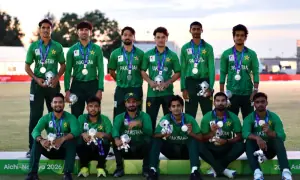
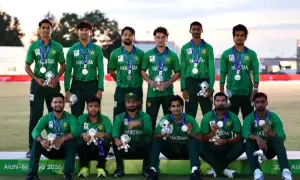
WITH the nation still recovering from the devastation caused by a massive earthquake in Azad Kashmir and parts of the NWFP, our cricketers have given us something to cheer about by convincingly winning the just concluded Test series against England. Skipper Inzamamul Haq, obviously the man of the series, was in brilliant form with the bat, scoring 53, 72, 109, 100 not out and 97 in the five innings that he played. In the process, he became only the 14th player in history to make 8,000 Test runs. The ‘Sultan of Multan’ lived up to his title against a side which had regained the mythical Ashes from Australia earlier this year. His languid majesty against pace and spin alike will long be remembered by those who have had the good fortune of seeing him in action and also by those who have been at the receiving end.
Pakistan’s thrilling victory in the first Test at Multan was reminiscent of our famous triumph at The Oval way back in 1954. In Faisalabad, England held on for a draw after an early scare. In Lahore, the visitors conceded a huge first innings lead. Muhammad Yousaf with a brilliant double century and wicketkeeper batsman Kamran Akmal (154) were associated in a record stand for the sixth wicket. England began their second innings trailing by 348 runs. After the loss of two early wickets, they were well served by an intrepid third-wicket stand of over 170 runs between Ian Bell and Paul Collingwood which lasted until after lunch on the final day and a draw looked the likeliest result. After the break, however, in a dramatic turnaround, Dinesh Kaneria and Shoaib Akhtar, in a deadly combination of wily leg spin and raw pace, broke the back of the English resistance and Pakistan emerged worthy winners on a wicket which gave them no assistance whatever. The stage is set now for the five-match series of one-day internationals between two evenly matched sides and spectators are assured of entertaining cricket in the days leading up to Christmas.
Oil price cartel
THE price of petrol was increased to its current (highest-ever) level on Sept. 30. At that time, the reason given by the Oil Companies Advisory Committee (OCAC) as well as the government was that world oil prices were at their highest levels ever — over $70 a barrel. The petroleum secretary had defended the hike by saying that had this not been done, the government would have had to pay Rs 1.2 billion to the oil companies because of the differential caused by rising world oil prices. He had also said that the government had paid Rs 10.5 billion since July 1, 2005, to the oil companies under this head. The fact is that the OCAC has representation only from the four oil marketing companies and various refineries but none from the government or those representing the interests of consumers. That probably explains why increases in world oil prices are usually passed on to the public whereas the benefit of a fall is rarely transferred to consumers.
This is unthinkable in most other countries where due care is taken to protect consumer interests. Such cartels are deemed illegal in many developing countries for the simple reason that the public interest is seriously compromised if the companies are allowed to set the prices of the products that they sell. The profit motive drives the corporate sector, and profits come at the expense of the consumers, especially monopoly or cartel power as is found in Pakistan’s oil marketing sector. So, to allow the OCAC to set oil prices was a bad decision, one which has, by the government’s own admission, cost it several billion rupees, and also hurt millions of ordinary Pakistanis. In any case, in the presence of the industry regulator, OGRA, there is no justification to allow the OCAC to continue to set oil prices.
Need for reinterpreting Islam
THE international geopolitical scene has changed radically since the cataclysm of 9/11. In the heyday of the Cold War, when the Soviet Union was the adversary for the West, the Islamic concept of Ijtihad had an entirely different connotation and perception in the minds of the Americans and the Europeans than is the case today.
The tragedy of 7/7, perpetrated right in the heart of London, has further radicalized the western perception of Islam and the Muslims.
What reigns supreme today on the minds of the West is a highly distorted and convoluted image of Islam. A religion of peace and tranquillity that Islam inherently is in its pristine sense is, regrettably, associated with violence, bloodletting and terrorism, Islam, today, is stuck in the western mind as a religion which has ‘zero tolerance’ for other religions and their followers.
We all know that this is not what Islam stands for. However, it is also a fact that the ill-informed, fanatical and, in a sense, opportunistic religious orthodoxy — the so-called clerics and mullahs — have only fuelled this erroneous perception of Islam in the western minds because of their ill-advised exhortations and sermons that do no service to Islam. The erstwhile Taliban regime in Afghanistan, for instance, did enormous damage to the name of Islam in the western world and made the Muslims a laughing stock throughout the world.
Enlightened and well-informed Muslims — in a clear majority in the Muslim ummah — are, indeed, conscious of the fact that these radical and extremist clerics don’t represent them and don’t speak for them. The majority of the Muslims in the world consist of moderate, law-abiding and pacifist people who neither believe in preaching a gospel of hatred against any other religion, nor do they subscribe to a distorted philosophy of jihad.
I believe that I speak for every sensible, enlightened and moderate Muslim in the world when I declare that the Islamic spirit of accommodation for others is ignited by the Quranic teaching of Lakum deen-o-kum, wallya deen, which translates as your religion is yours and my religion is mine.
Another universally applauded verse of the Holy Quran categorically lays down that there is no compulsion, or force, in Islam; the Quranic injunction says: La Ikraha fid Deen.
I would, therefore, like to appeal to my fellow countrymen, women, students, teachers and others to use all possible and peaceful means at their disposal to rectify and set right the wilfully propagated, and erroneous, perception in the western mind that Islam and violence are synonymous.
The early history of Islam as a message of hope and redemption is replete with glorious examples of Islam enriching the world with its mission of peace. The first temporal period of Islamic rule, the Khilafat-e-Rashida (the Enlightened Caliphate), that spanned three decades after the demise of Prophet Mohammad (PBUH), was the finest example of governance guided by peace and tolerance for all, Muslims or non-Muslims.
Although khilafat as an institution fell on bad days after the murder of the last enlightened caliph, Hazrat Ali, the basic Islamic norm of tolerance and peaceful coexistence with others and among the Muslims themselves continued to hold sway. The learned Imams — spiritual guides and religion’s interpreters — whose teachings are still regarded as beacons of light by Muslims all over the world — never wavered from a course of moderation and tolerance. Scholars and guides, such as Imam Malik, Imam Shafai, Imam Abu Hanifa, Imam Ahmed bin Hanbal and Imam Jafer Sadiq, may have differed in their interpretation and exegesis of Islam but never issued a fatwa against others. Today, mullahs and two-bit scholars among the Muslim ummah feel free to declare their opponents kafirs (non-believers) and don’t shy away from preaching intolerance and violence in the name of Islam.
Let it be known to all that Islam doesn’t teach its followers to remain cut off from, or non-communicative with, the followers of other religions such as Hindus, Buddhists, Christians, Jews and others. The Holy Prophet Mohammad (PBUH) interacted actively with believers of other religions and didn’t mind entering into contractual commitments and agreements with them.
It was ironic that in an age as advanced and enlightened as the 21st century the world was witness to an obscurantist and regressive Muslim regime like the Taliban, who violated the Islamic values of non-violence and tolerance. They were so archaic and backward in their views as to declare radio, television and other modern means of communication as unIslamic; they also made a mockery of Islam by forcibly excluding women from the mainstream of life and denying them the fruit of education. What else were the Taliban if not belonging to the long gone Stone Age?
What our younger generation of Muslims, students in particular, ought to remember is that in this age when non-Muslims are keeping a hawk’s vigil on the words and deeds of us Muslims, there is an unavoidable need for us to be realistic in our vision of Islam and pragmatic in its application to our everyday life.
I believe that we must correlate our action to measure up to the requirements of our age and adopt a realistic and pragmatic code of life that takes into account the following facts:
a. thought process and thinking changes with the passage of time; b. moral and civic values change too with a new lifestyle and dress code; c. technology dictates its own changes, introduces new inventions in sciences, communications medicine, pharmacy etc. d. sexual mores and traits change and usher in values that may have been taboo before; e. old myths die, or are radically transformed beyond recognition, and are replaced by values that may eventually become myths themselves.
There is an ineluctable compulsion on us, especially in this age when Muslims are being subjected to microscopic inspection by the non-Muslim world, to establish our values transparently and leave no confusion about them.
For instance, we have to let the world know clearly and categorically that Islam is not at war with the world, or with modern technology and inventions; and that we are an enlightened and progressive people who can coexist happily and comfortably with other peoples, irrespective of their beliefs or religious dogmas.
We must get rid of our weakness to get fixated on ideas and concepts proven wrong with the passage of time. Islam’s universalist ideology is what we must preach to ourselves and the world. We have done great injustice to ourselves and to the Poet of the East, Allama Iqbal, by narrowly projecting him as only an architect of Pakistan, instead of highlighting his message of universalism that he so rightly articulated in his famous poem, Sarey Jehan Se Accha Hindustan Hamara.
A qualitative change in our thought process should induce a new era of Ijtihad among the Muslims of the world. We don’t dispute the importance of the excellent commentaries and exegeses written by eminent Muslim scholars and interpreters. But what they dilated on were problems of their age, not necessarily ours too. There is, therefore, binding on us to interpret our religion in the light of the challenges posed to us by the 21st century and not remain mired in, for instance, the 17th century when the famous Fatawa-i-Alamgiri were compiled.
It is the crying need of the times that Muslims must take control of their lives by reinterpreting their religious values and mores in the light of their own age. Islam is a dynamic force that can’t, and shouldn’t, be held hostage to any one time frame or period. We must come to terms with our times and prove to the world that we are a progressive people who can move with the times and advance rapidly to take our due place among the most enlightened. This alone would ensure a place of honour for Muslims in the universal community of mankind.
The writer is the founder and leader of the MQM.
| © DAWN Group of Newspapers, 2005 |