Rural localities of Karachi
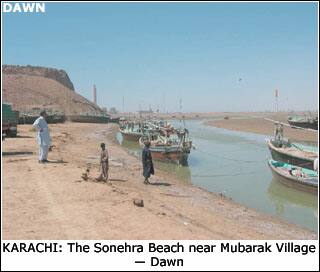 RECENTLY we had an opportunity to visit the seaside. On a Sunday, we drove up to Mubarak Village, the farthest end of Karachi in the southwest on the Arabian Sea coast. We did not stop at any of the known beaches and instead decided to have a long drive to see what the life is beyond the beaches where people usually come from far flung areas to spend a weekend and enjoy themselves.
As we crossed the octri post and took the road passing through Kakka Village, we noticed a marked change in the structures along the road side. Instead of the old and dilapidated huts, we saw modern luxury complexes where the rich spend long weekends along with their families and friends. These ‘huts’ are stuffed with everything needed for making life enjoyable. Water is transported through tankers and electricity is provided through generators.
After crossing the Soomar Village on the Hawkesbay beach, we decided not to proceed to Paradise Point. We rather took a bumpy road leading towards Mubarak Village. On the way, we did not come across any public transport except heavy dumpers loaded with bajri and other material excavated from the banks of Hub River. The excavation had a telling effect on the road, and also some of the culverts and bridges that we negotiated.
Not far from the beaches, where thousands come for enjoyment, those living in different villages on the coastline for generations still have to walk miles away to fetch water, which may not be sweet. There may be a few who can afford bringing a can of drinking water from the city, but such supplies are limited because of non-availability of public transport in the far flung areas. Mostly the supplies in coastal settlements come by boat. Few others get it from wells they have dug on a self-help basis. These villagers also lack electricity, proper schools, health care facilities, etc. During conversation with some local people, we found them very much conscious of their political and civic rights and they didn’t mince their words while expressing their views.
In Mubarak Village, we saw some windmill panels which some NGOs have set up to help the local people in generating electricity. As we approached the village we spotted a check ‘dam’ constructed at a cost of Rs4.6 million and inaugurated by the city nazim in August 2004. There was hardly any water in the pond. Whatever was left in the pond was not fit for human consumption. Some of the locals washing their linens in that water told us that the water was not sweet. This dam was constructed to check the rain water flowing from Hub River into the sea. Not far away, we could see the chimney of Hubco power station near Hub, in Balochistan. But there was no water or electricity in the area. We were reminded of Allama Iqbal’s verses Samandar say milay piasay ko shabnam, bakheeli hai yeh razzaqi naheen hai.
Mubarak Village and other villages in the area fall within the NA-239, Karachi-I from where MMA’s Hakeem Qari Gul Rahman was declared elected. It must have been a real test of transport management as in this constituency, there are many places where one can only reach by boat which is not only time-consuming but also inconvenient.
As we drove back from Mubarak Village, we spotted some people working on a project with mechanical excavator in the wilderness. We took a detour to find out what they were doing. After negotiating the rugged stretch when we reached the spot, we found that a small check dam was being constructed to trap the rain water and the water flowing from various streams into the sea, and create a pond for increasing the sub-soil water table. Eventually, they will construct a well so that water could be pump out to nearby settlements, if possible, through pipes. We spotted Iftekhar Hussain, who could not make it to the National Assembly from this constituency. He was discussing details of this project and the road he got built to Haji Darya Khan goth, besides a schedule for enabling the remaining local people to get their computerized NIC at their door step.
Not far from that spot was another pond, which was dry but enough water had gone down to increase the table of sub-soil water. Beyond the trap wall, a well had been constructed. According to residents, several thousand gallons of water is pumped daily on self-help basis. The water is transported through pipes to designated points in the nearby villages from where residents fill their cans for daily use. When we tasted the water from the can of an old man, it was sweet. Lucky. But he told us that pumping machine remained closed for most of the time because of paucity of funds for diesel oil.
A young man, who identified himself as Rasheed, said he was operating the machine to look after his family. He said that it required five litres of diesel a day to keep the machine operational. The poor local people contribute to the fund off and on for the purpose. The area is located in UC-8 Gabopat, Keamari Town. Rasheed complained that the concerned UC had not been taking any measures to ensure provision of required funds for the pumping station and pay him for sustenance.
But our encounter with Mohammad Qasim, who is a primary schoolteacher in Haji Darya Khan goth, was very revealing because it helped us understand how politically conscious people of the area are, and how jealously they defend their rights. He told us something that appeared thought-provoking.
He gave us a detailed resume of the lack of basic facilities in this far flung area of the country’s biggest metropolis. But what he told us about the difficulties people of the area had faced in the last general elections was mind-boggling and a matter of concern because the next local bodies’ elections are not very far away. If same things were repeated again, then people would loose faith in the sanctity of the ballot.
Qasim told us that during the last general elections, in a number of cases polling stations had been set up 10-15 kms away from the place of residence of voters who had to travel by boat from one island to another. Women voters of one island were asked to go to another one to cast their votes. Male voters also had to go through such a hassle. In this context, we were informed that female voters of Manora Cantonment, Ward No. 1, were asked to cast their votes at a polling station of the Ward No. 2, whereas female voters of Ward No. 2 were told to do vice versa. Male voters were asked to go to a polling station in Keamari Town UC-4, in Salehabad.
A sizeable number of female voters of UC-4 Salehabad were told that they could cast their vote at the Government Boys’ Primary School, Yunisabad, some 15 kilometres away from their locality. Similarly, male voters of Yunisabad were sent to Salehabad. More than 1,000 female voters of Muwach Goth were also sent to a government school in Naval Colony, Soomar Goth, Gabopat, located 15 kilometres away from their area.
Same difficulties were faced by the people of other localities of the coastal area where transportation was almost absent. We were wondering how the managers of election could expect anyone to travel 10-15 kilometres away to cast the vote, and why. Such measures are taken only to manipulate elections and subvert sanctity of the ballot.
While driving back, we were only hoping that this time, those who are responsible for holding elections would make sure that such foul play would not be repeated. If they didn’t take corrective measures, it would tantamount to subverting democratic process and befooling people. But at what cost?
Feminist writing and activism
THE last week was crowded with literary functions – book launchings, literary sittings and of course mini-mushairas. But an important event that could not quite catch much media attention was a workshop on feminism attended by many important writers like Kishwar Naheed, Intezar Hussain, Khalida Hussain and Fehmida Riaz, who was also the host. It was a two-day workshop filled with stimulating full-length papers and speeches. The main paper on the opening day by Dr Farzana Bari from Islamabad, which dilated upon the topic “What is feminism in our context,” proved thought provoking. The doctor, a PhD in sociology from England, is associated with the gender studies department at the Quaid-i-Azam University. She explained various phases of the feminist movement in a historical context from the early 19th century up to the present times. The feminist movement matured into activism after the Second World War in which mothers suffered most. As women have proved their mettle in various areas, their claim to have equal rights was gaining momentum the world over, Dr Bari explained.
How women have fared in literature was another gripping issue. There was a time till the advent of the 19th century when women hesitated to write verses in their own names, although they were more imaginative and skilful in their writings. That swiftly changed and in our own region, Ada Badayuni, later Ada Jafri, became the first poet writing under her own name to appear on the scene at the time of partition. Now the number of women poets is growing. As for fiction writing, women certainly outnumber men writers.
Shahida Hasan’s article probed the feminist consciousness in women’s poetry in Pakistan, and turned out to be a well-researched paper which also discussed poetry in other Afro-Asian countries.
One wishes the workshop, organized by WADA, had attracted more men writers to give us the perspective from the other side.
GOETHE-Institut held a literary sitting last Friday with Dr Enver Sajjad, prominent fiction writer and actor, in the chair.
Shamim Manzar, German language teacher at the Institut, presented an English translation of a short story by Thomas Mann, one of the great post-modern masters and a pioneer of new fiction. The narrative, titled “Disillusionment”, was discussed by the audience, which included Shamshad Ahmed, Rafaqat Hayat, Ms Shaukat Mirza, Noor Mohammad Shaikh and Ali Haider Malik.
Earlier, Ibn-i-Azeem Fatemi read out his verse ‘Mujhey Achha Nahi Lagta’. He is sad to see street children begging and some of them doing hard labour. The poem based on everyday reality, was to some ‘unpoetic’ and prosaic, but many others liked it. “Will such poetry survive for long?” someone asked. As long as conditions of economic and social injustice prevail, such poetry of realism will always have relevance, came the answer from the chair.
SHAKILA Rafiq, a writer based in Canada, is a keen observer of the lives of migrants from South Asian countries, trying to adjust in a new environment. A prolific writer, she presented her seventh collection of short stories, Teergi Key Darmian, last week.
Shakila started writing at an early age and continued her studies as well, besides working for a living and bringing up her children. The story Andhairon Ke Chiragh is autobiographical, reflecting her courage after the death of her husband and her commitment to life. One of her stories tells us how Muslim families living together have started to revive old traditions and to retreat into orthodoxy as a sign of identity.
Another piece by Shakila Rafiq, depicting the selfless and gentle nature of our most creative artist Sadequain, is highly readable.
An interview with the legendary Ismat Chughtai, spread over four hours, and published separately, is Shakila’s masterpiece, and admired by many.
The most sought-after poet in recent days was Ishrat Afreen, who lives in the US. After a lapse of two decades, she has published her second poetry collection, Dhoop Apney Hissey Ki, which was launched last week and was an instant success.
Intezar Hussain, Iftikhar Arif, Kishwar Naheed and many other writers admired Afreen’s distinct style of ‘weaving stories’, as Intezar Hussain put into. Her last appearance in Karachi before returning to the US was at the Karachi Press Club.
Sada-i-Dehqani, a poetry collection by Nazir Ahmad Dehqani (1908-1984), was launched on Monday by the Bahadur Yaar Jung Academy, Bahadurabad.
Nazir Ahmad migrated to Pakistan from Hyderabad, Deccan, and wrote humorous and satirical verses in ‘Dakini’ colloquial, widely admired in mushairas in the 70s and 80s. It was due to the efforts of Dehqani’s talented sons — Imtiaz Ahmad Rabbani and Niaz Ahmad Yazdani — that his verses were collected from different sources, compiled in a volume and neatly published.
Among those who spoke on the occasion included Prof Saher Ansari, Prof Afaq Siddiqui, Sarwer Javed and S.M. Moin Qureshi, who also presided over the function.
Mr Qureshi was eloquent in narrating the poetic qualities of Sada-i-Dehqani. Prof Saher Ansari gave a historical background of ‘Dakini Urdu’ - South India being the birthplace of Urdu poetry - and analyzed Dehqani’s verses, which reflected the state of Pakistani society. Although endowed with a rich sense of humour, Dehqani never allowed cheap humour to creep into his verses, a fact acknowledged by the speakers present at the launch.
SHUNNING publicity and leading a quiet life, unassuming Hajira Masroor has been awarded the life-time achievement award for outstanding contribution to Urdu prose by the Qatar-based Anjuman Farogh-i-Adab.
Perhaps it is not common knowledge that Hajira Masroor, who started writing short stories in the mid-40s and shot to fame soon after, has authored seven short story collections — Chaand Key Doosri Taraf, Teesri Manzil, Andheray Ujalay, Chori Chuppey, Hai Allah and Charkey. Combined together, the stories were published in one volume, Sab Afsaney Meray, in 1991 with a valuable critique by the late Mumtaz Shirin.
Hajira Masroor’s sister, the late Khadija Mastoor, was an equally well known fiction writer. The family originally belonged to Lucknow (UP) and moved over to Pakistan soon after partition.
No accountability for US soldiers in Iraq
WASHINGTON: Iraqi civilians who have suffered from US military operations face steep obstacles in obtaining compensation for the deaths of their loved ones or material damage, human rights analysts say.
The case of Italian agent Nicola Calipari, gunned down at a US checkpoint in Baghdad on March 4 as he was escorting an Italian hostage to freedom, shows how reluctant the United States is to admit culpability, even in high-profile cases.
The United States exonerated American forces in the incident, but Rome on Monday blamed nervous US troops.
“There is no reason to think that when a nameless Iraqi without international connections is the victim, the US military would take it even remotely seriously,” said Phyllis Bennis of the Institute for Policy Studies, a Washington think tank that opposes the US military involvement in Iraq.
Statistics on civilian deaths in cross-fire or at checkpoints in Iraq are scarce. Any released figures usually refer only to Baghdad and cover limited periods.
Marla Ruzicka, a humanitarian-aid worker, campaigned to persuade the US military to keep and release civilian casualty figures and helped persuade Congress to authorize $20 million for families of Iraqi civilians killed by US forces.
Ruzicka herself died on April 16 when her car was caught in an insurgent attack.
Just before her death, Ruzicka wrote in a report that she had received information from the US military that 29 civilians were killed by small-arms fire in Baghdad alone during firefights between US troops and insurgents between Feb. 28 and April 5.
The United States allows Iraqis to seek compensation for material damage, death or injury, but claims must be due to a “non-combat situation” and prove wrongful action or negligence.
An investigation by the Dayton Daily News in October analyzed 4,611 civil claims in Iraq against the US military and found that three out of four were denied.
The average payment for a civilian death was $4,421. In some cases, Iraqis received $2,500 sympathy payments without going through the claims procedure.
RULES “KAFKAESQUE”: The claims process is “Kafkaesque” in complexity and designed to frustrate most Iraqis, said a joint report in early 2004 by Occupation Watch and the Defence of Human Rights in Iraq, two groups monitoring US military operations.
“The US military’s definition of a ‘combat situation’ is elastic and ephemeral, and because the rules of engagement are secret, it is difficult to understand what legal space exists for people to have their cases heard and receive compensation,” the report said.
“Because of the way the compensation system is structured and managed, the American troops have adopted an atmosphere of impunity. Arrogant and violent behaviour goes unpunished and continues,” they said.
Steven Boylan, a spokesman for the US-led coalition in Iraq, said in an e-mail to Reuters that after an incident that caused casualties, a commander would normally start an inquiry and name an investigating officer. No Iraqis are included in such investigations.
US personnel believed to have committed crimes are put on trial, Boylan said. Last month, the military held a hearing into whether to court martial 2nd Lt. Ilario Pantano for the premeditated murder of two Iraqis in April 2004. A ruling is pending.
In October 2003, Human Rights Watch published a lengthy report on civilian casualties in Iraq, saying it had collected credible reports of 94 deaths in Baghdad between May and September of that year that warranted investigation.
The organization recommended ways to lower civilian casualties and provide compensation but said it saw no evidence its findings were taken seriously by US officials.
“Certainly no one in the US government told us our ideas had any merit,” said Joe Stork, of the Human Rights Watch Middle East division.
The United States does not keep count of Iraqi civilian casualties. The British medical journal, The Lancet, last October put the toll since the US invasion of March 2003 at around 100,000, most caused by US air attacks at the war’s beginning.
The London-based group Iraq Body Count, which tallies only deaths directly reported by the media or tallied by official bodies, puts the total at between 21,000 and 24,000. For recent months, deaths have been in the 400-600 range, most caused by insurgent attacks.
Stork said US investigations of Iraqi casualties were insufficiently rigorous.
“When there are civilian casualties, the immediate commander interviews the soldiers on the ground and makes a decision on whether it should be referred on for further investigation. In very few cases does it move beyond this immediate inquiry,” he said.
Sometimes, the US military is forced to investigate, such as when journalists for international news organizations are killed. Even then, critics say the investigations have not been timely, serious or thorough. —Reuters