0
0

Left: needed a new poet
There was a time up to the early 1960s, or just a little after that, when the Indian left, led by a resurgent united communist party - the Communist Party of India - would dream of a socialist revolution in Pakistan, which would then, as a few had hoped, trigger a ripple effect across India and elsewhere in South Asia.
Although this was not written in any of the Communist Party resolutions, the belief was an article of faith nevertheless, the kind of stuff revolutionary lore is made of.
There was camaraderie and poetry - mostly Urdu poetry, but also Bengali and Punjabi poetry - to work as a kind of ideological and cultural glue that bonded leftist intellectuals of a common hue across the subcontinent.
Communist poet Majrooh Sultanpuri's moving ghazal that rang through the streets of India about that time was penned to express solidarity with Pakistan's leftists who were then locked in a grim battle against the draconian military regime of Ayub Khan.
Jala ke mishal-i-jaan, hum junoon sifaat chale
Jo ghar ko aag lagaaye hamaaray saath chale.
Sutoon-i-daar par rakhte chalo saron ke chiraagh
Jahaan talak ye sitam ki siyaah raat chale.
Borrowed from Kabir, the peerless mystical-revolutionary poet of the 15th century India, the fiery verses and many others like them ignited the hearts and minds of millions. Exhorting the youth to selfless social commitment, the idea of family, home and hearth - today's me, mine and ours culture was frowned upon.
On the political front the Indian left was not terribly enamoured of Jawaharlal Nehru and critiqued him and Gandhi alike. Nothing less than truly revolutionary fervour was accepted.
"Commonwealth ka daas hai Nehru, maar lo saathi jaane na paaye!" Nehru is a slave of the Commonwealth. Let's give him the boot, echoed the slogan from the left at a meeting at Aligarh Muslim University which was to be attended by the Indian premier.
Compare this with today's tragic come down in which India is seen quibbling over Pakistan's mere membership of the Commonwealth and in which Pakistan looks forlorn and friendless when reprimanded by the same group or even shown the door.
The "bourgeois" leaders of India and Pakistan, including those from the Bengali flank of Pakistan, were identified, rejected and targeted without fear or favour. Faiz Ahmed Faiz, never seen as merely a Pakistani poet, was a celebrity in Delhi, Lucknow, Bombay and Dhaka alike.
Then something happened with the Indian communists which was not entirely the doing of the parting of ways of China and the Soviet Union, which had in any case split the international communist movement into two.
The Communist Party of India (Marxist) and several variants of Maoist groups came out of the mother party to set up their own shops. At some point the CPI-M went ahead and apologized for its support in 1942 of the movement for Pakistan.
The CPI, which was the mother party at the time but is now a junior partner in the CPI-M led Left Front, remained quiet on the issue. It has still not publicly recanted on supporting the idea of Pakistan.
It was obvious that rightwing nationalist fervour of the kind which the likes of Bharatiya Janata Party revel in was taking root in a big way and the left was not immune from its influence.
In fact the left and the right had already begun to find common ground, first against Nehru and later Indira Gandhi's Congress. In 1967, they - the communists and the Jan Sangh, the forerunner of the BJP - came together in a proper, conscious, thought-through alliance in India's first experiment with coalition government.
The Samyukta Vidhayak Dal coalition government that started with Uttar Pradesh in 1967 mutated again 10 years later when the Jana Sangh got its first chance to grab federal power, albeit through the back door, with the support of the CPI-M. This was the 1977 Janata Party experiment. Then in 1989, the CPI-M and the BJP came together to shore up the anti-Congress V.P. Singh government for as long as it could last.
The point is that the revolutionary fervour of yore was giving way to what you would otherwise dismiss as bourgeois politicking, a kind of hobnobbing in the power arithmetic.
And yet in a strange kind of way, the communists have abjured power. To borrow a phrase from Shakespeare, they were offered the kingly crown thrice, which they thrice refused.
At some point, as they got more and more involved in their state-level politics in West Bengal and Kerala, and also in their newfound zeal as national-level king-makers, the communist parties appeared to lose track of their brethren in the neighbourhood.
When the general secretaries of the two main communist parties began to embark on their first visit to Pakistan last week, which ought to be a landmark tour, there where whispered queries about the protocol in Pakistan.
Should they meet President Pervez Musharraf, who they see as a military dictator? Which of the numerous communist and socialist parties, groups and individuals should they liaise with?
For answer, they got an embarrassing message. There are communists in Pakistan, the Indian communists were told, who support Musharraf as a bulwark against rightwing religious groups.
On the other hand, as irony has it, the rightwing groups are viciously anti-American and Musharraf, who is supposed to be fighting the mullahs, happens to have become a key ally of the Americans. Of course there are communists in Pakistan who oppose both the mullahs and Musharraf. Take your pick.
So what were the Indian communists to do? Nothing much really: they would do what they have been doing at home. After all they had all lined up to meet Prime Minister Shaukat Aziz in New Delhi.
They can't really quibble about a meeting Pakistan's head of state. What they need really is a new poet to pen the new reality. So what if there is no certainty that the poem would be accepted by their followers, much less sway them.
* * * * *
In a unique show of religious solidarity, the Hindus of Muthavan Thidal village in Sivaganga district in Tamil Nadu last Sunday observed their annual Muharram ritual, feeding the poor and praying at the local mosque. They even replicated a typical Hindu temple custom by walking on a fire pit specially prepared outside the mosque, newspapers reported.
In fact, no Muslims have been living in Muthavan Thidal for quite some time now after all the Muslim families migrated to other places in search of livelihoods. But their mosque remained intact, attracting a large number of Hindu devotees from the village and its neighbourhood to pray.
Music and gang war
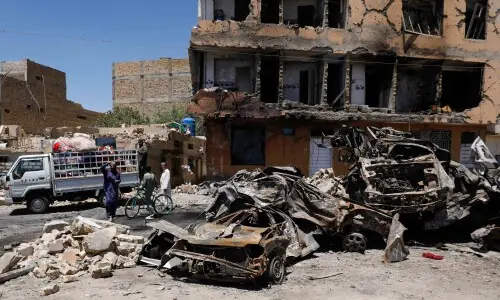
On the road, Kalashnikovs are roaring and bullets are flying as two groups of criminals are engaged in a pitched battle. In the street, people are running to the safety of their homes.
Amid this chaos, the soothing notes of Raga Malkaus filter out through the windows of a room. Behind its closed doors, a music session is in progress: a not-so-young vocalist is singing Ustad Amant Ali Khan's "Pyar Nahin Hey Sur Se Jisko" on a taanpura, a half blind man's tiny hands are playing tabla and a couple of listeners are immersed in the music.
This is how music lovers of Lyari face gang wars which have replaced music, boxing and football to become the identity of the area. Kalri and Rangiwara, housing the baithaks of a majority of Lyari's musicians, are among those areas which have been infested by felons.
Criminal activities, which have otherwise badly affected the livelihood of musicians as fewer people dare hold music concerts at the weddings of their children, have failed to reduce attendance at the baithaks.
These single-room humble places, locally called music clubs, are used by their members to practise and rehearse, besides serving as academies for learners and providing an opportunity to music lovers to enjoy live music indoors.
Though the baithaks are thronged by people all the day, they attract a larger audience at night. They used to remain open till late in the night and occasionally till early morning, but not any more.
The fear of robbers or the breaking out of a new episode of gang warfare compels the musicians to close the clubs by 11pm. While on their way home, they remain alert so that they do not fall prey to a stray bullet.
It needs a daredevil to keep music alive in such a violent environment. The musicians do not have any other option. Since they do not possess any other skill, music is their sole way of earning bread and butter for their family. The baithaks will continue as long as the people of the locality retain their passion for life and music.
THE 54TH FLOWER SHOW
The 54th flower show of the Horticulture Society of Pakistan opened on Feb 24 at Karachi's Sea View Park, second year in a row at the same place. This year's opening ceremony, which stood in contrast to last year's when security had gone awry and guests were mistreated, came as a pleasant surprise when the chief guest, State Bank Governor Dr Ishrat Hussain, arrived on time with hardly any security.
Dr Hussain in his brief address must have motivated quite a few gardeners when he cited the example of Kenya and explained how the African country earned valuable foreign exchange through its cut flower exports.
Some 67 prizes were given out in such unimaginable categories as rockeries, roadside lawns, kitchen gardens, gardens of various sizes, parks, educational institution lawns, hospital lawns, mosque lawns, nurseries, etc.
Coming all the way from Hyderabad Deccan was horticulturist Nawab Shah Alam Khan who had been specially invited as a judge. Competition was tough. A strange thing about the prizes was that in some of the categories the judges only awarded a second or third prize. Well, what do you do when you don't find anything worthy of a first prize?
The Sea View park where the show was held was itself a prize winner and as most of the winning gardens and rockeries happened to be in DHA, the administration's green drive was appreciated by the judges who awarded them the Abdul Sattar Pirzada Trophy.
The flower show, a brainchild of Dr A.K. Khan, founder of the Horticulture Society, has come a long way from when it was first held in Gandhi Gardens just one year after independence.
From then onwards it has been an annual affair. The society has established many branches in such diverse fields as the Ladies Horticulture Club, the Floral Art Society, Amateur Gardener's Club, Ikebana International Karachi chapter, Ikenobo Study Group, the Orchid Society of Pakistan, Cactus and Succulent Society of Pakistan and the Pakistan Bonsai Society.
Thanks to timely rains which brought on pleasant weather, the plants and flowers this year looked healthier and prettier than last year. Like always the snacks of kachori, etc, pulled people away from the famous fast food joints near the park.
Also among this year's special features was a bonsai demonstration. Susumu Nakamura, a bonsai master from Japan, gave the demonstration in the main tent in front of a small audience as a large number of people who were having such a lovely time amongst flowers could not be persuaded to return to the tent for the workshop, even after several reminders.
A tall and lush Ficus plant was selected to be reduced to a midget. After a while someone in the audience commented in Urdu, loud enough for everyone else to hear, "What a villain this man is to have ruined such a beautiful plant!" Not knowing the language, Mr Nakamura of course kept going on with his work. But later when he reached for his second plant, most of the people winced and left.
THE CROWS
Protesters of all persuasions stage demonstrations in front of the Karachi Press Club almost every day. Quite often when an opposition party tries to protest, all roads leading to the club are cordoned off by police. But the other day a colleague noticed that, in an unusual move, the police had not only blocked the road on the which the club is located, but had also cordoned off Sarwar Shaheed Road, which is a major artery since it links the commercial heart of the city to Sharea Faisal.
Curious, the colleague asked a policeman why such tight security arrangements had been taken. The policeman said that supporters of the dismissed Sindh minister, Imtiaz Shaikh, wanted to stage a protest demonstration in front of the Karachi Press Club.
"But we would not have cordoned off all the roads leading to the club had we not been tipped off about a certain object that the protesters were said to be bringing," he said.
When asked what the protesters were bringing, the policemen said, somewhat sheepishly, that they wanted to set free a couple of crows. "But why should this be such a bother?" wondered the colleague.
"Well, apparently a certain high-ranking politician has been likened to crows in the past, and we have received instructions from the Chief Minister's House to stop the supporters from letting off crows at the demonstration," he said.
HIGHWAYMEN
The other day a friend narrated an incident which occurred while he was driving back to Karachi from Hyderabad with his family. Traffic was fairly thin, since it was the 10th of Muharram, and he was driving along peacefully at 100km per hour.
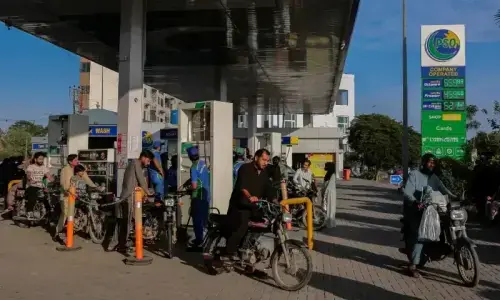
After about 15 minutes of leaving the toll plaza at Hyderabad, he saw some highway police cars standing next to a petrol station. A couple of policemen were in the process of pulling cars on the side, while another was glued to an instrument which reminded one of something which surveyors use. In fact it turned out to be a radar, or so they claimed.
Anyway, he was pulled over and told that even though he was under the speed limit, this particular patch of the highway had been designated as a 70km-per-hour zone. When the friend said that there was no sign or warning to this effect, the policeman told him that the actual fine was Rs760 but since it was his first time (how did they know one does not know) he would only be charged Rs200. The friend, a law-abiding citizen, complied.
He still wonders if this was the genuine thing or another creative way to fleece the uninformed and law-fearing public. Next you drive get ready to play the new highway game of guess the speed limit, without your friendly highway police.
email: arachi_notebook@hotmail.com.