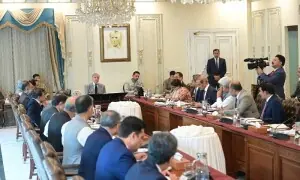
Gwadar port — holding promise for future
LAST week President Pervez Musharraf performed the ground-breaking ceremony of the Gwadar Deep Water Port at a small but impressive ceremony which was attended, among others, by the Chinese Vice Premier, Wu Bangguo, the Chinese communication minister and the Chinese ambassador to Pakistan. The function was held at the Gwadar Fish Harbour. A number of federal and provincial ministers, high civil and military officials also attended the ceremony. Security was tight and all the routes leading to Gwadar Fish Harbour, normally busy, wore a deserted look on Friday.
The port is being built with Chinese financial and technical assistance. The China Harbour Organisation and its experts are building the port and its allied facilities. The design and layout of the port were prepared in ten months and the Federal Communication Minister, Javed Kazi, thought it was a record time. Secretary Communications, Iftikhar Rashid, paid a long visit to China where he finalized the details of the designs after discussion with Chinese experts and officials.
President Musharraf told the gathering that the Chinese prime minister took personal interest in accelerating the process offering generous technical and financial assistance for Gwadar Deep Seaport and the Saindak Copper and Gold Project in Chagai.
The Chinese will be providing a soft loan of 198 million US dollars for the Gwadar port while remaining 50 million dollars will be provided by Pakistan. The federal government had already released Rs one billion for the current fiscal year meeting the local currency requirements. The cash flow in Pakistani currency is estimated to be around Rs 10 billion through budgetary allocation by the federal government. The bankers kept an eye on the cash flow for the project. The provincial chief of the Allied Bank of Pakistan, Mr Lakiari, made his presence felt by all the dignitaries and top officials having a say in handling finances.
The port will be built in two phases. In the first phase, three berths with allied facilities will be constructed handling vessels of 50,000 DWT. The Chinese experts will dredge the channel preparing the passage for the large vessels to anchor at the new port. The first phase will be completed in 36 months, but the Director-General of Ports and Shipping, K. B. Rind, told Dawn that it could be much earlier as both the Chinese and Pakistani experts are working with complete dedication making it another landmark in Sino-Pakistan relations. In the second phase, ten additional berths will be constructed with two huge oil terminals and a container terminal. The port with its enhanced capacity will handle larger vessels with 100,000 DWT and oil tankers of 200,000 DWT.
The National Highway Authority is building the Mekran Coastal Highway from two directions with full speed. The Coastal Highway is expected to be complete in 36 months. The President performed the ground breaking ceremony of Coastal Highway from Gwadar end on Aug 14 last with a promise that he will be performing the ground breaking of Gwadar Port on the eve of Pakistan Day. He fulfilled his pledge on Friday last.
Similarly, the Wapda is working on the Mirani Dam Project. Its estimated cost is Rs 7.5 billion. It is expected to irrigate 32,000 acres highly fertile land of Dasht Plains in the downstream while more than 20,000 acres in the upstream through recharge of hundreds of dead and old Kans (deep wells linked up from the bottom ensuring a greater flow of water for domestic use and farming). The Wapda water wing activities were found to be very slow and below the development pace of other projects. However, the Quetta Electric Supply Company (QESCO), another subsidiary of the Wapda, has geared up the work for building the power transmission line. It is expected to be completed by the end of this fiscal year. Almost all the governments, including the present one, felt the embarrassment when the local residents agitated when they received the Chief Executives making the lone demand of 24-hour power supply to Gwadar.
The Federal Minister for Education, Ms Zubaida Jalal, paid an official visit to neighbouring Sultanate of Muscat and Oman and signed many agreements for economic and financial assistance for Pakistan, including power generators for Gwadar. Four of the generators were handed over to QESCO recently and two of them installed improving the power supply during the visit to Gwadar by the President of Pakistan. Interestingly, there was no interruption or suspension of power supply during our stay in Gwadar.
The federal government, in collaboration with provincial government, is preparing a master plan for development of Gwadar as the second port city of Pakistan. All the future needs of the city are kept in mind. The Gwadar Nazim, Babu Gulab, expressed his confidence that the government would be giving preference to the local residents in development projects ensuring adequate job opportunities for them. The President of Pakistan promptly responded making a public commitment that local people would be given preference in all matter. However, he advised the younger people to get proper education and acquire necessary skills to fill those jobs otherwise outsiders will get those jobs.
When the function ended with formal ground-breaking ceremony, two men on the top in Balochistan, the provincial governor, Justice Amirul Mulk Mengal and Corps Commander, Abdul Qadir, were found in jubilant mood receiving warm congratulations from all corners for the inaugural of construction work with Chinese assistance. Malik Naeem Ahmed Khan, Balochistan Minister for Planning and Development, said that there are two landmarks in history of Sino-Pakistan relation on a single day. Besides Gwadar Port, Saindak resumed production of copper and gold today.
Sliding into self-imposed siege
Over the last three years all those who are opposed to military governments have argued day in and day out for a quick return to democracy. They have rejected military governments in all forms and shapes — benign or not so benign, Martial Law based or non-Martial law based, those that give total freedom to the media or those which do not, those which anchor their legitimacy in Islam and the so-called Pakistan ideology or those who follow the Ataturkian path, and those that succeed in bringing in the so-called free lunches by selling national sovereignty or those who stake their claim to patriotism as does every scoundrel as his last resort. In the supreme national interest they have asked for returning to the path of democracy, the kind of democracy which is understood universally, and not some kind of diluted form of it as many ill-advised and misguided ‘flag-wavers’ would like Pakistan to practice.
On the other hand those who support the present military regime have argued repeatedly over this period why President Gen Pervez Musharraf should continue to rule this country, even if law and Constitution do not permit him to hold the office. These arguments in favour of Gen Musharraf’s continuation are based on its perceived benevolent approach, its professed financial integrity, its supposed good governance, its seeming reformist slant, its so-called deft economic management, its apparently dexterous handling of foreign challenges and its self-proclaimed ability to protect national interests better than the people at large. If these supporters of his could have their way they would even make him life President. Remember the talk about turning Field Marshal Ayub Khan into one just before he suffered from his stroke? People of this ilk are found in every age. And such people appear to be highly unnerved by the approaching elections. They know what happens after an election is held in Pakistan. After the first nationwide election held in 1970 the man who held them had to go home in total ignominy. The man who held the next elections in 1977 ended up on the gallows. The third one, who produced an elected parliament like a rabbit out of his COAS cap in 1985, was brought to his knees by this very parliament. The one who held the 1988 and 1990 elections, too, had to go home in total ignominy. And the man who held the 1997 elections does not know how to hide his shame.
So, those, who sincerely believe that the only solution to all the ills being faced by Pakistan is a military dictator with a lifetime tenure, would like very much to see Musharraf avoid an election. That is perhaps why they have advised him to first secure his position as General Zia did through a referendum. They, perhaps, believe that they would cross the bridge of election when they come to it in October. There are still many tricks in their bag to get Musharraf secured in his present job without having to refer even to the people. These people know that even if Musharraf obtained a genuine mandate to rule the country for five more years in the proposed referendum, there is no guarantee that the elected parliament would not try to put him in a box, lock it, throw the key and forget about him for the next five years. Even the so-called National Security Council (NSC) would fail to help avert this eventuality. Ambitious generals and equally ambitious civil servants encouraged by the natural penchant of elected members to attain as much power as possible would ensure that a turf war is quickly kicked off among the various institutions represented in the NSC and very soon the President would be left holding his veto without anything to veto against. Zia perhaps knew this, and that is why, perhaps, he did not insist on the NSC. In fact, he used it as a trading chip to get the Parliament to give him in the trade off all pervasive powers under 58(2)b.
But with an elected parliament in place, no matter how compliant, even 58(2)b has been seen to have served only limited purpose and that, too, a negative one. In fact, all could see from day one how the group of civil servants working in the Presidential secretariat and the one that was working in the Prime Minister secretariat were goading their successive masters to enhance their respective turfs so as to be able to assert their ‘constitutional’ powers more emphatically. Both these groups of the civil servants, which kept changing with the change of masters, were clearly goaded into taking such a path by their desire to win the goodwill of their respective masters and get them to help them in their promotions and extensions and at times to look the other way when they dipped their hands in the cookie jar.
The Zia experience has also shown that even if all those, who pose a formidable political challenge to the incumbent, are kept out you do not get a compliant Parliament. Zia had tricked the then largest political party, the PPP, and all other recalcitrant political elements into boycotting the elections, but the Parliament he finally got elected turned out to be an even greater threat to his power and he had to, in his desperation to save his power, dissolve it within a matter of three years. Since he knew that an identical trick would not work this time, Musharraf has adapted it with a few flimsy innovations to suit his times. From day one he has been making it clear that he would not allow Benazir Bhutto and Nawaz Sharif to contest the forthcoming elections. He is not likely either to allow those who would get PML(N) tickets to contest the elections even. And he, perhaps, believes that if he could, somehow, disqualify Benazir Bhutto from contesting the elections, the Party would boycott the polls in a huff and he would then have the entire field to himself to do what he liked. Remember why the MRD boycotted the 1985 elections? Well, they said they would not like to participate in partyless elections and that was that.
Musharraf, perhaps, believes that if he can keep the two main parties, the PML(N) and the PPP, out of the elections he could get PML(QA), ANP, MQM and Sindh Alliance to share the bulk of seats in the Parliament with Millat Party, Tehrik-i-Insaaf, Pakistan Awami Tehrik and Qaumi Jamhoori Party getting few crumbs. Those with crumbs are expected to be pushed into an alliance inside the Parliament to function as the loyal opposition as Junejo’s Parliament had in the shape of a group of independents led by Haji Saifullah. However, this proposition, too, is likely to appear rather risky for Musharraf as election date draws nearer and that is when, perhaps, the regime would commit blunder which the previous two military rulers committed after the elections. It will, in all probability postpone the elections under one pretext or the other and then become a government under siege.—Onlooker
Not a clown in a circus
I HAVE before me the annual report of the Human Rights Commission of Pakistan (HRCP). It is titled, State of Human Rights in 2001. It deals with several subjects such as rule of law, enforcement of law, fundamental freedoms, democratic development, rights of the disadvantaged (women, children and labour) and social and economic rights.
Spread over 350 pages and more, it is not possible for me to review it at one go. For that, I would be required to read the report at one go for which alas I do not have the time. I received the book on Tuesday (March 26). I decided to pick on a chapter in which I am most interested these days — the Rights of the Disadvantage — and among the disadvantaged, women must be regarded on the bottom rung of the social ladder. The report quotes from the Constitution’s articles 25, 27, 35 and 37. The basic law of the land (such of it as is still in force in the country and is universally respected) lays down that:
There shall be no discrimination on the basis of sex alone.
No citizen otherwise qualified for appointment in the service of Pakistan shall be discriminated against ... on the ground only of ... sex.
And the Universal Declaration of Human Rights lays down that “Men and women of full age ... are entitled to equal rights as to marriage, during marriage and during its dissolution.
Again, “Marriage should be entered into with the free and full consent of the intending spouses”.
Now all these are truism and most of us are agreed that women indeed must not be discriminated against under any circumstances. Why, then, does the HRCP find it expedient to quote from well-meaning documents every year? Because women are among the most exploited among us. Evidently, all men do not believe that women must not be discriminated against under any circumstances. That is why the HRCP has to remind us again and again that women must have equal rights — all rights enjoyed by men. Somerset Maugham once said of a woman (he could say the same of men with greater force): “She plunged into the obvious like a clown in a circus jumping through a hoop.... She hit on the commonplace like a hammer driving a nail into the wall. She had a truism for every occasion.” (Winter Cruise from his collection of short stories, The Colonel’s Lady).
All I want to say is that the HRCP is not “a clown in a circus jumping through a hoop”. The commission does not specialize in truisms nor is it “like a hammer driving a nail into the wall”.
When the commission reports that women are being discriminated against, it is making a political statement of vital importance. It is the powers that be that like to push intractable social problems under the carpet because they have not remedies to offer. The 2001 report says (pp 205-06) that “Promises to end honour killings and discrimination also came in, but implementation .... remained virtually non-existent”.
It reported that the number of honour killings, including Karo-Kari murders, had increased during the period under review. According to HRCP figures, there were 379 Karo-Kari cases during the first ten months of 2001. Some deaths, the report said, could have been undocumented. The report noted that “illicit relations” had been cited as a possible motive in 204 of the 722 cases of murder in which women were the victims.
The report commented:
Government officials continued to pledge on end to ‘honour’ killings all through the year. In April, in Karachi, the Inspector-General of the Sindh Police promised a ‘crusade’ against such deaths. However, no significant change in the number of ‘honour’ killings appeared to be visible, with more and more reported from areas where they had once been unknown. These included the urban areas of Sindh and the Punjab. The UNHRC in March (2001) sought a detailed report from the Pakistan government on ‘honour’ killings and steps to curb them. It was unclear if this had been provided. (emphasis added).
These, then, are the facts as the HRCP found them in 2001. As you can see, here there’s no case of a “clown in a circus jumping through a hoop.” Perhaps it’s we who see no evil.
The Maugham collection I have quoted from above, has another short story, The Point of Honour. The following passage occurs in it:
“I should explain that the point of honour is the mainspring of much of the Spanish drama. It is the noblemen’s code that impels a man to kill his wife, in cold blood, not only if she has been unfaithful to him, but even if, however little she was to blame, her conduct... has given rise to scandal. In this particular play .... the physician of his honour takes vengeance on his wife, though aware that she is innocent, simply as a matter of decorum.
... It’s in the Spanish blood. The foreigner must just take it or leave it.
(Another character says): Oh come, a lot of water has flown down the Guadalquivir (river) since Calderon’s day. You are not going to pretend that any man would behave like that now.
“On the contrary I pretend that even now a husband who finds himself in such a humiliating and ridiculous position can only regain his self-respect by the offender’s death.”
(Another character): Barbarous.” It was just cold-blooded murder....”
“You are talking nonsense, my young friend. Don Pedro (the fellow who had killed his wife) did the only thing he could do under the circumstances.”
‘Honour’ killing in the Spanish blood? Well the Arabs went to Spain and the Arabs came to Sindh. But in Spain, only the ‘noblemen’ used to kill their wives for ‘honour’. But in Sindh, generally, it men who are less than noble who commit the dastardly crime. Further, in Spain, ‘honour’ killings are a thing of the past. In Sindh (and parts of the Punjab), they have come down to us in the XXI century. But first of all, let’s first establish whether there’s any relationship between the Arab occupation of Spain and Sindh.
MANY years ago, I had quoted from Fred Truman’s autobiography, Ball of Fire in which the Yorkshire and England fast bowled had said: In England, they call a spade a spade but back home (in Yorkshire) we call a spade a bloody shovel. (Or words to that effect).
Now I find that this ‘bloody shovel’ thing is of earlier birth. Somerset Maugham, for instance, says in his short story, Appearance and Reality:
“.... which may be described as the ribaldry that likes to call spade something more than a bloody shovel”. I stand corrected — or do I?
A poet’s desecrated grave reveals India’s dangerous cultural currents
WHEN the news came in at first that a certain Wali Gujarati’s grave on the outskirts of Ahmedabad had been razed by Hindu mobs, it seemed to be a case of routine vandalism that is of a piece with a communal riot.
Also, since indescribably worse things were happening with fellow human beings, there was little space or time to worry about the destruction of a little-known monument. More so, since some ancient and truly beautiful mosques and mausoleums had been destroyed with the trained precision of civic demolition squads using bulldozers and other heavy equipment.
An eyewitness account by Teesta Setalvad, a tireless campaigner for human rights, had only hinted that a mob had ransacked the grave of “a sufi poet revered as Wali Gujarati” on the approach road to Ahmedabad city.
Inquiries revealed that the grave was indeed that of Wali Dakhani (1667-1707), who was among the first great poets of the Urdu language. The initial response was one of disgust, although on the face of it there was not much cause for lament about yet another grave of an Urdu poet coming to a mournful end.
There are, or were, several more in Delhi, such as Mir Dard’s tomb on a heap of filth near the new Zakir Husain College. A public urinal had cornered Sheikh Muhammad Ibrahim Zauq’s grave until someone, shamed by what he or she had seen, had rescued it.
Mirza Ghalib’s home in Delhi’s famed Gali Qasim Jaan was literally dug up from underneath a coal depot.
Even after its semi-restoration amid much self-congratulation by the authorities, a public telephone booth continues to occupy this spot, its owner refusing to remove the eyesore to another place.
But to come back to Wali Mohammed Wali. The poet, also known as Wali Dakhani, was born in 1667 in Aurangabad.
According to an account by one Nita Awatramani, suggesting a Hindu woman admirer, Wali loved travelling, which he regarded as a means of education.
His visit to Delhi in 1700 had a significant influence on Urdu ghazals. His simple, sensuous and melodious poems in Urdu, awakened the Persian-loving poets of Delhi to the beauty and versatility of Rekhta, (the old name for Urdu) as a medium of poetic expression.
His visit thus stimulated the growth and development of the Urdu ghazal in Delhi.
However, Wali, it is said, was not immune to the vigour and verve of Persian diction and imagery, and combined this into the body of his verse. He thus became the architect of the modern poetic language, which is a skillful blend of Persian and Urdu vocabulary.
Though Wali wrote in different types of verse forms - masnavi, qasida, etc _ he specialized in ghazals. He wrote a total of 473 ghazals, comprising 3,225 couplets (ashaar).
He was also the first poet to start expressing love from a man’s point of view as against the prevailing convention of impersonating a woman.
Wali died in Ahmedabad in 1707, and was buried there.
My first encounter with Wali’s celebrated love poems came via the mellifluous voice of Madanbala Sandhu, a hugely talented singer, a household name in Punjab, and a beautiful actress whose love for the theatre was spotted by Sheila Bhatia and Begum Akhtar.
They gave her the lead role in a musical that revolved around the history of the ghazal. The chosen composition from Wali’s anthology was set to music by Begum Akhtar in Raag Bihaag.
The result was sheer magic. Its words went thus:
Jisey ishq kaa teer kaari lagey
Usey zindagii kyon na bhaari lagey
Na chhordey mohabbat dam-i-marg lag
Jisey yaar jaani so.n yaari lagey
Na hovey usey jag mein hargiz qaraar
Jisey ishq ki beqaraari lagey
Har ik waqt mujh aashiq-e-paak ko
Piyaarey teri baat piaari lagey
Wali ko kahe tu agar ek bachan
Raqibaa.n ke dil me.n kaTaarii lagey
Wali Dakhani loved Gujarat and wrote affectionately about it, particularly about Surat, the coastal town with which he had developed a special bond.
It is this man’s tomb that has become a meaningless casualty of the genocide in Gujarat.
The razing of tombs is common throughout history, and is usually seen as an act of revenge by succeeding icons of power. But there are different underpinnings for this.
In Egypt it was customary for the local people to vandalize the tombs of the Pharaohs for the rich booty that these contained. The Mughal Emperor Shahjahan, on the other hand, built his new capital Shahjehanabad, after pulling down what was left of Ferozabad, created 200 years earlier by Ferozshah Tughlaq, and the city that Sher Shah Suri built.
Incidentally Shahjahan’s great Jama Masjid was looted by the Rohilla Afghan chief Ghulam Qader, who even removed a a gold cupola; fortunately, the others were saved by a Hindu sepoy commander, Manihar Singh, who considered it an outrage.
So various factors may come into play when a monument is destroyed.
What happened with Wali’s grave in Ahmedabad was a calculated act of cultural annihilation, and nothing less. The method and the message of the desecration were both part of the Rashtriya Swayamsevak Sangh’s philosophy of cultural nationalism.
According to the accounts of Setalvad and several others, the grave which lay close to a busy road, was destroyed on the first day of the riots.
On the second day, a saffron flag was planted on it, as was done with the few historic mosques that were destroyed. When the matter was brought to the notice of the authorities by secular Hindu activists, the flag disappeared.
And on the third and final day of the gory ritual the state officials levelled off the remaining bits of the grave and promptly covered it with coal tar, thereby obliterating — perhaps forever — any sign of the memorial to Wali Dakhani from his adopted home in Ahmedabad.
In some ways the episode is symptomatic of the ascendancy of rightwing Hindu fascism in India. It affects different facets of life in this secular republic.
For instance, people from Mumbai, Hindus, for the most part, make a beeline for Goa these days during the key festive seasons. Why? Because the rabid Shiv Sena will not allow them to celebrate anything that is Western and therefore “un-Hindu”.
Celebrated film-maker Deepa Mehta tried and gave up the idea of shooting her film about the Hindu widows of Benares (today known as Varanasi). Why? Because the Bharatiya Janata Party government felt it was too sensitive a subject to be portrayed in celluloid.
Mehta was reminded to good effect that the Vishwa Hindu Parishad and the Bajrang Dal, all experts at breaking heads, cameras or whatever else they disapproved of, would be most unhappy if the shooting of the film was allowed. So the state of India gently moved out of the frame, leaving Mehta and her stars, Shabana Azmi and Nandita Das, to take on the goons of the Sangh Parivar at their own risk.
The plundering of renowned artiste M.F. Husain’s studio in Ahmedabad a few years ago was the handiwork of the same marauding mobs. It is not as though this plunder and bigotry is one-sided. Whenever the mullah disapproves of anything that he deems un-Islamic, he leads gangs of hooligans to set fire to a cinema house or two.
Here I must point out that actresses like Azmi and Das are attacked by the rabid elements from both sides and get no state protection of any kind.
There is a move under way among India’s badly jolted secular citizenry to reverse the fascist onslaught. Plans are under way to celebrate the spirit and essence of Wali Dakhani, who is seen as a symbol of the country’s secular, syncretic culture.
As part of this, efforts are being made to bring his works into public view by organizing mushairas and musical mehfils across the country.
From what I am told, there is also a campaign to get the government to rebuild Wali Dakhani’s grave and restore its sanctity. In a small way, it might help to assuage the sense of outrage over the desecration that Gujarat has been subject to.
The Wali Dakhani initiative by the secular brigade is part of a much wider campaign to confront the rising wave of fascism that is threatening to engulf not just Urdu, but all other languages and cultures of India that stand in its way.
Harry Potter in Urdu
After being translated into umpteen languages, Harry Potter has finally made it to Urdu. Harry Potter Aur Paras Pathar — as in Harry Potter and the Philosopher’s Stone — can be bought at any bookstore in the country. The unveiling of the Urdu translation was formally done this past Friday at the British Council in Karachi. The translator, Darkshanda Asghar Khokhar, the guest of honour, Fatima Surayya Bajiya, and representatives of the publisher, Oxford University Press, and the book’s distributor, Liberty Books, were all at hand. So was Charlie Walker, the Council’s director who read out part of his brief speech in Urdu.
The main feature of the event, though, was supposed to be brief presentations by five children who had been specially invited, along with colleagues and teachers from their schools, to talk about various aspects of the Urdu translation.
Before that, however, OUP’s Ameena Saiyid, spoke how the Urdu translation would make it easier for children from all backgrounds to access the wonderful world of Harry Potter. She also made it a point to mention — as she always does — to say how important it was that the rights to publish the Urdu translation had been duly paid for and how the book publishing industry had been hampered by unscrupulous rogue publishers who published anything they could get their hands on just to make a quick buck.
The part where the kids were supposed to share with the audience what they thought about the book was very disappointing. Almost all five of them said more or less the same thing about the book and it had little relevance to their assigned topic. For example, they all thanked OUP and the translator profusely for making the book possible, and then some moved on to thanking the British Council for making the function possible.
All of them told the audience all the records the book, and its adapted film, had broken and just how successful J K Rowling had become. One student began her speech by saying how much she valued the Urdu translation since the English one had too many difficult words, but then went on to use extremely difficult Urdu to talk to the audience. Only one student, and I think she was from Pinnacle School, was brief and too the point and sounded spontaneous in her style and original in her content.
Some teachers from other schools were sitting behind me. I could hear them say that the teachers were to blame for this because they must have put the students up to all this by first writing these superfluous speeches and then making the kids learn them by heart.
Harry Potter Aur Paras Pathar is available for Rs 250 at bookstores citywide.
April elsewhere in the northern hemisphere means spring. Not so in Karachi. Only an April’s fool will think so, for it is a month here when summer really begins in earnest. Somehow, the dry April heat is very annoying after our spring-like winter comes to an end. It takes a bit of getting used to, but the good news is that the season for catching a bad cold is now behind us. The heat will also kill the mosquitoes. That’s just about the only good thing about a dry Karachi summer spell, a colleague from work says.
So are you bracing yourself for the long KESC blackouts this year? Shortage of water is another perennial summer problem. Living in Karachi, it helps to be prepared for the worst. So stock up on water while you can, or be ready to be fleeced by the tanker mafia.
There was a time when it was safe for one to go to Dhoraji and have a cool gola ganda to beat the summer heat. Not anymore. If you’ve noticed, the number of gola gandawallahs has shrunk over the years, as people become aware of water-borne diseases.
Not too long ago an outlet in DHA Phase V’s stadium commercial area introduced gola ganda that used ice made from mineral water. Those who had it said it tasted more like the slush they serve in the US. For desi bazaar food to be any good, it’ll have to be somewhat unhygienic. Needless to say, the shop offering the gola ganda made from mineral water eventually closed down.
The summer heat of the past week has also taken a toll on the city’s parks. Surprisingly, this past winter, Karachi parks wore a lovely look. There were literally rows and rows of flowerbeds in the parks and even outside people’s houses. These will now all but die down in the April heat. The grass also looks paler and given the general scarcity of water in summer, the situation will worsen.
By the way, even though it’s already very hot, as conventional wisdom goes, you can still have fish in the month of April. Remember grandmothers used to tell us not to have fish in months that do not have an ‘r’ in them.
Tell this to teenagers today and they’ll tell you: “Hogwash! Grandma’s tale!”
The movie club of the Karachi Arts and Theatre Society will be showing four more classics in the first two weekends of April. On April 5, you can see What’s Up Doc? with Ryan O’ Neal and Barbara Streisand and on the next day, Saturday, David Lean’s Doctor Zhivago will be shown. The next weekend has Stanley Kubrick’s 1960 epic Spartacus on offer with Kirk Douglas and Laurence Olivier and the following day The Godfather will be shown. All movies are shown at 8 pm and for details the following numbers can be called: 5878661 & 2.
The popular Zamzama Park has come up with arguably the most ridiculous rule since Lahore’s Sheeba Park in Defence came with its now legendary no-shorts restriction. The park, whose landscaping many say has been done by the architect daughter of a famous and very powerful man, suddenly has a sign that asks visitors, rather orders visitors, to not indulge in any political or religious discussions once inside.
Now, one would like to ask the park’s management — which is probably the DHA or the Clifton Cantonment Board — just how it would even think of enforcing this most illogical of rules. Will a guard walk with each visitor and monitor their conversation or will the place be littered with listening devices? If a political figure is being gossiped about does that also leave one vulnerable to prosecution? Ironically, Zamzama Park is also known as Musharraf Park by the people who use it.
Thankfully, Karachi is not as prone to strikes as it used to be in the past when shutdowns happened at the drop of a hat. However, every now and then, we have a strike by transporters who want to press their demands on the government. Usually it’s for a fare increase but this Saturday it had to do with the tragic deaths a couple of weeks ago of two college students and a motorcyclist who were run over by a speeding bus in Liaquatabad.
The Karachi Transport Ittehad called the strike in protest against the government’s decision to charge both the bus driver and owner with murder.
The association said that the owner should not have been charged at all and that the driver should be booked for negligent driving or something less culpable like involuntary manslaughter.
So the strike was called and, as it turns out, was very successful. You could hardly see a single bus, coach or minibus anywhere. Yes, it must have been very inconvenient for those who rely on public transport to get around or reach their workplaces.
But, as far as motorists are concerned, the strike was a heaven-sent because the roads were free of the toxic smoke that these ugly mechanical monsters spit out. Also, in the absence of these behemoths you suddenly realized just how expansive Karachi’s roads really are. Only if there was a way to make this arrangement permanent and at the same time taking care of the need for commuters to get to work. — By Karachian
After ages, a good word
DURING the last few weeks Karachi has received some flattering testimonials. Latest to come is one from three members of the British parliament (MPs). They have found evidence (also reason?) to say that the “situation in Karachi is improving”. This is not the case of distance lending charm to the view. The MPs have been here to see things for themselves. Obviously, they know at first hand what they are talking about.
For a city of 13 million-plus people that has only oscillated from frying pan to fire, this may be a shift for once from fire to the frying pan. Some relief nonetheless. Also some small reason for a modicum of comfort, some consolation, perhaps some hope, too. Few of us in Karachi would be able to recall the last time we heard a good word spoken for this city or its people.
Those with some hardy optimism may say there is more of compliments in the findings of some international financial institutions, like the World Bank and the IMF. A more demanding and less forgiving censor, the Standards and Poor, too has put in a good word. By and large, Washington’s comment on our performance on various levels has also been positive.
If the face of Karachi’s Stock Exchange is a reliable index to its heart, there is some reason to feel a little elated. Sympathy and appreciation adds up to the kind of uplifting breeze that has been alien to Karachi’s experience since Field Marshal celebrated his election victory over Miss Fatima Jinnah. That was some forty years ago.
All these years this city has only tossed between crisis and catastrophe. There is not a social sickness and financial ailment that has not afflicted Karachi by turns, more often both descending together. If any welcome change in the direction of the wind over this city is perceptible, however mildly or vaguely, it should be greeted.
There is some slight qualitative improvement in life, still very minuscule and feeble though. From where we stand at this moment, it is beginning to appear that an elected local government is, after all, something that can do a deal of good. This is not an ideal state of affairs.
However, compare it with what it was under the rule of Benazir and Nawaz from Islamabad.
There is still too much of crime and violence. But, unlike those dark days, the Interior Minister is not issuing “shoot-at-sight” orders to the police. Now the same force is being told to be good boys. Register public complaints, the FIRs, that is. There is the “Madadgar 15” for instant help. None of this is flawless. Even so, this little bit makes a world of difference, hopefully for the better.
Beneath whatever little relief one feels today, lies the fact that we are less scared of the fanaticism of the pious and less fearful of the violence of the self-appointed, gun-totting redeemer. This twin menace has not been reined in effectively enough. But its mindless intensity may have been tamed a touch or two. One can feel that there is just a little less of tensions. Every inch of ground that sanity gains is a blessing.
There has never been anything wrong with Pakistan except the twin curse of corruption and crime. In fact, at the base it is only corruption. It erupts into crime. Every corrupt act is crime. Because by its very nature life in Karachi has to be lived more intensely, this city is more vulnerable. Here the tiniest bit of corruption instantly translates into big crime.
Every little segment of life is riddled with this curse. Imagine the level of corruption in the matter of admission of children to schools. Think of the corruption in the school and college promotion examinations. Consider the corruption behind the water tanker Mafia. Imagine the mountain of corruption in private road transport juggernaut. All of this, and such a lot more, is the raw material out of which sick ingenuity fabricates hefty crime.
Wherever there is a change for the better, it must be celebrated. More because we are so unused to improvement in life as to be mentally unable to believe it. Karachi has been forced into a state of listlessness that subconsciously breeds nihilistic sort of hopelessness — when nothing can be improved, why worry? However, sensible citizens do not give up. With an elected city administration, there is at least the freedom to take it to task, to lash it into action.
Absolutely the first priority today is to clean up Karachi. Cleaning up at every level, in every direction, in every sense. It is the high priority all the way. Clean up the streets. Clean up the administration. Clean up the political environment. And clean up the cobwebs in the minds of the much abused people of this city. In some respects, cleaning up the minds should be given a higher priority and urgency. For far too long, we have allowed ourselves to be pumped with a lot of humbug. We must purge our minds of this garbage.
It is time to move into fresh air. Breathe normally. Re-establish kinship with hope.