0
0
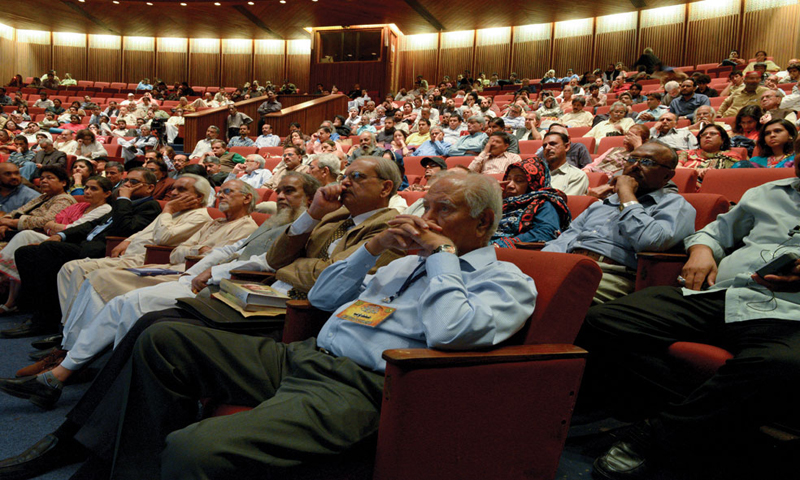



Their phraseology was almost similar as were the subjects that they chose to write on, with only slight variations. There was a personal angle to their ghazals and there’s nothing wrong with that. But they lacked a collective consciousness which hinted at their detachment from Pakistani society. I’m compelled to quote only one couplet from the event, and that is by Ahmed Navaid:
Put an end to the debate, let’s get intoxicated
Each should have his own self, each his own God
However, Professor Sahar Ansari, in a discussion on contemporary Urdu poetry on the second day of the conference, said that contemporary poetry is addressing current topics such as ‘honour killings,’ child labour and terrorism. He said that it’s the issues that pave the way for literary trends.
At the same discussion, poet and scholar Khurshid Rizvi spoke on the prose poem. He said writing uneven lines (one short, the other long, or vice-versa) wouldn’t serve the purpose unless the urge to compose a poem was genuine.
A session exploring modern trends in Urdu literature in general on the conference’s penultimate day had an interesting thesis presented by poet Ambreen Haseeb Ambar. Speaking on the kind of ghazal that’s being written in the 21st century, she argued that contemporary poets are influenced by the way products are advertised. The images that they see in different media dictate to them because of which they are heavily dependent on their visual sense. Her arguments, though, were countered by distinguished Indian scholar Dr Shamim Hanfi who pointed out that since the 21st century still has an 87-year-old journey to undertake, it would be too soon to draw such conclusions.
Among the poetry collections launched at the conference were Ahfazur Rehman’s book of nazms, Zindah Hai Zindagi, Afzal Ahmed Syed’s Diwan-i-Mir Farsi Ka Urdu Tarjuma and the complete works of Aziz Hamid Madani. Writer Zahida Hina read out an insightful essay on Ahfazur Rehman’s life and work in which she talked about the poet’s difficult life during General Ziaul Haq’s rule, despite which he stayed true to his principles. Dr Aslam Farrukhi’s assessment of Aziz Hamid Madani was a cerebral treat as he went down the memory lane and entertained the audience with anecdotes about the poet’s life. Madani sahib’s nephew, Zafar Saeed Saifi, gave an insight into the poet’s personal and family life, which was something unique as very seldom does one get to see this side of a creative person.
A senior poets’ mushaira at the end of the third day, presided over by Khurshid Rizvi, drew quite a few listeners. Among those who participated were Anwar Shaoor, Sabir Zafar, Ambreen Haseeb Ambar, Amjad Islam Amjad, Liaquat Ali Asim, Kishwar Naheed, Ahmed Navaid and Aqeel Abbas Jafri. The following ghazal by Aqeel Abbas Jafri was very well received:
Unknown men kill me in my backyard
Then lament, and sing a dirge for my death.
The writer is a Dawn staffer