0
0

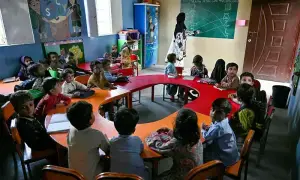
Schoolteachers in Punjab are not only ill-equipped to deliver on the government’s policy of promoting English as medium of instruction but are actually impeding their pupils’ learning of the content and preventing them from becoming proficient in the language.
This has been identified in a report entitled “Can English Medium Education Work in Pakistan – Lessons from Punjab” launched by the British Council (BC) last week.
In order to make a case for English-medium education, the BC has recommended that policymakers should involve teachers and head teachers in consultations, developing lesson plans that facilitate teaching and most importantly the teachers should be given incentives to improve their language skills for the purpose.
The Council has identified the maladies and suggested remedies in its report after conducting a survey in 18 districts, involving as many as 2,008 primary and middle school teachers in public and private sector, using its computer-based Aptis Language Testing System. It had conducted the study in partnership with the Directorate of Staff Development and Idara-e-Taleem-o-Aagahi (ITA).
The report reveals that some 62 per cent of the private schools’ teachers and 56 per cent of those in public sector lack basic knowledge of English and that most of the remaining teachers were found to be at beginners’ level. The situation was no better in so-called English-medium schools. However, it mentions that younger teachers had a much higher level of English than their older colleagues.
Through another survey, the British Council learned and reported that their reluctance to embrace English medium teaching did not mean that Punjab’s schoolteachers were resisting the change. It says most of the teachers are motivated to avail more training sessions in English teaching methodology with a strong desire to see their students flourish in a global environment.
The council’s report suggests that the policymakers should consult and involve teachers and head teachers in planning and implementing policies for strengthening the teachers’ ability to deliver.
The BC recommends evaluation of the curricula and textbooks with a view to updating them and making them more relevant to students’ needs and thematic interests. Shifting the focus towards practical speaking and listening activities would help students become better equipped to use English in their daily lives. The council stresses that the curriculum and textbook developers should discuss the issues with the teachers who should be encouraged to give input.
It suggests testing of English language abilities should be included in the teachers’ recruitment process. It says minimum quality standards should be developed for English medium schools, besides their long-term monitoring, to ensure that improvements were being maintained and built upon.
The Council suggests that an independent body should be engaged to conduct a rigorous assessment of the effectiveness of the existing training programmes for English.
For the Directorate of Staff Development and District Teacher Educators, the BC stresses that the lesson plans for teachers should include English-Urdu translations of keywords and phrases. It says lesson plans and training programmes should initially be aimed at the most receptive audiences.
Stating that pre-service teachers can be a key audience for training programmes, the council recommends that English-medium instruction should be incorporated into pre-service training for English, mathematics and sciences teachers – and should also be made part of the testing procedure for trainees.
The report states that younger teachers are vital to efforts for expanding English medium education. “The next generation of Punjab’s teachers is the most receptive to the new policy and best-equipped in terms of language ability to deliver it. After training receptive teachers, it says, the programmes could be rolled out for the others.
The Council proposes that cluster method may be used to train large number of teachers. It also calls for exploring technological solutions as means of reaching large number of teachers with training and support. It says the training should not be seen as a one-off event and refresher courses should be developed to keep teachers abreast of developments in English medium education.
The BC report states that teachers’ data can be used to ensure that schools contain a mix of older and younger faculty. It observes that the schools with predominantly older teachers are likely to have a culture that is more resistant to change.
Enlisting recommendations for head teachers and teachers, the BC report says that they should be given incentives to improve their language skills, including certificates for completing training courses and monetary awards for improving results. Those who receive rewards should be monitored to ensure they are maintaining standards, it adds.
It also advises the head teachers to encourage their subordinates to use modern teaching methods, including interactive learning and making greater use of technology as a teaching aid.
In order to support the Punjab school education department in implementing its English as a medium of instruction policy, the Council has also launched a five-year “Punjab Education and English Language Initiative (PEELI)” with the department’s help. The project aims at improving the ability of 300,000 primary and middle schoolteachers to use English language skills to effectively implement the policy.
THE Government College University’s Abdus Salam School of Mathematical Sciences (GCU ASSMS) has earned the distinction of producing 100 PhDs in a short span of six years.
Ms Haniya Azam is the 100th PhD produced by the school.
The ASSMS has produced 100 PhDs having international recognition with the input of its foreign faculty members. The Higher Education Commission’s policy to discontinue its foreign faculty programme may hit the cause of the school in the long run.
GCU Vice-Chancellor Prof Dr Muhammad Khaleeq-ur-Rahman says the ASSMS has been declared an emerging centre of excellence by the European Mathematical Society (EMS) and its students’ research has been acknowledged worldwide.
The VC also quoted EMS president as saying “The GCU ASSMS has indeed put mathematics on the map of Pakistan and the Pakistani mathematics on the map of the world”.
ASSMS Director-General Prof Dr A. D Raza Chaudhry claimed that all universities in Pakistan put together have not produced 100 PhDs in mathematics in the last six years, while the School alone did it.
He said the ASSMS also held the distinction of producing the youngest doctor of philosophy in mathematics in the world who was just 23 when he faced the open defence of his PhD thesis.
Prof Chaudhry said that all PhDs produced by the School were now working for top-ranking research institutes and universities home and aboard. —
mansoormalik173@hotmail.com