2
2
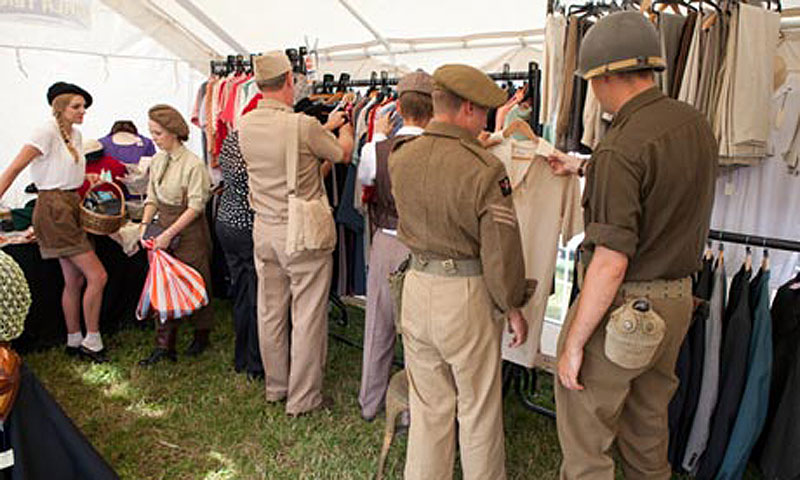

LONDON: On a humid summer’s day, in a field just outside Peterborough, half a dozen 20 somethings are sitting in a foxhole. Every item of their clothing is from the 1940s. Every detail of their encampment is from the 1940s. Two women are eating brandied peaches from a jar, prepared according to a wartime recipe.
“A few years ago I had no idea this scene existed,” says Jodie Roe, a recent graduate who is dressed in khaki. “If my history teachers saw me now they’d say: ‘What are you doing? You hated history.’”
“It takes over your life,” says Annie Andrews, a part-time singer and wartime-style pin-up model. “You get bitten by the bug.”
This is the Festival of the Forties, just one small event in a packed six-month calendar of events ranging from colossal hardware displays to strict re-enactment weekends where you can eat only wartime rations. In the “battlefield”, dozens of men in uniform set up camp in preparation for tomorrow afternoon’s military re-enactment, complaining about the price of blank ammunition. In the main field, a row of gleaming classic cars is flanked by stalls selling vintage clothes and assorted wartime paraphernalia.
There is nothing new about air shows or war games but the exponential growth of interest in the 40s extends way beyond the battlefield. You can see it in the proliferation of tea shops in which women dressed as land girls or WRAFs serve cakes on antique China, in the number of wartime designs sold on eBay and Etsy, or in the unprecedented demand for vintage clothing. The home front’s make-do-and-mend spirit has helped feed the recent resurgence in handicrafts, cake making and allotment gardening, reflected in BBC hits such as The Great British Bake Off and Wartime Farm. And the Keep Calm and Carry On poster, originally designed by the Ministry of Information for use in the event of a national catastrophe, has infiltrated British life to an extent Hitler could only have dreamed of.
Because the 40s scene has grown organically, nobody can quite explain why it has happened, although they all have theories. “It’s a collective sense of pride,” suggests Roe. “People like to know Britons in the past did something amazing together. They like to know it was possible. They were some of the best times our country had.” Obviously, this reading is problematic. Every decade has its horrors — 70s nights tend to focus on disco and flares rather than Pol Pot and the PLO — but the 1940s were uniquely hideous, giving the world the Holocaust, Hiroshima and more than 60 million war dead. Are the enthusiasts romanticising it too much by equating it with only the cheerier aspects of Britain’s wartime experience? And is it possible to detach benign collective pride from the belligerent patriotism of people who venerate the war for more reactionary reasons? “We all cherry pick the past but you have to be aware that you’re cherry picking,” says Wartime Farm co-host Ruth Goodman, a historian and presenter who also studies the Tudors and Victorians.The 40s trend began with fashion. “There’s always been an underground vintage movement,” Angel Adoree tells me over the phone. An early adopter, she started by selling clothes, and then moved into events, design and styling. “It used to be people who lived and breathed it but it’s mass market now. It can be slightly annoying, especially when it’s done badly, but I’ve had to embrace it.”
Kathy Stafford, a home front re-enactor who runs the 1940s Style for You stall, says that in the past few years the price at auction of desirable items such as women’s shoes has tripled. Recently, she was outbid for some dresses by a group of teenage girls who wanted unusual prom-wear. “People want the real,” she says. “They want a piece of history.”
Inside a classic caravan that’s been transformed into a mobile museum of the 40s, I meet Karen and Bob Poole. Everything in here is authentic, Karen says proudly, indicating a collection of tea sets, ration books, gas masks, bars of soap, faded boxes of washing powder, yellowed newspapers and several clocks drumming a manic rhythm. “I think people want to keep a piece of the past,” she says. “Everything’s computers now. People want to go back to basics.”
“They’re fed up with technology,” agrees Bob. “That’s what they say when they come in here.”That’s clearly part of it. You can understand the emotional pull of historically resonant artefacts and handmade goods as an antidote to the intangibility of digital life. There is also the economic context. When times are hard, it can be appealing to consider a period when Britons managed with even less and were more self-reliant. “At re-enactments you lose all the modern trappings and interference,” says Stafford. “And it does tip over into your real life. You become a lot thriftier. God help me, I actually wear darned jumpers now.”There are elements of the 40s scene, however, that should give anyone on the left pause for thought. Participants find moral virtue in austerity and valorise community activity while paying little attention to such landmark achievements as the NHS, social housing and the welfare state. You wonder if it’s another iteration of the passive comfort-blanket nostalgia that fuels the country’s current love-in with the Windsors. Can 40s fetishism be anything other than politically regressive?
Goodman thinks so. She points out that the second world war was a “brief, bright moment” of empowerment for young women, and thinks the interest in the lives of ordinary Britons, which seeps into the post-war period via the likes of Call the Midwife and David Kynaston’s bestselling social histories, is a progressive development. “History in general is changing focus from being about celebrities to being about the rest of us. Heroes and guns have been celebrated a lot but the sort of people who plugged through for years on end tend not be talked about. I do think the resurgence in interest in the home front is semi-political. You have to show the breadth of experience.”
At the Festival of the Forties, politics only rears its head in the shape of a long-running disagreement about whether there should be re-enactors on the German side. This year, the Wartime Weekend in Ramsbottom, Lancashire, turned away anyone arriving in black SS uniforms. “It’s a very unhappy divide,” says Stafford. “People are either perfectly OK with it or they bitterly resent it. We belong to the camp that says what the hell are you doing here when there are people who were POWs who will look at this uniform and quake?”
I head over to the “battlefield” and approach Mo Mowbray, a former British soldier who has been a Wehrmacht re-enactor for more than 20 years. Doesn’t he find it strange playing the oppressor, with a swastika on his shirt? “You have to be careful,” he says over “barbed wire” made from grey-painted string. “On at least two occasions a veteran has walked past and shouted and sworn at us. You can understand it. We’re not here to upset anyone. Somebody has to be the bad guys. You won’t find many people who do the political side — the black uniforms and that — because nobody will have them around. They’re bad news.”
You could argue that a German presence is a necessary reminder that it wasn’t all Glenn Miller and nice hats. Nostalgia is selective and tends towards the positive, but sanitising the nastier elements of history can lead to dangerous sentimentality. “I do get a little bit cross with the rose-tinting: ‘it was the best time of our lives’,” says Goodman. “I think it was pretty darn grim.”
“I think our parents would feel this was a bit of a charade,” says Chines Stewart, watching two “promenaders” walk past. “My mum would say ‘we’d never do that!’ ... Kids today think world war two is a big computer game.”
“It’s very difficult for people to understand how hard it really was,” says Bob. “People were tearing themselves apart. There was a lot of pulling together, but there was also a lot of looting and robberies. It was played down by the government.” When he wears the uniform of an Air Raid Precaution warden, with its armband reading Casualty Collection, most people assume the job involved collecting the wounded, but no. “They’d collect the bits up in potato sacks and try to match them up,” he says, suddenly solemn. “Fingers. Heads. But you don’t tell the children that.” At this event alone, there is no single, consensus version of the 40s but rather several readings, sometimes overlapping, sometimes conflicting. It’s impossible to assign one motive to the people who spend their weekends poring over the decade. The only thing everyone I speak to shares is an awareness that this period still has living witnesses whose individual memories prick holes in simplistic narratives, and they need to be heard.
By arrangement with the Guardian