Nasir Kazmi was born in 1925 and passed away in 1972. He should be ranked among those of our writers who were not destined to live long but who, during their limited span, wrote extensively and touched the heights of creativity before passing away.
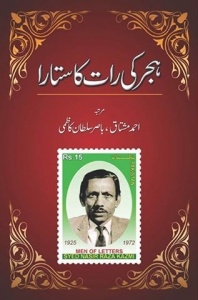
Soon after Kazmi’s death, Ahmad Mushtaq sat down to compile what had been written about his poetry and his personality and brought out a collection titled Hijr ki Raat ka Sitara.
Now, after nearly 40 years, Mushtaq, in co-operation with Basir Kazmi, has brought out the revised edition of the book. During these years, much has been written about Kazmi’s achievement in poetry. A strict selection from these writings now forms part of the revised edition of Hijr ki Raat ka Sitara. This addition to the collection adds a lot of value to the volume. Now it gives the impression that critics have been able to access what Kazmi had written after the publication of his first collection Berg-i-Nai and are in a better position to make an assessment of his work.

The articles included in the first edition show that the critics of Kazmi’s poetry were still under the spell of his early period covered in Berg-i-Nai. Of course, that period has great significance and carried a lot of charm. Kazmi had emerged as a new voice in Urdu poetry, trying to capture the unique experience of his age. And it was an age which, under the pressure of Partition, had emerged as pregnant with far-reaching consequences for people on both sides of the dividing line. It was left for Muhammad Hasan Askari to point out that Nasir Kazmi is the one poet who was able to capture this great experience in his ghazal. Enriched with this experience, Kazmi’s ghazal gained an alluring quality which was very popular with the readers.
But as Suhail Ahmad Khan has pointed out in his article, Kazmi’s admirers, in their immense admiration for the poet, forgot the fact that a genuine poet never likes to be a prisoner of any one way of expression or any one mode of feeling, however popular. He must go farther in search of something different or new. So the ghazals in his second collection Diwan tend to be a little different, giving way to a sense of maturity in place of the romantic flavour.
Not only this but in Kazmi’s poetic journey there comes a point when he says goodbye to the ghazal and turns to nazm. Thus his collection Nishat-i-Khwab has something different to offer us. Ahmad has tried to explain the kind of nazm he wrote. Kazmi, according to Ahmad, is trying to understand his experience through the traditional form known as hikayat or parables. These experimentations seem to be pointing towards his childhood experiences and to the cultural region where the Ajami temperament mingled with the Hindi temperament.
While talking about this intermixing of two cultural temperaments, Ahmad reminds us of Kazmi’s deep interest in doha, bhajan and folktales, and such poets as Kabir and Mirabai. Here he refers to Kazmi’s verse play Sur ki Chaya. In this play, Kazmi’s Hindi sensibility is reflected.
Another critic who has looked at this play is Sajid Ali. Others seem unaware of any attempt on Kazmi’s part to write a verse play. In fact, only two critics in the entire collection, Suhail Ahmad and Shamim Hanafi, have considered Kazmi’s varied attempts to come out from what Ghalib called the narrow alley of ghazal and discover a wide field for his poetic expression. The rest seem bent upon treating him simply and solely as a ghazal writer.
Shamim Hanafi has tried to take into consideration all of Kazmi’s writings. He has paid attention to the poems collected in the volume Nishat-i-Khwab, particularly his long poem carrying the same title. In Hanafi’s estimation, this is a wonderful piece of poetry. As interpreted by him, the poem brings to life a cultural atmosphere which had blurred under the pressure of circumstances in a way that two aesthetic traditions appeared to make one common cultural tradition.
He discusses in more detail the series of ghazals published under the title Pehli Barish. This series, according to him, is the most unique experimentation in the tradition of Urdu ghazal. One may say, according to Hanafi, that the whole landscape of the poet’s inner world appears to breathe the atmosphere of the past. All the ghazals have been written in the past tense. We find here a tale of love told in a way that was something new and unfamiliar for ghazal. Here is, Hanafi says, a mixture of poetry and dastangoi, something unknown to the tradition of ghazal.