0
0
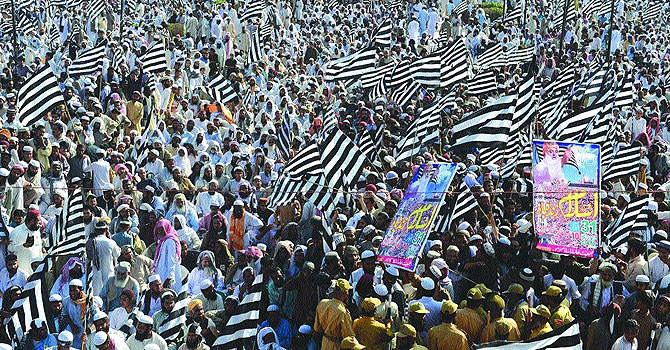
The Jamiat Ulema-i-Islam-Fazl (JUI-F) was in its first incarnation the Jamiat Ulema-i-Islam (JUI), established in Multan in 1952 as an offshoot of the Deobandi Jamiat Ulema-i-Hind (JUH). It was originally not a family enterprise. In 1962 the late Maulana Mufti Mahmood became its acting chief.
Soon after Mufti Mahmood’s death in 1980, his eldest son Maulana Fazlur Rehman became the party’s general secretary and turned it into a family concern from the Abdul Khel area of Dera Ismail Khan. Maulana Hamid Mian, who came from a family renowned in religious terms, was elected the JUI chief in 1988, yet the power remained with the young Fazlur Rehman.
This led to the formation of splinter groups within the JUI. These include the Samiul Haq Group, the Nazaryati (ideological) Group, the Haqiqi Group and the Constitutional Group.
Today, the JUI-F derives its strength from thousands of affiliated seminaries across the country. Basically a political party of clerics, it espouses a liberal outlook in Pakistan’s parliamentary politics.
Yet it is a staunch supporter of the Afghan Taliban and top leaders of the Afghan Taliban and the heads of various Pakistani Taliban factions operational in Fata who once studied in its seminaries.
But in domestic politics, the JUI-F leadership is liberal and accommodating. The party opposes neither women’s education nor parliamentary democracy. The late Maulana Mufti Mahmood formed a coalition government with the secular-liberal National Awami Party in what was then the NWFP in 1973 and was its chief minister. He opposed Field Marshal Ayub Khan and defeated Zulfikar Ali Bhutto from Dera Ismail Khan, his hometown, in the 1970 general elections. Mufti Mahmood led the Tehreek-i-Khatm-i- Nabuwwat and the Nizam-i-Mustafa Movement.
After his demise, Fazlur Rehman became the general secretary of the party at the age of 27, while he was studying at a seminary in Multan. He was very active in the Movement for the Restoration of Democracy during the Ziaul Haq martial law and was put behind bars for this.
The JUI-F has always operated in mainstream politics, playing an active role in electoral politics. Meanwhile, the party has also worked towards maintaining sectarian harmony and for this purpose joined religious parties’ alliances such as the Milli Yakjehti Council and the Muttahida Majlis-i-Amal (MMA).
Historically, the JUI-F has not supported or encouraged non-political extremist alliances or forums such as the Pakistan-Afghanistan Defence Council and the Difa-i-Pakistan Council, conglomerates of various political, jihadi and banned outfits.
In electoral politics, the JUI-F always attempts alliances to pull together the religious vote. For this purpose the party is willing to make alliances with religious groups even if that leads to the dilution of its own identity. The party contested the 2002 general elections from the MMA platform and its MPA Akram Khan Durrani was elected chief minister in Khyber Pakhtunkhwa, while Fazlur Rehman became the opposition leader in the lower house of parliament.
The MMA might have been torn into pieces in 2007 after the withdrawal of the Jamaat-i-Islami and the Jamiat Ulema-i-Islam-Sami. But the JUI-F, which still has a strong vote bank in the southern districts of Khyber Pakhtunkhwa and Fata, kept the MMA intact and contested the general elections from the alliance platform in 2008. However, it was reduced to 15 seats in the Khyber Pakhtunkhwa Assembly, including reserved seats for women and minorities. In the National Assembly, the MMA retained only seven seats in 2008.
Until recently the JUI-F was making efforts to restore the MMA to use that platform in the upcoming elections to pull the votes of the religious parties together. The party has also kept its doors open for seat adjustment and is looking for a deal with the Awami National Party, the Pakistan Peoples Party, the Pakistan Muslim League-Nawaz, the Qaumi Watan Party as well as smaller groups.