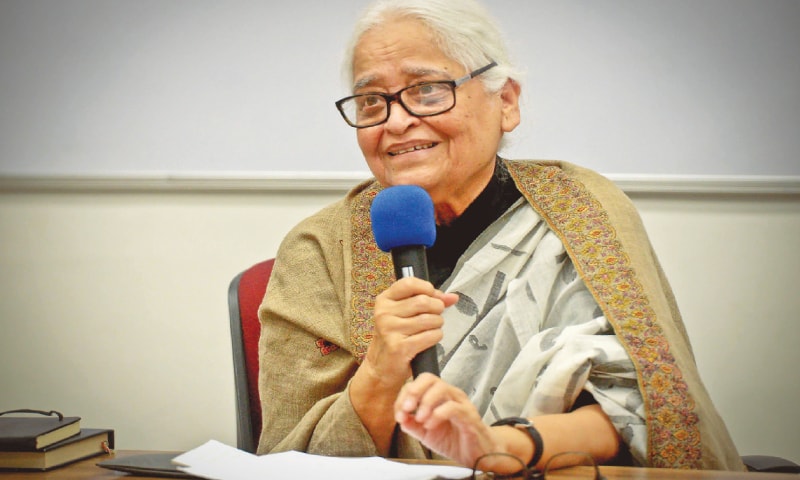
KARACHI: An engaging conversation, a witty sense of humour and a love for the Urdu language. These are all part of the offering each time Zehra Nigah sits down to talk. And at the Habib University on Wednesday, while addressing students, professors and lovers of Urdu adab, she shared her passion for the Urdu classics that has profoundly impacted her art till this day, and kept her company in lonely times.
Moderated by Asif Farrukhi, the informal conversation oscillated between several topics, from the floundering tradition of mushairas, to the lack of tarannum and why it has become a dying art. However, throughout Ms Nigah returned to the same thread — the importance of the Urdu classics and how pertinent is classical Urdu poetry in the troubled times today, providing solace in the darkest of times.
Ms Nigah furthered her belief that what was written in the past is almost always connected to the present, and this cycle will remain so. She proved this hypothesis by citing verses from legends life Hafiz, Mir, Momin, and of course Ghalib and Faiz. Hearing Ms Nigah speak eloquently on the tradition of classical Urdu poetry inspired many students in the audience, several of whom are at the cusp of immersing themselves into tomes of Urdu literature, in an academic setting.
“Students must understand this reality that in the kingdom of literature there is no dictator. Each individual who either reads or writes is a king in his own self,” she said.
“Literature should have the ability to force the reader to ponder on what has been written and it should raise questions within you. This is the quality of great literature and such a piece of prose or poetry belongs to every era.”
Ms Nigah shared the characteristics of great writer. For her, any writer who looks a hundred years in to the future and pens down realities of life that may be pertinent to the time he is writing in, as well as to the distant future, makes the cut. According to her, the Urdu language has been blessed with classical writers and poets who have upheld this tradition and continue to do so.
She also believes that classic Urdu poetry has a divine quality to it with the ability to shape lives, and tear them down. Written in the midst of burning empires, or surrounded by idyllic scenic beauty, it carries within it the message of love and humanity.
“A poet’s sorrow is not just his own, it is the sorrow of the entire world,” she said. “He uses ordinary words which we use daily and collects them within a strand which gives the same words a new dimension.”
A poet’s art, his thought and his consciousness play a very important role in painting images through words and she advised the students present to take inspiration from all these.
The highlight of the evening was certainly when Ms Nigah read from her own oeuvre of poetic excellence, and in particular when she read out ‘Jungle Ka Qanoon’.
Published in Dawn, January 28th, 2016