4
4


THE district of Khairpur is one area where Sindh’s fabled heat is celebrated. As temperatures climb in the searing summer months of June and July, thankful farmers pray for more sun to ripen their dates and keep their fingers crossed for no rain. The landscape is breathtaking during the date harvesting season. Thousands of palms heavy with bundles of thick, yellow dates are interspersed with fields of near-ripe red barley and rows of sugarcane plants. In every open space, hundreds of mats are spread upon the ground and covered with dates being dried in the sun. And dozens of tractor trolleys ply the roads piled high with dates and happy workers singing songs and shouting slogans.
The process is quite a wonder to observe. The smooth yellow dates, known as doka in Sindhi, grow in bunches. The stem branches out from the top so the bundles appear to be hanging in baskets. Specialist workers climb the trees to chop the dates. The rest of the work is done by unskilled labour.
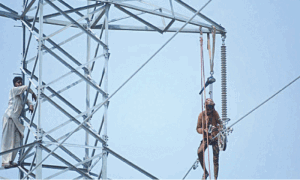
Fauji Subhan has been working on date farms for five years. He ties a rope around his waist and almost slithers up the rough trunk of the date tree, chopping off bundles of dates and sliding them down the rope to another worker holding the other end. Once he’s cleared out the entire palm, he comes down and the two workers collect up the bundles. Subhan earns about 700 rupees a day and chops bunches from 100 date palms a day.
“This is really good business, I earn a good living and I am occupied all year round,” Subhan, 30, said at the farm where he works at Phori Chandia village in Khairpur district. “During the harvesting season I do the hard work of cutting the dates and loading them up and in the off season I take care of the trees.”
Once the bundles have been chopped off the tree, they are transported in tractors to an open-air processing area. There, at a temporary workshop made of tree trunks topped with hay, the date bunches are dragged through a 12-toothed wooden handmade rake that separates the stem from the dates. Then, they are sorted and graded; those below grade are discarded.
Those which are half raw and half ripe are immediately put aside and sold as doka. Those which are completely raw are spread on an open ground on dried leaves from the date trees or woven mats to become dates in the sun. The rest are stewed in boiling water with a bleaching agent added and then spread out in the sun to become dried dates, known as chuwara. The empty basket-like stems are used as fuel for this process. The dates lie in the sun for six days, rolled over every 24 hours to prevent them from rotting, said Adeeb Ali Arain, a farmer along the Khairpur-Larkana bypass, who owns 4,000 palms and earns Rs3 million a season.
All the three types of dates are then packed in sacks from all across Khairpur, which is the biggest date-producing district in the country, and sold in the date market in Sukkur from where they are sent elsewhere in the country and also shipped overseas.
Gadda Hussain, who employs 20 workers including Subhan, owns 600 date palms and says he makes a profit of about Rs6 million in the month-long harvesting season. Workers are also provided with meals and tea by the date farmers.
The discarded raw dates aren’t wasted. During the harvesting season, a minority Hindu community known as Baagri arrives in entire families from riverside areas all along from Jamshoro to Sukkur. They set up makeshift straw huts in date farms to collect reject dates. These, one family said, they sell to agents who sell them onwards to confectionery factories.
“We welcome them when they come every year and give them space in our farms to live and work,” Hussain said. “We don’t sell the discarded dates. We leave them for the Baagri. They take them away. Seeing them around is a part of our harvesting season.”
Witnessing the harvesting is a true delight. Compared with the stark poverty so widely visible all across Sindh, the date harvesting in Khairpur is a season of such bounty and plenty. Moreover, the camaraderie and cooperation with which farmers, labourers and scavengers work together, making room for each other and caring for each other’s needs is also deeply heartening. A true lesson of how opportunities for income generation can change both the drabness of the landscape and the lives and social interactions of its people.
—The writer is a journalist and founder of Ali Hasan Mangi Memorial Trust.
Published in Dawn, August 4th, 2015
On a mobile phone? Get the Dawn Mobile App: Apple Store | Google Play