WASHINGTON: The post-2014 US military strategy for the Pak-Afghan region and the Zarb-i-Azb Operation will be reviewed carefully at the next meeting of the US-Pakistan Defence Consultative Group, official sources said.
The group meets in Washington in the second week of December.
The Pakistani delegation is expected to give a detailed review of the operation launched earlier this year to eliminate militant hideouts from North Waziristan.
The US delegation will give a presentation on post-2014 US and Nato military strategy for the Pak-Afghan region.
This will be the 23rd meeting of the US-Pakistan Defence Consultative Group, which was founded to devise joint strategies for combating militancy in the Pak-Afghan area.
The forum also allows both sides to exchange views and coordinate defence policy “with the goal of strengthening defence cooperation to support each country’s security interests”, said a Pentagon press statement.
In the last meeting, both sides agreed that: “Their defence partnership was vital to regional and international security and that it should continue to endure and grow in the years ahead,” the Pentagon said.
The Pakistani delegation provided an update on its military campaign along the Pakistan-Afghanistan border, and the US delegation briefed on International Security Assistance Force activities in Afghanistan.
The US State Department confirmed on Sunday that Secretary of State John Kerry will meet Pakistan’s Chief of Army Staff Gen Raheel Sharif at his office later in the evening.
Gen Sharif came to the United States two weeks ago for talks with senior US defence and security officials. His assurance that Pakistan was targeting all militant groups – including the Haqqani network – during the current operation against militants helped improve ties between the two militaries.
DCG meetings also review the challenges to regional security, with an emphasis on regional peace and stability.
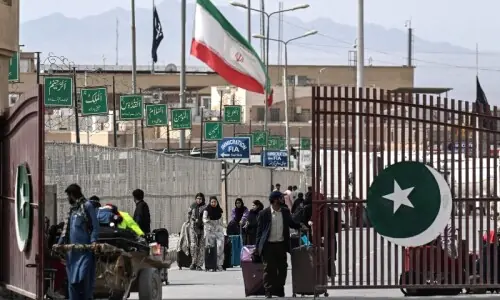
The meetings also review relations between Pakistan and Afghanistan, particularly cross-border cooperation between the two neighbouring countries that face an existentialist threat from militant groups operating in the region.
Published in Dawn, December 1st , 2014