10
10
WHAT had looked likely for months has now become a reality: yesterday, after a meeting of the International Health Regulations Emergency Committee concerning the international spread of wild poliovirus, WHO said in a statement that the conditions for a “Public Health Emergency of International Concern” have been met. “This situation,” it said, “could result in failure to eradicate globally one of the world’s most serious vaccine-preventable diseases.”
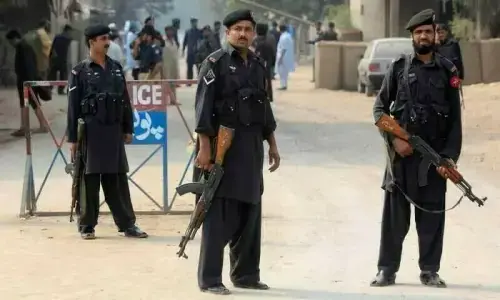
Pakistan finds itself in the dock yet again. It remains one of the world’s three remaining polio-endemic countries, and the Pakistani strain of the virus has been detected in several other countries. Notwithstanding all the work put in by the polio immunisation campaign over more than two decades, the situation continues to worsen. From the passive refusal to let the Oral Polio Vaccine be administered, we now have active and brutal aggression. Vaccinators have been attacked and murdered, health teams work under siege conditions, there are problems with the cold-chain storage and doubts over the efficacy of the vaccine. In the TTP-dominated tribal areas, a ‘ban’ on the vaccination has been imposed, and in other areas tribal elders have tried to use it as a bargaining chip. It’s hardly any wonder, then, that WHO has finally advised that restrictions be placed on people travelling from countries that could export wild poliovirus, which includes Pakistan. The measure was first proposed in 2011 by the Independent Monitoring Board for Polio Eradication, and India implemented it early this year.
The way forward is what it has always been: Pakistan needs to get its house in order, urgently. The means and motivation have to be found to further the OPV initiative. While adults stand a small chance of contracting the disease, it is children with whom this crippling virus has an affinity, and in immunising every child — with starter and follow-up doses of the vaccine — lies the only hope for eradication. The state must not only better organise the logistics involved in reaching every child, it must also accomplish the task that is perhaps just as daunting: taking control of the narrative. No other country is at a comparable place, ie witnessing a seeming resurgence of the disease, and therefore the bulk of medical research refers to risk-assessment in the context of a falling, or halted, incidence of polio. The travel restriction advisory means that more challenges have been created. The various political elements that declaim their passion for the ‘national interest’ need reminding that the best way of achieving this lies in closing ranks. They must if they are to ensure that future generations don’t face being crippled, and that Pakistan is not an international pariah because of its inability to control the spread of a disease that, just a year ago, had very nearly been globally eradicated.