0
0
KARACHI: The answer to road transport issues is not just the Karachi circular railway project but rather an integrated mass transit system that combines different modes of transports, said speakers at a seminar held on Monday at a local hotel.
The seminar to sensitize journalists on issues related to the transport sector was organised by the International Union for Conservation of Nature (IUCN) Pakistan. The initiative was part of the Pakistan Sustainable Transport Project (Pakstran) which is being implemented by the government with the support of Global Environment Facility (GEF) and United Nations Development Programme (UNDP).
Speaking on the economics and social dynamics of the transport sector, Mohammad Aqibuddin, an expert on transport and environment related issues, said the population of Karachi was growing 4.2 per cent annually since 1998 and was projected to grow 18.9m in 2010 and 27.6m in 2020.
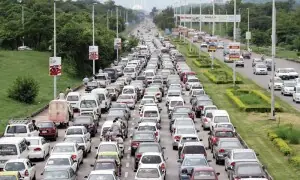
“The city has registered a 500 per cent increase in the number of vehicles that has jumped from 5.21m (1987) to 24.5m (2006). It has been assessed that 40 persons compete for one bus seat in the city as compared to Mumbai where 12 individuals vie for the same. This is because the Indian city has an efficient railway system,” he explained.
Showing a slide, he said the public transport of Karachi constituted only six per cent of all vehicles in use but it carried 55-60 per cent of all transport users. Private cars which comprised 29 per cent of the total vehicular traffic carried only 22 per cent of transport users.
He criticised the government policy of addressing traffic jams through more flyovers and said it was flawed since the city continued to face frequent traffic snarls. Identifying obstacles to an efficient urban transport system, he said these barriers existed at the institutional, regulatory and financial levels.
“For instance, the lack of consensus between two major political parties in Karachi over the governance system is a big stumbling block in implementing any policy or project,” he said.
Giving a presentation on sustainability concepts in transport sector/options and benefits, Prof Dr Shabbar Ali, chairman of the Department of Urban and Infrastructure Engineering of NED University of Engineering and Technology, said that the Japanese International Cooperation Agency (Jica) data showed that an overwhelming majority of people in Karachi travelled by public transport.“Sixty per cent people utilizing the public transport spend Rs500 to Rs1000 monthly on commuting. The city with a rapidly growing population has no urban transit system. The gap is being filled by qingqi (motorcycle rickshaws), an unsafe mode of transport,” he said.
To a question regarding Karachi circular railway project, he said it was a viable option but not a complete answer to the transport problem as the city had now become huge and more complex.
Regarding the obstacles causing delays in implementing the railway project, he said that one major hindrance had been to acquire land from encroachers. “The writ of the government could be gauged from the fact that it could not vacate the land to complete Lyari Expressway,” he said.
Dr Raza Mehdi, a senior teacher at NED University, spoke about the linkage between air and noise pollution caused by traffic congestion and human health.
Informing the audience about Pakstran, Syed Kamran Haider Naqvi, urban specialist at IUCN, said the five-year project with a funding of $7.8m was aimed at reducing the growth of energy consumption and greenhouse gas emissions. “These objectives would be achieved through planning and implementation of integrated urban transport systems,” he said.
Project proponents, however, failed to give satisfactory replies to journalists who raised questions over how the desired objectives would be achieved considering the failure of multiple transport schemes. No target areas in specific cities were identified in the programme for project’s execution.
Country Representative, IUCN, Mahmood Akhtar Cheema and Dr Saleem Janjua, National Project Manager, Pakstran, Ministry of Water and Power, also spoke on the occasion.