Bloomers in NYC
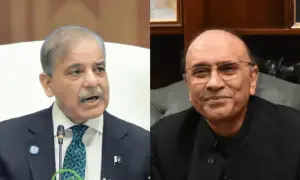
IT must be asked whether President Zardari’s various engagements in New York on the sidelines of the UN General Assembly session have brought his nation any glory or joy. The obvious case in point is his ill-conceived flattery of President George W. Bush at a time when US-Pakistan relations are at their ambivalent best. Even a high school student, anywhere, would pause before saying what Mr Zardari did when he held that the world was a safer place today because of Mr Bush, and that the ‘axis of evil’, the neoconservatives’ war bogey, was expanding. This is immature and runs counter to public sentiment not only in Pakistan but in many countries sucked into being America’s allies in the ‘war on terror’. Only the former British premier Tony Blair would have probably ventured this far to placate his friend. The disaster in Iraq speaks for itself. Just what the president set out to achieve with what can only be termed as schmoozing is anyone’s guess. There was no cause for it. Acknowledgment of the necessity of Pakistan’s role in the war against terrorism is universal. More Pakistanis today own this war than ever before, but that does not mean that they endorse Mr Bush’s way of dealing with it.
Mr Zardari’s latest statement came on the heels of the embarrassing exchange he had with the Republican vice-presidential hopeful, Ms Sarah Palin. How one wishes there was a diplomatic mechanism in place whereby our leaders were somewhat tutored before going out to meet world leaders so as to avoid being awkward in spite of their inner compulsions. The only redeeming feature of the visit would be if the so-called Friends of Pakistan deliver on the promised financial assistance to bolster the crisis-ridden economy of the world’s only Muslim nuclear power.
Back home, there was some optimism attached to Mr Zardari’s tour to the UN. The small delegation he was to lead, opting to travel by commercial flights, was welcome and gelled with the government’s austerity drive. But then political exigencies came into play and the entourage reportedly swelled to some 60 members, comprising a large number of journalists. Finally, given the president’s conduct of affairs in New York, it will also be said that the tour followed Mr Musharraf’s practice, who as the president hogged the limelight at international forums. The head of government who should have led the Pakistani delegation meanwhile lay low in Islamabad. This does not match up with the PPP’s stated policy of re-empowering the prime minister.
A difference in shades
MANY Pakistanis entertain the notion that Republican regimes are generally friendly towards this country, while Democratic administrations are not. Space constraints do not permit us to accept or challenge this theory, but we can draw some lessons from the TV debate between John McCain and Barack Obama over the weekend. Both want to send more troops to Afghanistan, both realise that the situation in that country has not improved, and both believe that America should attack Taliban bases in Fata. If there are differences between the two on their Pakistan policy they are in shades, because American foreign policy is generally a bipartisan affair. More importantly, the process of foreign policy formulation is institutional in nature, and Congress does not give the executive a free hand in its conduct of external affairs. This leads to a compromise in which the two parties differ at best on details.
As a careful reading of the two candidates’ remarks in the TV debate would show, McCain does not disagree with Obama on the need for attacking in Fata. What the Republican presidential candidate wants his Democratic counterpart to do is not talk about it. While Obama’s tone is vicious, McCain sounds friendly and emphasises the need for winning over the hearts and minds of the Pakistani people and staying engaged with Islamabad. But he does not disagree with Obama on the question of attacking what the Democrat calls the Taliban’s safe havens. What he objects to is Obama going public with his belligerence. Says McCain: “You don’t say that out loud. If you have to do things, you have to do things”. Translated, it means: I too will attack Fata but I am not going to talk about it.
A couple of months ago, President George Bush authorised the US military in writing to attack Taliban targets in Fata on “actionable intelligence”. Since then American helicopter-borne troops and Predator missiles have been regularly attacking presumed Taliban safe havens, resulting often in heavy civilian casualties. One can only hope that Obama the president will be more responsible in his conduct and utterances than Obama the presidential candidate. The issue is Pakistan’s sovereign right to fight the terrorists within its own borders. Pakistan cannot allow foreign forces to operate in its territory. Attacking Fata will torpedo the war on terror, add to anti-American sentiments in this country and undermine the democratic government.
Global financial crisis
THE biggest banking rescue in US history has been authorised by the White House and congressional leaders. At stake is nothing less than the financial system of the US, and large parts of the world, which has been brought to its knees by the implosion of mortgages and securities backed by them. The extraordinary price tag — up to $700bn — reflects the extraordinary worry of American politicians. Here in Pakistan, the question is, how will the crisis affect us? Directly, Pakistan’s exposure to the US financial system is minimal and there is little risk of sinking American firms taking Pakistani-owned dollars down with them. Indirectly, the situation is more complex — and potentially grave. First, Pakistan’s ability to raise money in the international financial market at a reasonable rate can disappear in the weeks ahead if the market is not calmed by the US Treasury rescue effort. While much of the focus has been on the tottering US housing sector, the real global worry has been that financial institutions are reluctant to part with their cash in a market where no one seems to know how badly the balance sheet of any given institution has been affected by the crisis. In economic parlance, lenders have become risk-averse.
Unfortunately for Pakistan, this general risk aversion has coincided with a dire local need for dollars to finance a record current account deficit measured at $2.6bn in July and August against foreign exchange reserves of less than $9bn. The only cushion against this double whammy is that Pakistan does not rely much on commercial external debt. However, Pakistan’s preferred route for raising money internationally — privatising assets such as the Qadirpur gas field — will almost certainly be impacted by a limp financial system. And foreign direct investment from the US could be affected — in July and August, the US was the largest direct investor in Pakistan ($127mn) if one-off payments from Singapore and Malaysia are overlooked.
Finally, if the crisis spills over from Wall Street to Main Street, one of Pakistan’s largest export markets, worth approximately $300mn a month, may shrink significantly. The benefits of a lower import bill, if oil and food prices continue to fall in a weak global economy, may then be lost by weakening exports. In the weeks ahead, finance ministers of many countries will watch nervously as the world financial market digests the American rescue package. No doubt our finance minister will be one of them.
America’s new war
While the continuing wars in Iraq and Afghanistan have not receded from centre stage, the American military juggernaut seems to have lost its appetite for opening a third front against Iran. Almost out of the blue, however, a new theatre has emerged on the US home front.
As in the preceding two wars, the blame was put initially on a failure of intelligence. Like its predecessors, the new war was also to be fought against an invisible enemy, which was hiding not in the Tora Bora mountains in faraway Afghanistan (or in adjacent hideouts in Pakistan) but in the tall towers of Wall Street and other financial centres.
The enemy’s ideology transcended religious and political boundaries and was based on such indefinable characteristics as ‘greed’ and ‘irrational exuberance’. However, in the past 10 years it had received considerable encouragement from the dominant neoconservative ideology whose market fundamentalism was no less dogmatic than the religious fundamentalism of the architects of the 9/11 disaster.
The war metaphor is being used frequently in discussions of the financial crisis in the United States. Warren Buffett, the renowned financier, recently described the new instruments of financial innovation as financial weapons of mass destruction. And the way the US government and the Federal Reserve Board (which may be considered counterparts of the Pentagon and the State Department) have decided to combat the financial meltdown is clearly reminiscent of the way the decision to wage war in Iraq was made.
The congressional bill presented last week to enable the administration to clean up the accumulated financial toxicity has a price tag almost as large as the five-year-old Iraq war. It seeks unlimited authority and a war chest of $700bn, without a proper examination of consequences and with unprecedented lack of detail. However, the bill is facing far tougher resistance in Congress than the passage of the Iraq war bill five years ago, which was called Authorisation for Use of Military Force. Detractors of the current bill are calling the proposed legislation Authorisation for Use of Financial Force or, even worse, “cash for trash”.
The bill, which comes on the eve of the presidential and congressional elections in November, faces tremendous opposition from voters who perceive it as a reverse Robin Hood operation in which taxpayers, many of whom have lost their homes or who face default on their mortgage, credit card, car and college loans. Many in America feel they will be made to pay through future tax burdens in order to bail out the fat cat corporate executives with million-dollar ‘golden parachutes’. Barely three days after the bailout plan was revealed, President Bush, facing the possibility of its rejection by Congress, had to appear on prime time television to address the nation and allay its fears about the daylight robbery most people felt was being committed to save the financial barons of Wall Street.
In a veiled attempt to give an edge to Republican presidential candidate Sen McCain, who had announced the suspension of his election campaign to avert the financial meltdown through bipartisan changes in the bill, he invited the two presidential candidates to join him, the congressional leadership and officials piloting the bill to help arrive at a consensus solution regarding the scope and content of the legislation. Congress is reluctant to give the administration a blank cheque and has asked for assurances about protecting the public interest. Sunday’s parleys have culminated in a tentative bipartisan accord but the Bush administration will most probably not be granted the sweeping powers it seeks.
For one thing, the money will be released in tranches, it seems, and how it is spent will be subject to review. Also, the bill is yet to pass the House of Representatives and the Senate, and a presidential veto of an amended version cannot be written off either.
The US president, who had to cut short his visit to New York to attend the UN General Assembly session, couldn’t help referring to the new war effort in his maiden meeting with Mr Zardari, even though the latter would have liked to discuss Mr Bush’s first war on terror, which has inflicted untold damage on Pakistan. The latest manifestation of the battle against terrorism came in the shape of the bombing in Islamabad of the Marriott hotel, a symbol of the Pakistani elite’s opulence and profligacy as well as a favourite five-star billet for foreigners, including US citizens and marines. The preoccupation of Mr Bush with the US’s financial difficulties, however, puts a damper on Mr Zardari’s hopes of getting any substantial American help in bailing out his country from its own economic meltdown, at least during the remaining days of the Bush administration.
Although the main source of the current financial mess in the US is generally said to be the sub-prime crisis, stemming from the housing bubble that had been waiting to burst for the last few years, its underlying causes are much deeper and its impact much wider. The current crisis had been anticipated by many analysts, who characterised it as a train wreck in slow motion which could have been prevented at different stations had signals been in place and the red lights not been ignored.
The underlying philosophy of the US central bank, especially under the watch of Alan Greenspan — eulogised by the financial press as the greatest central banker of all time and considered by some to be the architect of the US financial bubble — has been that the private banking system is self-policing and does not need an elaborate regulatory mechanism. Any mistakes it makes are remedied by market corrections, sooner or later. The Fed’s most egregious failure as a regulatory body in the current context was to approve the creation of dubious credit instruments such as mortgage securitisation, whereby instead of holding mortgages banks would simply originate the loans and would then distribute them to investors, such as pension and hedge funds.
This technique, called originate and distribute, gave rise to a runaway process of credit creation similar to a Ponzi scheme, which ultimately becomes unsustainable and results in massive defaults. As a result, Greenspan presided over the most reckless debt binge in US history which helped create the housing bubble. When housing prices began plummeting and borrowers stopped making payments, financial institutions found themselves with huge inventories of bad loans. These investments are so intertwined and complex that no one seems able to figure out what they are worth. So no one has been willing to buy them. This is the crux of the difficulty faced by the $700bn Bernanke-Paulson bailout plan, which aims to buy these assets through the creation of a new government agency.
Even if the Treasury-Federal Reserve bailout plan clears all the hurdles, it is doubtful whether it will be any more successful in bringing stability to the US financial system than the Pentagon and State Department have been in bringing peace to Afghanistan and Iraq. America’s military and financial supremacy are both on the block.
syed.naseem@aya.yale.edu
Bypassing bipartisanship
IN a week when the wheels nearly came off the US economy, the gloves came off in the presidential race. Barack Obama and John McCain continue to say they favour a bipartisan approach to solving the nation’s problems. But vicious congressional infighting over the bailout, last Friday’s terse, testy televised debate and the ensuing raucous slanging match have again exposed and dramatised the deep political and cultural divisions lurking just below the surface of American life.
All earlier talk of a “new politics” is now dead and buried. The subliminal message from both campaigns to voters as the race enters its final month is clear: It’s time to decide whose side you’re on — and step up to the plate. Nationally, the polls show the battle finely poised at 47-43 in favour of Obama. Each party is searching for advantage. A stumble, a gaffe or a smear could yet change everything.
Obama is using the economy as an anvil on which to beat McCain. “The truth is, through 90 minutes of debating, John McCain had a lot to say about me, but he had nothing to say about you. He didn’t say the words ‘middle class’ or ‘working people’,” Obama said at a North Carolina rally following last week’s TV head-to-head. To the noisy accompaniment of crashing banks and collapsing markets, the Democrat is now unapologetically positioning himself as the champion of “ordinary folks”. The enemy? Greedy Wall Street fat cats and their governmental and Republican cronies.
Having kept his powder dry on stage in Oxford, Mississippi, McCain is loading for bear. He was widely criticised for rushing back to Washington to help negotiate a bail-out deal. Democrats called his move a “stunt”.
Now a deal has been initialled, Republicans say he did the responsible thing while Obama sat idly by, polishing his debating points. According to McCain on Sunday, Obama’s aim is to exploit the crisis for political gain first, and solve it second.
— The Guardian, London
OTHER VOICES - Sindhi Press
Meet the friends of Pakistan
Ibrat
PRESIDENT Asif Ali Zardari’s efforts have resulted in the establishment of ‘Friends of Pakistan’, which will be a permanent forum for the country. Developed countries all over the world have come together to set up a consortium that will provide financial aid to Pakistan and is expected to meet next month in Dubai. Countries including the UK, US, Saudi Arabia, Canada have pledged to help Pakistan. President Zardari appealed to world leaders for financial support in the war on terror, asserting at the conference that Pakistan needed $15bn immediately to prevent its economy from collapsing…. At the UN headquarters, President Zardari told world leaders that Pakistan was alone in fighting the war on terror. He said that while the world only read about the war in newspapers, Pakistan was experiencing this conflict on its soil.
After 9/11, the US has not been a victim of terror attacks. It has avenged the incident by declaring war on Afghanistan and Iraq. Now this conflict has spilled over into Pakistani territory. …The elected government has inherited the war on terror, the operation in Fata and an economy on the brink of collapse. Millions of dollars received during the Musharraf era for the war were pocketed by the elite. The poor got poorer and the rich got richer. A huge amount of money was spent without any accountability. This issue was raised temporarily but to no avail.
Pakistan is facing an economic crisis. High levels of poverty need to be addressed on a war footing. The government’s resources have been used up by the war and now the beleaguered nation is in dire need of financial aid. Developed countries will offer limited support which is why we need to be self-sufficient. We are desperate for investment but the current security situation has kept investors from coming to Pakistan. On the other end, we may get aid but proper utilisation is equally important. A huge amount was received for health, education and some other social sectors and funds were also allocated to the new local government system. The previous government also received billions of dollars as aid for the war on terror but details are not yet available about how the funds were spent. Although the democratic government wants to undertake numerous projects for the welfare of the people, resources remain scarce as the war has pushed us into an economic crisis. We need financial aid and t he international community should realise that no country can fight the war on terror single-handedly. — (Sept 28)
— Selected and translated by Sohail Sangi