No ‘release Imran force’ exists, KP CM tells Federal Constitutional Court

• Sohail Afridi says ‘Imran Khan Rehayi Aman Movement’ is a peaceful, voluntary civic initiative, aimed at raising awareness about due process of law
• Terms petition ‘speculative, politically motivated’ and liable to be dismissed
• Constitutional court to hear plea tomorrow
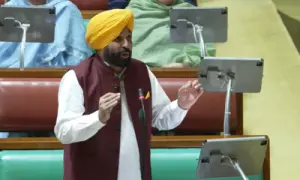
ISLAMABAD: Khyber Pakhtunkhwa Chief Minister Sohail Afridi on Monday categorically denied before the Federal Constitutional Court (FCC) the existence of any armed structure or paramilitary setup, asserting that the “Imran Khan Rehayi Aman Movement” was a peaceful, unarmed and voluntary civic initiative aimed at raising awareness about due process of law.
The KP chief minister made the assertion in a rejoinder filed in response to a petition moved by Malik Zaheer Ahmed, who challenged the legal status of the movement. The petitioner argued that the formation of the force to secure the release of incarcerated PTI founder Imran Khan violated the Constitution and posed a threat to public order.
A three-judge FCC bench, headed by Chief Justice Aminuddin Khan, will take up the petition on July 29. At the last hearing on April 1, the FCC had directed the KP chief minister to respond to the petition seeking to prevent the mobilisation or activation of the force.
The rejoinder stated that the alleged “Imran Khan Rehayi Force” had neither been constituted, notified nor operationalised at any stage. “No armed structure, organisational militancy, coercive framework or paramilitary setup exists or has been contemplated”.
Any prior reference to the term “force”, if misinterpreted, has no legal or factual existence and cannot be relied upon, the KP chief minister emphasised, adding that the initiative in question was, in fact, the “Imran Khan Rehayi Aman Movement”, a peaceful, unarmed, voluntary, civic and political movement. Its primary objective, the rejoinder said, was to raise public awareness about due process of law and the state’s responsibility to act fairly in initiating criminal prosecution.
The movement, rejoinder explained, was strictly aimed at lawful, democratic and constitutional advocacy for the release of a political leader, without any element of force, militancy or coercion.
The comparison drawn by the petitioner between the present movement and alleged historical organisations such as the Al-Zulfiqar Organisation or elements associated with the Muttahida Qaumi Movement is entirely misplaced, factually incorrect, misleading and legally untenable, it contended.
Such comparisons, it argued, are based on political conjecture, generalisations and historical references that have no nexus with the present facts and cannot be used to infer illegality, militancy or a threat to public order.
The rejoinder stated that the responsibilities of the KP chief minister are confined to public welfare, development, governance and the well-being of the people of the province.
It added that policy decisions regarding the formation of any movement, including the Imran Khan Rehayi Aman Movement, fall within the domain of the political party and its organisational structures, and not within the constitutional or administrative functions of the chief minister acting in his official capacity.
In his capacity as KP chief minister, he neither has the authority nor the mandate to unilaterally constitute any such political or organisational movement in an official capacity. Therefore, the allegation is legally misconceived and factually misplaced, the rejoinder argued.
It maintained that the petition fails to meet the constitutional threshold under Article 175(3), as no question of public importance involving the enforcement of fundamental rights had been made out. It argued that no actual, imminent or continuing violation of fundamental rights exists and that the petition is based entirely on assumptions, media interpretations and speculative fears.
“It is settled law that constitutional jurisdiction cannot be invoked on hypothetical or anticipatory grounds,” the rejoinder said, adding that the petition is therefore not maintainable in law and is liable to be dismissed for being premature, speculative, hypothetical and based purely on conjecture and apprehensions, without any actual or imminent violation of fundamental rights.
Moreover, the petitioner has failed to establish any locus standi, legal injury or enforceable cause of action against the KP chief minister, it said, adding that the petition is politically motivated, misconceived and based on a misrepresentation of facts, intended to portray lawful political activity as an unlawful enterprise.
The petitioner has not approached the FCC with clean hands, having selectively misquoted and mischaracterised statements, the rejoinder said. It added that the petition suffers from vagueness, lack of material particulars and absence of evidence, and is therefore liable to be dismissed on this ground alone.
Published in Dawn, July 28th, 2026