0
0

Expelling the Uzbeks
THE concept of ‘jihad’ has been trivialised and misused. But in this case, the decision by a jirga of religious and tribal elders to declare jihad against Uzbeks in South Waziristan makes eminent sense. One would like to ask the Uzbek militants what precisely is the purpose of their stay in Pakistan’s tribal areas and in what way they are serving the cause of Islam. They have been killing fellow Muslims and that too in a Muslim territory not under alien occupation and they are now engaged in warfare against those who were once their willing hosts. They have also indulged in common crime and, in short, have made a nuisance of themselves. The locals have been forced to take up arms against them because their presence has disturbed the area’s peace and normal life. In other words, the Uzbek militants have reduced themselves to a source of trouble, forcing their hosts to turn on them in full fury. Indeed, if there is one country which needs the Uzbek militants’ services, it is Uzbekistan. Their country is ruled by a ruthless dictator who has often attempted to deceive the world by using the anti-terrorism bogey to come down hard on all political dissent. Liberating their country from this dictatorship and putting Uzbekistan on the road to peace and prosperity should be their foremost concern. Instead, misguided and misled, they are killing and getting killed in Pakistan for no apparent reason. Among the people they have killed are two relatives of a local journalist who had helped a team of newspapermen interview some local commanders opposed to the Uzbek guerillas’ presence.
The exact number of casualties in more than a fortnight’s fighting is not known. But rough estimates put it in hundreds. The Waziri elders’ anger is evident from the fact that they have decided to raise a lashkar to expel the militants and to punish those who support them. In keeping with tribal traditions, they have decided to impose a fine of one million rupees on a person who harbours the Uzbeks and to demolish his house. Maulvi Nazir’s supporters have also asked the tribesmen to shoot any Uzbeks they come across. Some of them are well entrenched in a bunker built by the military, and it was thought after last week’s fighting that the Uzbeks had been evicted from it. This turned out to be wrong, and the Uzbeks hold their position.
The Political Agent must review the situation carefully before committing the security forces on Maulvi Nazir’s side. Open and conspicuous support of the anti-Uzbek group could arouse negative feelings among those sections of the tribesmen who are neutral and who - like most tribesmen - do not welcome the presence of security personnel in their midst. The turning of the local tribesmen with such intensity against the foreign militants is a welcome development on which the government must build by offering all assistance to the Maulvi Nazir group without full-scale participation in the fighting. Ultimately, there has to be a negotiated settlement of all that is going on in the tribal belt. Force alone cannot achieve peace in an area which has traditionally defied all policies that smack of a diktat. Let the tribesmen themselves realise the harm done to them by foreign militants and get rid of their unwanted guests.
On the sidelines of Saarc
WHEN Prime Ministers Shaukat Aziz and Manmohan Singh meet on the sidelines of the Saarc summit in New Delhi today, the possibilities of an India-Pakistan détente will be further strengthened. It is encouraging that in recent months the two sides have adopted a more positive stance towards each other. This has not only helped in improving the political climate in South Asia, it has also facilitated the movement of the two countries beyond atmospherics to the resolution of tangible issues. True, this involves some hard bargaining but that has been taking place and is now expected to produce results on the ground. It is a measure of success of the peace process that the fourth round of the composite dialogue that opened in March has promised agreement on vital questions such as Siachen, Sir Creek, the visa regime and Kashmir. The two governments have already signed a nuclear risk reduction accord that obliges them to notify the other of any accident relating to nuclear weapons. Also being perceived on a positive note is the Indian government’s move to set up a committee to “determine whether there is need to relocate and reconfigure security forces” in Indian-held Kashmir. In plain words this is a step towards demilitarisation of the valley. The bright prospects of an early finalisation of the IPI deal has also given rise to much optimism.
One hopes that India and Pakistan will begin to see the larger picture now. If they continue to quibble over minor issues - more out of a tradition of historical mistrust - they will lose out on the broader political and strategic advantages they can draw from a partnership based on mutual respect for each other’s interests that do not necessarily clash. Seen against the backdrop of the war on terror that the United States and its allies are waging and their endeavour to gain control over the oil resources of the Middle East, any closing of ranks between India and Pakistan will be welcome. After all, they are squeezed between the devil and the deep sea as the challenge they face comes as much from the US as from the extremists who do not hesitate to unleash terror on them.
Towering risks
IT is reassuring that the ministry of information technology is planning to relocate some 300 mobile phone towers in the country for health and environmental reasons. Out of the 10,000 towers in the country, 300 are built on top of or around buildings in residential areas which can expose people to radiation hazards. According to the IT minister, concerns about people getting serious diseases like leukaemia or cancer prompted his ministry to conduct a comprehensive study of the issue and then decide to relocate such towers. This is a good initiative and must be carried out forthwith. It is also advisable for the ministry to take stock of the situation and review its guidelines for setting up mobile phone towers. For example, each mobile phone operator sets up its own tower whereas companies can be allowed to share a tower. This would reduce the number of towers and thus the environmental and health risks that go with them. The ministry can devise ways whereby companies can share the infrastructure of safe towers.
It is equally important that the ministry ensure that a tower is built only at approved locations. Last year, there were a lot of problems when a mobile phone company was set to build a tower in the vicinity of the Moenjodaro archaeological site. The company was already going ahead with the construction when a Unesco team visiting the area noticed what was going on and reported it. This simply must not be allowed to happen and the ministry must keep a watchful eye. Undoubtedly, the telecom sector has been going through a boom over the last few years and there is great international interest in investing in the sector. But this cannot be done at the cost of people’s safety and health.
Through the prism of April 4
ON this spring day, when flowers bloom and sparrows sing, all of nature joins in celebrating creation. For the multitudes of this stricken nation, though, April 4 is a sad reminder of the day when the shadows lengthened and darkness set in … forever.
As Zulfikar Ali Bhutto’s nephew, I have lived through those dark, dreaded nights watching for the signs, waiting … waiting for tragedy’s midnight hour to strike.
I met my uncle twice in the week leading up to his judicial murder. I had arrived from London and, after an excruciating wait, was allowed to meet him at the Rawalpindi jail first on March 27, 1979, and then again on March 31, a mere four days before his execution.
On my first visit, I was accompanied by a certain Yar Mohammad, a jail superintendent, who subsequently was to disappear without trace. Yar Mohammad harped only on one theme — that I should convince my uncle to petition for mercy which, he assured, would be granted. We arrived at the courtyard which housed his cell. I thought I would be allowed in so I could embrace him. I protested but was told firmly that I could only talk to him from across the bars.
I went into shock when I first lay eyes on my uncle. The sight of a lion caged in a suffocating, squalid death cell rankles till this day in my mind’s darkest recesses. His cell was no larger than six feet by 10. There was no mattress or bedding and a lavatory seat was placed near the cell door to humiliate him. To deprive his captors of their sordid pleasure, he had completely stopped eating. His frame was reduced to a skeleton. I could not believe that the man who had been the country’s president and prime minister could have been kept in this subhuman condition.
I recall a man physically bruised and emaciated but his head unbowed. Tortured and taunted by his jailers, his spirit was unscathed. He smiled and put me at ease. He wanted to talk about his country, his people, his achievements. He was unconcerned about the looming shadow of the hangman’s noose or such trivial issues as life and death.
Deals come easy to the normal breed of our political chameleons. He too could have made a deal and lived to fight another day. Here was a man who could see death’s shadow but as he said, “no matter what the outcome, we must come through this trial with our honour intact.” He did not flinch.
During the course of our last meeting on March 31, he was whispering some instructions into my ear (the cell was heavily bugged and two policemen stood right behind me to eavesdrop), when the superintendent informed us that my half hour was over. Instinctively, my uncle asked his jailer for another minute to complete a conversation which was crucial to him. With his arms folded, and a smug look on his face, Yar Mohammad replied in Urdu, “alright, you can have your one minute.” And then suddenly, my uncle got up and, kicking down his chair, said to me: “I do not like this man’s patronising attitude and don’t need his one minute.” And thus the meeting ended.
I flew back to London and was awakened by the ringing of the phone at around 3am. It was Murtaza Bhutto at the other end. “They have done it” was all he said. It was all he needed to say. We gathered together at Murtaza’s flat. There was darkness at dawn. We sat in silence, and stared at each other through that haunted gaze. The sharpness of the pain was like steel through the soul. Just as instantly, the soul was numb. One vicious, violent act in Rawalpindi had left us bereft, like dead leaves in the wind. Facing Makkah we bowed down in prayer. They had killed Zulfikar Ali Bhutto and with him, they had killed a little bit in all of us.
Not far from the Pindi death cell, in captivity and the desolation of Sihala, two women were waiting for death. In the watches of the night they waited through those endless, harrowing hours as the clock ticked away the minutes, and finally that unforgiving second when the heavens were rent asunder as the trap door came down. April 4 had witnessed no dawn.
And so today April 4 is upon us again — a reminder of the grimness and gloom of that terrible day.
It is a sad day for a grand lady rendered a widow by the single rapier-like stroke of the dictator’s pen. Since that fateful day, death has remained her constant companion as it took away one young son and then another. And so she lives a life reduced to all but zero. It is a day that took away from four youths a man who to them was more than a father. It took away an uncle, a brother, a friend and an icon from so many others.
It has taken me 28 years to put all this in writing. But why now?
First, time is a healer and it has taken this long to dull the pain that comes from forcing recollection. But more importantly, a record needs to be set straight.
For 28 long years I have seen pygmies roll their poisoned pens with impunity to deride and disparage my uncle. I have seen very small men who have a sporadic relationship with truth utter garbage and engineer history.
The hatred of some, based on petty personal grounds, has been so deep and visceral, the licence accorded to them to vent their rancour so wide, that truth needs to come out of the closet.
Masquerading as journalists and lacking the moral wherewithal to render judgement, these people churn out reels of hate text, attributing to Bhutto every sin or suffering that visits the land. Being courtiers to military rulers and icons of cronyism, they suffer from a serious credibility gap but continue to savage and slander Bhutto in print, even after a lapse of nearly three decades.
To satisfy personal bias, they use newspaper spaces to practise their brand of intellectual pornography in their hate-Bhutto campaign, while the general readership is forced to swallow their prejudice. They continue to fill the cup of poison. The confederacy of charlatans has had its day and needs to be challenged. The cup of their inequities is full.
When Zulfikar Ali Bhutto took the reins of a truncated Pakistan in December 1971, a new state was taking shape, not through gaining liberty as was the case with Bangladesh. It had come into being because it had been decapitated and dismembered. Unlike 1947, there was no hope, no anticipation, no dreams, only distress and dejection.
In 1947, Pakistan had to be built from the physical building blocks. In 1971, it had to be rebuilt psychologically.
If Jinnah got a moth-eaten Pakistan, Bhutto got a truncated and traumatised Pakistan. He had to carry his charge forward through its first steps in a mocking world. He bore the pain and the passion of a new Pakistan. It was like the first chapter of Genesis.
Myriad problems and challenges confronted Pakistan, both at home and abroad. Over 5,000 square miles of territory lay under enemy occupation and 90,000 prisoners of war, 20,000 of them civilians, were languishing in Indian jails. Not a day passed without the anguished cry of thousands of sisters, mothers and relatives reverberating across the country. The humiliating vision of Pakistani soldiers surrendering to General Aurora at the Dhaka Race Course haunted our people. An empty treasury, a tottering economy, an all-pervading sense of gloom — it seemed we were set to collapse in a slow dance of death.
Globally, Pakistan had become a pariah. Indira Ghandi threatened and taunted us from across the border while Mujibur Rehman ranted and raved about war trials and demanded a share from our empty coffers.
Recognition of Bangladesh was a thorny issue as Pakistan was caught between growing international pressure to recognise and domestic public opinion which was virulently opposed to the idea.
Added to this was India’s insistence on making the release of the POWs and Pakistan’s captured territory contingent on recognising Bangladesh and satisfying all her unreasonable demands. It was a diplomatic tightrope which called for unprecedented political dexterity.Internally, ZAB’s enemies and opponents embarked on a foreign-inspired and relentless campaign to undermine and bring down the people’s government. The police strike in Punjab, the labour strikes and the reign of jalao and gherao, the language riots, all were but a sample of the challenges that ZAB’s fledgling state had to contend with.
And if things were not bad enough on their own, nature too was unforgiving. The floods of 1973, and then again in 1975 and 1976, wreaked havoc. Add to this the 1973 Arab-Israel war which saw oil prices skyrocket and one can only begin to get an idea of the insurmountable challenges that confronted Pakistan.
There was a mountain to climb and soon the mountain would become an Everest. But ZAB moved with amazing alacrity in all directions. “We have to pick up the pieces, very small pieces,” he declared in his opening address to the nation.
Brick by brick, the edifice of a shattered Pakistan was rebuilt from the debris of defeat and dismemberment. An ailing economy was nursed back to health. In line with the PPP manifesto, agricultural reforms were introduced and land distributed amongst the landless peasants. Labour unions were allowed and the minimum wage for labour was fixed.
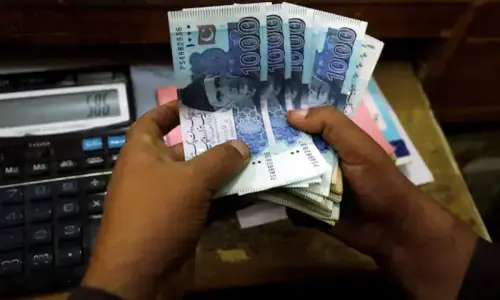
Owing to a near economic collapse faced by the country, currency devaluation became necessary. It was a very difficult decision but it was taken and the currency devalued.
ZAB has been much maligned for his economic policies and nationalisation programme. Pakistan was ruled by the famous 22 families who held complete monopolistic sway over the economy. Together they owned the industries and the banks, disbursed loans to each other and controlled the means of production and supply. The poor were becoming poorer. They were without a voice, without hope, without a future.
(To be concluded)
| © DAWN Group of Newspapers, 2007 |