MMA and the NSC
The MMA's boycott of the inaugural session of the National Security Council remains a sort of a 'riddle inside an enigma'. How would the MMA be able to reconcile its support of the passage of the controversial (and basically undemocratic) Legal Framework Order (17th Amendment) with its boycott of the NSC - an integral part and off-shoot of the LFO? Regardless of polemics, the MMA marshalled its parliamentary vote for the LFO as an expedient pro-democracy measure, irrespective of the fact that the LFO tended to violate both the letter and the spirit of the Constitution.
How can a popularly elected parliament through a joint session at all allow an elected president to stay in his military uniform as army chief even for a short period of time? Ayub, Yahya and Zia all forged devices like LFOs and 'Continuance in Force' laws to legitimize their regimes by an extra-parliamentary executive fiat.
Ayub Khan and Ziaul Haq had their parliaments indemnify their constitutional violations to close the chapter of their coups. Only Yahya ended with his boots around his neck as a vanquished general.
Pliant and muted through Yahya's disastrous reign, the superior judiciary came into action only after his fall to brand him a 'usurper'. Never before, however, it fell to the sad lot of an elected parliament to vote for an army chief to combine in his person the brass and the bowler hat even as an expedient move.
Political pragmatism is not the same as party or individual opportunism. While the pragmatist knows where to stop, the opportunist fails to resist the fatal attraction of yet another chance, yet another pasture new around the corner.
The MMA's supreme council must ask itself whether or not by supporting the passage of the LFO they did indeed commit a terminal error of judgement. And whether they did not sacrifice their reputedly principled party politics at the altar of expediency and opportunism.
Worse still, they did so at the cost of the united front they had forged with such mainstream parties as the PPP and the Muslim League-N. A major compromise was made with Gen. Pervez Musharraf's regime, now invoking the NSC as the main plank of its future governance.
If such were to be the end of the military-mullah alliance, it should not be difficult to see who is the loser. The nexus has been a part of our history, either marginally as under Ayub Khan or covertly as under Yahya Khan or naked and deeply written into the system as under Ziaul Haq.
Ayub's secularism as part of the military culture of British Indian Army was like an open book without any fine print. Even the prefix Islamic attaching to the Republic of Pakistan was dropped until restored under the writ of superior judiciary.
That continued to be the case until the fateful day of 1965 when India attacked Pakistan along the international border, with Lahore as its principal target. Even in his first address to the nation within hours of the Indian invasion, Ayub went on to recite the 'Kalama-i-Tayyaba' in a stirring, emotion-choked voice.
His subsequent meeting with religious parties - mainly the Jamaat-i-Islami under Maulana 'Abul 'Ala Maududi - marked the beginning of the military-mullah nexus. Yahya would not have much to do with things spiritual until the induction of retired Maj.-Gen. Sher Ali Khan into his cabinet as minister in-charge of information and national affairs.
He initiated Yahya into ideological lore and saddled him with the mission of protecting the 'ideology of Pakistan and the glory of Islam'. Yahya's intelligence chief, Major-(later Lieut.) Gen. Muhammad Akbar Khan made no secret of his close liaison with the Jamaat-i-Islami especially in respect of its pro-active role in East Pakistan.
The Jamaat was to go even to the extent of certifying Yahya's draft constitution as Islamic. The draft was authored by Justice A.R. Cornelius, Yahya's law minister. As for Zia, he embarked on his Islamization programme even as he assumed his army command.
He gave the army the triple motto of 'Iman, Taqwa, Jihad fi Sibil Lillah'. Subsequently, as president, he introduced the Hudood Ordinance and collaborated with the Americans in projecting the Soviet-Afghan war as a jihad. The country continues to pay the bitter wages of Zia's jihad syndrome.
Gen Musharraf continued to recognize the Taliban's radical Islamic regime as a legacy of the Nawaz Sharif period and extend muted support to the Kashmiri mujahideen until 9/11.
That was the turning point and the defining moment for the future shape of relations between a para-secular government on the one hand and jihad-oriented, religious groups on the other.
Musharraf relented on his temporal stance vis-a-vis the religious group under the pressure of political necessity during the general election of October 2002. He placed the mullahs at par with university graduates to qualify for membership of his 'graduate' assembly.
The mullahs returned with strength sufficient to form coalition governments in the NWFP and Balochistan. Once in power they gradually and subtly clanged their religion-based stance into realpolitik where it suited their interest.
They supported the LFO to extract from Musharraf the promise that he would shed his uniform by the end of 2004. However, when it came to endorsing the NSC by an act of parliament, they abstained from voting.
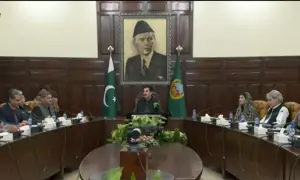
Hence the present crisis. The MMA's Supreme Council, in no uncertain terms, declared its resolve to 'scrap' the NSC when it 'obtains a simple majority in the house'. The inaugural session of the NSC (June 24) was off to an unhappy and not a little ill-tempered start.
Chairing the session, the president was livid over the absence of the leader of the opposition, Maulana Fazlur Rahman, and NWFP Chief Minister Akram Durrani. He took particular note of the latter absenting himself as a government functionary - a somewhat strange observation to make about an elected public leader with a party mandate of his own.
The president spoke spiritedly and at some length on the rationale and functions of the NSC. Prior to the NSC, he said, there was no forum where 'key functionaries' including the opposition, provincial heads and armed forces chiefs could debate issues of national importance and 'exercise checks on each other and lend support to each other'.
Of course, the defence committee of the cabinet (DCC) was always there, but hardly as a body as comprehensive as the NSC. The question now is: what other body could be either more comprehensive and competent to discuss and resolve all issues of national importance than an elected parliament? Even in the context of a best-case scenario, it won't be easy to rule out a perpetually difficult relationship between parliament and the NSC.
- The writer is a retired brigadier of the Pakistan Army.
Keeping literary scene alive
A silence has settled on the literary zone of Karachi, partly because of the hot and humid weather and partly due to the law and order problems encountered almost daily by the citizens.
But the city is fortunate to have small cultural units such as Bazm-i-Adab and Halqa-i-Fikro Danish - in New Karachi, Federal B Area, Landhi, Malir, Drigh Colony and many other areas.
These organizations continue to slog on in the most trying of circumstances and manage to hold mushairas and literary sittings at weekends. Some popular poets are much in demand. After reciting a ghazal at one place, they rush to the other end of the city to participate in another mushaira. In this way, the poets keep the literary scene alive.
One literary body, Halqa-i-Fikr-i-Jadeed, even chose a weekday (Wednesday) to hold a mushaira in honour of a poet from the Northern Areas who was returning home the very next day.
Saima Ali, with a published poetry collection to her credit, is a teacher of mathematics at an institute. She recited her fresh ghazals, which drew applause from everyone, with her emphasis on the uncertainties of life and the unjust world order.
Other poets also took part in the evening's proceedings. Rehana Ehsan recited the following lines:
Ya rab ab mein zinda rehna chahti hoon
Merey ghar mein phoolon jaisey bachey haen
A couplet from Salman Siddiqui was much admired:
Yeh shaher hai ke koee zakham hai lagaya hua
Yeh zakham hai to issey indimal chaheye hai.
Appropriate advice to those in power came from Qamer Jamali:
Masley hal naheen hotey sharar afshani sey
Dil jhulas jatey hein nafrat ki farawani sey.
Mushairas have developed a strong institutional base. In a recent interview with an Urdu weekly, poet Wasim Barelvi spoke of how he kept himself awake in mushairas 20 to 23 nights a month. The practice, he said, he had been following for the last 35 years.
Thus, roughly three-fourths of Wasim Barelvi's conscious life has been devoted to mushairas. That at least testifies to the stamina of our mushaira poets. They also serve Urdu as they carry its message to the farthest corner of the world and thus expand the area of its popularity.
Whether this is contributing to the scope and richness of the language is a different question. Urdu continues to lack a strong economic and social base, and while poetry has its appeal, we need Urdu books on sociology, physical sciences and current affairs.
Something else that Wasim Barelvi said in the interview needs to be noticed. He said somewhat proudly that he had found his place in literature not through 'chai khanas' and 'qehva khanas', but through libraries.
His derisive assessment of tea houses and coffee houses may not be true. These have served as cultural centres in cities the world over, including Pakistan and India, and have stimulated intellectual activity.
In fact, the gradual disappearance of such cafes in our cities as gathering places for writers, poets and artists should be seen as one of the factors responsible for the decline in creativity and informed debate.
Coffee houses in Lucknow, Allahabad, Delhi, Lahore and Karachi of yore had their own fascination, intellectual charm and grace, adorned by the presence of poets, university teachers, politicians, actors and bureaucrats. Exchange of ideas among them, followed by heated arguments and light banter, provided a link between literature and the real life.
Lahore's Tea House over the years became an institution in itself. Nasir Kazmi, Ejaz Batalvi, Shohrat Bokhari and in later days Habib Jalib and Safdar Mir had enlivened the place with their presence.
Karachi's Coffee House had a short life. It was eaten up by the vicious and rapid growth of commercialization in the city, particularly in Saddar. The late story writer and television producer Hameed Kashmiri wrote a nostalgic play under the title of Coffee House about those days - days now almost forgotten, like the Coffee House itself.
* * * * *
Shansur Rahman Farooqui has been very much in the news lately. A revised edition of his book - Afsaney ki himayat mein - has just appeared in Karachi. Another, a collection of his letters, titled Shams-i-Kabir, has also been published. The letters were addressed to Kabir Ahmad Jaesi.
A poetry collection, Harf harf aaena, by senior poet Parveen Haider has also been recently published with comments from many stalwarts - Dr Farman Fatehpuri, Dr Pirzada Qasim, Prof Afaq Siddiqui, and others.
It seems most authors and poets are not always confident of themselves and want to have their success testified by winning favourable comments from the maximum number of colleagues.
* * * * *
Short story writer Ahmad Yusuf was in the city from India. Author of four story collections and a collection of reportages, he had visited Karachi a few years ago when in a small circle of writers, he had read out his story 'Aag ke hamsai' based on Indra Gandhi's emergency rule. It is a symbolic story, its contents craftily woven in simple prose, the author's hallmark.
Ahmad Yusuf began his writing career in 1947-48, when the progressive writers movement was at its peak. In 1960, he was one of the active members of the modernist movement. He was the guest at a couple of functions held in New Karachi.