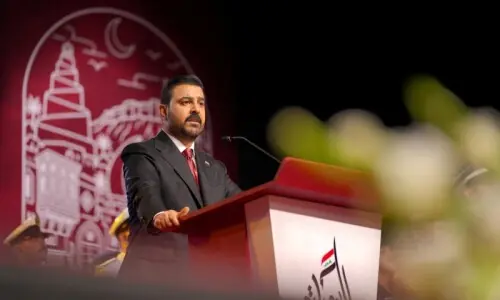
KARACHI, March 14 Recalling the strange life, turbulent times and epic death of Mansur al-Hallaj - the tenth century Muslim mystic sent to the gallows for professing beliefs deemed heretical by the rulers of the day - religious scholar and columnist Dr Muzaffar Iqbal told a seminar held on Saturday that the message and teachings of Hallaj and those of his fraternity are as relevant today as they were a millennium ago.
The Canada-based scholar was delivering a lecture titled 'The legacy of Hallaj love, martyrdom and poetry' at the Sindh Institute of Urology and Transplantation. The event was organised by the SIUT's Centre of Biomedical Ethics and Culture as part of its Ethics and Culture Hour.
Dr Iqbal described in vivid detail the events leading up to and including Hallaj's execution, at Baghdad's Bab-i-Khurasan on the banks of the Tigris. The scholar said he would not discuss the aspects of Hallaj's spiritual stature during the lecture as such talk was more suited to gatherings of Sufis, otherwise it could be misinterpreted by the uninitiated.
He talked about Hallaj's impact on Urdu, Arabic, Farsi, Sindhi, Pashto, Bhasha, Turkish and other languages, as the scholar claimed many of the languages spoken in the lands of Islam owed a debt to the iconoclastic Sufi. Dr Iqbal also touched upon aspects of the Divan-i-Hallaj - which he has also translated.
It should be mentioned that Dr Muzaffar Iqbal heads the Centre for Science and Islam in Canada and edits a journal titled Islam and Science, while also contributing a weekly column to a Pakistani English-language daily. Though holding a doctorate in chemistry, he is better known for his work in the spheres of religion and literature.
The scholar started by touching on the details of the mystic's gory death (which is said to have occurred on March 26). “At the time, Baghdad's population was 1.5 million. A massive mob had gathered to witness the execution of Hallaj at the Bab-i-Khurasan. This was an incredibly motley crew. There were viziers, Sufis, Ulama and common people present. None of them were aware of Hallaj's true stature.”
Dr Iqbal said that after a hurriedly conducted trial, the Sufi's death warrant was signed by the Abbasid caliph of the time. Dozens of witnesses had testified against him, including many Muftis and divines. Hallaj was accused of trying to topple the caliph; since the caliph was considered the vicegerent of God, the offence was akin to blasphemy. “They said his beliefs had become corrupted, that he had become a Batini. The Batinis were considered terrorists of their time.”
Recounting the period before Mansur al-Hallaj's execution in 922 AD, Dr Iqbal said that nine years earlier, the mystic had been tried and sentenced in another case, for which he was imprisoned in the royal dungeon until his death at the gallows by the Tigris. “By imprisoning him in the royal dungeon, the authorities wanted to give him an 'exemplary punishment'. Interestingly, while he was incarcerated the caliph's own mother became his disciple.”
He recalled that most of Hallaj's writings date back to his period in incarceration and his work was said to be smuggled out of the dungeon by his disciples.
Moment of truth
Dr Muzaffar Iqbal said that it was a spiritual change the mystic experienced after his third Haj that emboldened him to publicly protest against injustice and which attracted the ire of the powers that were.
“During his third Haj, on the day of Arafat, he felt his self was extinguished to subsist forever in God. When he reached Baghdad, he started preaching against the injustices prevalent in the system. Because of the threats he received he had to flee and took refuge in Khurasan.”
Dr Iqbal recalled that in reply to one of Hallaj's questions, revered Sufi master Junayd Baghdadi asked him to be careful and warned him that the gallows would one day be smeared in his blood.
“Hallaj was one of those Sufis who lost themselves in the ishq of Allah. When he said 'Ana al-Haqq' (I am the Truth!) ... if this was indeed a sinful statement and a sign of apostasy, why did the revered Sufis not distance themselves from Hallaj? If you want a reference about a doctor, you ask another doctor. So when you want to find out about a Sufi, you ask another Sufi,” said the scholar.
He said that Hallaj was a great muhaddith (scholar of Hadith) as well as a Hafiz-i-Qur'an. “Hallaj was deeply attached to the Holy Prophet (Peace be upon him) and to Allah. In the Kitab at-Tawasin there is a beautiful na'at which is proof of his aqeeda,” Dr Iqbal said, while reading out a few lines of the na'at. “If you read it in Arabic, you will feel the Noor-i-Muhammadi (PBUH) light up your hearts. Can such a man be an apostate?”
The scholar added that in the Sufi tradition, great emphasis is laid on the opening of hearts, which is different from appealing to fahm and the mental faculties.
“Some people are drawn more towards intellectual arguments, hence they are attracted to mystics like Junayd. Others are prone towards mohabbat. But Hallaj is a guide for those who want to traverse the purely spiritual path.”
As for Hallaj's contribution to poetry, Dr Iqbal said that the masters of Urdu verse such as Allama Iqbal, Mir and Ghalib have all been inspired by Hallaj, as have been poets of Arabic and Farsi. “The symbol of the parwana (moth) was first used in the Islamic era by Hallaj in his poetry. The moth is drawn towards the fire, encircles it and finally destroys itself within the flame.”
The scholar read out excerpts of Qasidas in Arabic - accompanied by their Urdu translation - from the Divan-i-Hallaj. “One should ponder over these words. There is great sorrow in his Divan.”
Dr Muzaffar Iqbal ended the lecture by urging the audience to seek the treasure of knowledge safeguarded by the mystics.
“Hallaj has spoken of 40 stations the soul passes through before life and after life. Just as a doctor knows about the state of the body, Sufis know about the state of the soul. The journey of the soul is the real journey. Ask those who know.”—QAM