0
0

 CENTRAL IRAQ, March 28: The United States unleashed huge “bunker-buster” bombs on Baghdad on Friday in some of the most savage air strikes of the Iraq invasion, and prepared to throw another 120,000 troops into a fight which a top commander acknowledged that war planners had misjudged.
“The enemy we’re fighting is different from the one we’d war-gamed against,” the US army’s senior ground commander in Iraq, Lt Gen William Wallace, said in an interview with the Washington Post.
Overextended supply lines combined with unconventional Iraqi tactics made a longer war look likely, he said at a base in Iraq in the bluntest remarks by a US commander on the war so far. With any hopes of a quick victory dashed, the Pentagon said on Thursday it planned to more than double its troop strength in Iraq, committing another 120,000 soldiers on top of the current 90,000.
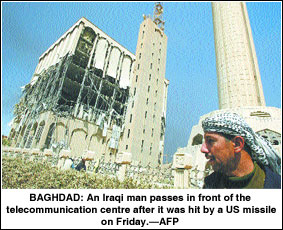
Defence officials said a radar-avoiding B-2 stealth bomber had dropped two earth-shattering 2,086-kg bombs on a communications centre in downtown Baghdad.
It was the first use of the bunker-busters on Baghdad since the invasion began nine days ago.
Two communication centres were damaged in the bombing. One big building had been struck at its base. A tangled pile of smouldering rubble was all that was left of a smaller facility. Many telephone lines were knocked out.
Defiant Iraqis converged on mosques for Friday prayers, enraged rather than cowed by the US bombardment.
“You can see and hear the missiles and bombs raining down on us and yet Muslims are coming to the house of God to pray,” said the imam at the “Mother of All Battles” Mosque.
In the second week of a campaign that has seen US-led forces drive quickly to the doorstep of Baghdad but leave behind serious resistance in the south, planners faced daunting logistical problems.
“The long distances we have travelled make it hard to push that amount of logistics — water, fuel, ammo and chow — over the vast area that’s been covered,” said marine First Lieutenant Tom Elssinger.
The US Central Command, which is directing the war effort, insisted the operation was on track and pointed to the rapid progress made toward the capital in the drive to remove President Saddam Hussein.
The US army’s Third Infantry Division, backed by the 101st Airborne Division, was as close as 80kms south of Baghdad, while marines advanced north in two prongs between the Euphrates and the Tigris rivers.
Waiting for them around Baghdad were at least three divisions of the Republican Guard, Iraq’s best trained and most loyal forces, who were dug in defending the approaches to the city to the south, southeast and northwest.
US-led air strikes battered the Baghdad area with bombs and cruise missiles again on Friday, hammering communications sites and the Republican Guard troops guarding the capital.
BASRA: British forces had their hands full in the southern port of Basra, where they accused Iraqi militia of shooting at civilians trying to flee in their hundreds.
“The Black Watch are engaging them and doing their best to protect the civilians,” Flight Lieutenant Peter Darling said, referring to a Scottish regiment.
Lt Darling could not say how widespread was the alleged shooting. There was no immediate word on casualties.
Another British spokesman Major Will McKinlay said that centres were being set up on the outskirts of the city to provide food and water to the “hundreds” of fleeing civilians who would be given safe passage.
US forces have encountered stiff resistance and atrocious weather that has significantly slowed the advance anticipated by military planners and placed a heavier burden on supplies coming up from the south.
Around the central-southern cities of Najaf, Nasiriyah and Al Samawa, Iraq had deployed thousands of militiamen who were “fighting tenaciously”, said one officer with the Third Infantry Division.
He said the drive north had been delayed by a day because troops had to be deployed around Najaf to prevent more reinforcements from flowing in.
NORTHERN FRONT: Iraqi Kurd rebels also advanced on Friday to within 16kms of the northern oil capital, Kirkuk, in the first major movement on the northern front against Baghdad, their commanders said.
Fighters from the Patriotic Union of Kurdistan (PUK) claimed capturing the town of Qarah Anjir, situated in hills to the east of Kirkuk.
“The Iraqi army is finished. They were ordered to pull back to defend the city,” Rostam Hamid Rahim, a top PUK commander, told reporters, adding that his forces were determined to seize Kirkuk, despite the risk of angering Washington and especially Ankara.
But the Iraqi forces near Kirkuk were quick to signal that their battle was not over.
A salvo of around 10 rockets slammed into Chamchamal, east of Qarah Anjir, injuring at least one person.
Also on Friday, thousands of PUK fighters backed by US special forces swept into territory held by Ansar-ul-Islam, a hardline group allegedly linked to the Al Qaeda network, Kurdish officials claimed.
MISCALCULATION: Two leading US dailies, the New York Times and Wall Street Journal, said on Friday the war in Iraq was in trouble because of miscalculation, too much restraint and failure to assemble an overwhelming force at the outset.
“The Bush administration misread the Iraqis,” the Times said in a military analysis, criticizing what it said was a war plan that counted on the Iraqis opting for an “urban-centric” defence around Baghdad.
“What the Pentagon did not understand was that the Iraqis planned to expand that strategy to include Nasiriya, Najaf, Samawa and other towns in southern Iraq,” the paper said. —Reuters/AFP