0
0

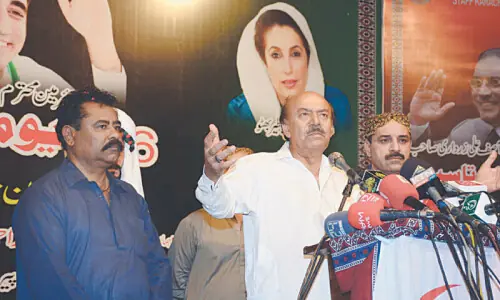
KARACHI, Feb 28: Speakers at a seminar on Friday demanded of the government to immediately repeal all discriminatory laws and declare parallel systems like jirgas, panchayats, etc., illegal.
They were speaking on the concluding day of a two-day seminar on the United Nations’ Convention on Elimination of all forms of Discrimination Against Women (CEDAW), organized by the Aurat Foundation.
“The government should bring all laws in conformity with the CEDAW, which it has signed, as Pakistan is bound to make all laws in accordance with the international convention,” they observed.
Justice (retired) Shaiq Usmani urged the civil society organizations to lobby with the women parliamentarians so that they could take a unified stand, regardless of their party affiliations, in the parliament whenever an issue relating to women was taken up.
He said that under the new laws domestic violence could now be tried by the family courts as the judges have been given the powers of the first-class magistrate, who can fine and imprison a violator.
He said that the family courts could direct a husband not to sell his property till the case was decided, while earlier when a court decided against a man and directed him to pay some amount to his wife, he used to sell all his property before implementation of the law and the woman could not get the share.
Justice Usmani was of the view that under the new laws the procedure to get Khula” (a woman’s right to divorce) had been made easy and women have been provided relief and now they can get khula easily.
He said that many cultural and social traditions were being practised under the garb of religion, but it would need a long time and struggle to change these centuries-old traditions.
Other speakers urged the government to sign the Optional Protocol of the CEDAW and said that after signing the protocol the government would become accountable to the committee, which could ask it against any violation of the CEDAW.
At present the government has reservations on at least two points in the CEDAW: one is its provisions should be in accordance with the constitution while the other is that under the cover of the convention a state could take another country to the international court by making a complaint against a violation of the CEDAW, they maintained.
The speakers said that many countries had expressed reservations on the second point as they felt that any country would take another, whom it opposed on various matters, to the court just to settle old scores.
They suggested that awareness campaign be launched at a large scale so that the masses and, in particular, the decision-makers become aware of these issues.
Shagufta Alizai, Nighat Shirin, Yunus Khalid, Shahid Fayaz and others also spoke. Representatives of civil society organizations, NGOs, political parties and parliamentarians were present.