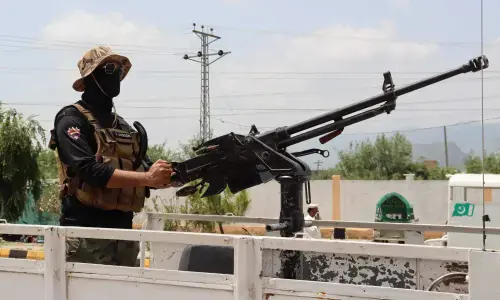
AFTER a brief lull in the attacks against the state and the security apparatus, the violence has picked up again. Yesterday's devastating fidayeen-cum-suicide attack on a high-security Rawalpindi mosque frequented by military officers is a sign that while the counter-insurgency operation in South Waziristan may have notched up some military successes, the fight against militancy is far from being won. Several points need to be made. First, the security forces must launch an enquiry into what appears to be a breakdown in security measures. That half a dozen militants reportedly entered the premises of the mosque around the Friday afternoon prayer time is inexcusable. It is not just that there has been a terrible loss of life as a result, but also the fact that the militants execute such operations as much for the psychological impact as the physical toll. Senior army officers and their relatives being killed in a high-security area sends a terrible signal nobody anywhere is safe. Fear of that kind can be fatal to long-term success against the militants.
Second, the outside world needs to recognise that Pakistan is locked in a bloody fight against militants and therefore the 'do more' refrain needs to be tamped down. In these columns, we have repeatedly warned the security establishment here that any 'good Taliban/bad Taliban' distinction needs to be dropped for the long-term security of the country. But the outside world must acknowledge the limitations of a sub-optimal state fighting a hydra-headed enemy. Putting pressure on Pakistan to fight X group of militants when it is already struggling to defeat Y can risk losing the war against both X and Y.
Third, the US needs to think very carefully about the impending expansion of its drone operations inside Pakistan, as reported in The New York Times yesterday. The potential benefits of Pak-US collaboration on the drone programme to take out militants in Fata causing trouble for both sides are real. But so are the dangers of the US squeezing Pakistan to accept a rapid escalation in the strikes and expanding the target area from South and North Waziristan to other parts of Fata, and perhaps even Balochistan. A public and/or political backlash against expanded strikes could create further instability in the country. And American pressure on the drone programme could affect military cooperation in other areas, further complicating counter-insurgency operations in the two countries. Frustration and unhappiness in both the American and Pakistani camps should not overshadow a basic reality the two sides need one another if they are to defeat the militants.