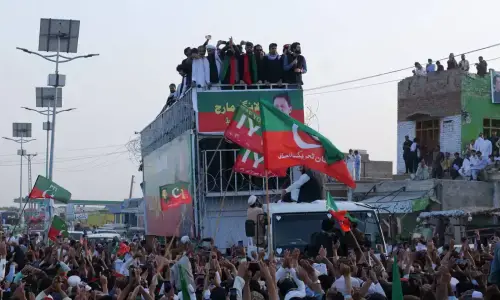
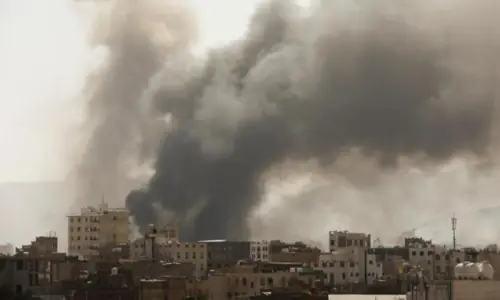
DHAKA: Bangladeshi police broke up a protest by tens of thousands of religious hardliners and shut down an Islamist television station Monday after 32 people died in some of the fiercest street violence for decades.
Hundreds more people were reported injured in running battles as riot police broke up the rally near a key commercial district in a pre-dawn raid.
Dozens of demonstrators were also arrested, while the leader of the protests was put on a plane to the second city Chittagong.
Hundreds of bankers, insurance officials and stock market traders had to sleep in their offices as the sound of gunfire echoed around the Motijheel Commercial Area through much of the night.
Shops and vehicles were set alight while the roads were littered with rocks that protestors had thrown at police, witnesses said.
Police said they used sound grenades, water cannon, tear gas and rubber bullets to disperse at least 70,000 Islamists who were camped at Motijheel as part of a push for a new blasphemy law.
“We were forced to act after they unlawfully continued their gathering at Motijheel. They attacked us with bricks, stones, rods and bamboo sticks,” Dhaka police spokesman Masudur Rahman told AFP.
The protesters dispersed early Monday, he added.
Mozammel Haq, a police inspector at Dhaka Medical College Hospital, told AFP that 11 bodies were brought to the clinic, including a policeman who had been hacked in the head with machetes.
A total of 21 other people were killed in the protests, according to an AFP toll compiled through police and medical officials.
This included eight people killed in the Kanchpur district on the southeastern outskirts of Dhaka, said the sources.
At least two people were known to have been killed in the southern coastal district of Bagerhat where police exchanged gunfire with several thousand Islamists, police spokesman Shah Alam told AFP.
A pro-Islamist television channel which broadcast live footage of the raid on Motijheel was meanwhile forced off the air in a dawn raid.
Diganta Television’s chief reporter M. Kamruzzaman said around 25 plain-clothed policemen and an official from the broadcast commission had entered their studios without warning.
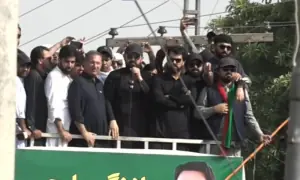
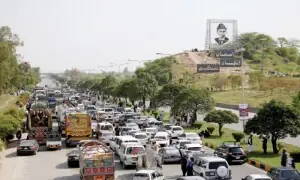
The violence erupted Sunday afternoon after police tried to disperse tens of thousands of Islamists who had blocked major highways in Dhaka.
The protests had been instigated by Allama Shah Ahmad Shafi, the leader of Hefajat-e-Islam who is said to be around 90 years old.
Police managed to persuade Shafi on Monday to leave his madrassa in Dhaka, escorting him to the airport from where he was to be flown to Chittagong.
In a sign of their desire to avoid inflaming tensions, police insisted he had not been arrested but was leaving of his own volition.
Prime Minister Sheikh Hasina has ruled out a new blasphemy law, insisting she will not cave into the demands of hardliners who have been infuriated by bloggers whom they accuse of insulting the Prophet Mohammed.
Chanting “One point, One demand: Atheists must be hanged”, activists from Hefajat-e-Islam marched along at least six highways on Sunday, effectively cutting Dhaka off from the rest of the country.
Police said the number of protesters reached around 200,000 people at one point although the numbers had dwindled by the early hours.
Social media networks were inundated with photos of bloodied Islamists lying on the streets after the crackdown.
The main opposition Bangladesh Nationalist Party, which had given its backing to Hefajat’s Dhaka blockade, on Monday accused the government of “killing hundreds of people and concealing the bodies” but gave no proof.
Fearing further violence, Dhaka police Monday banned all protests as well as the carrying of firearms until midnight.
Bangladesh, an officially secular country with a 90 percent Muslim population, has seen a surge in violence between Islamists and government forces since the start of the year, when a court began handing down war crimes verdicts related to the 1971 independence conflict.
Three leading Islamists have so far been convicted for their role in mass killings during the conflict, which saw what was then East Pakistan break from the regime in Islamabad.
The overall death toll in violence between religious hardliners and the police since January now stands at around 150.