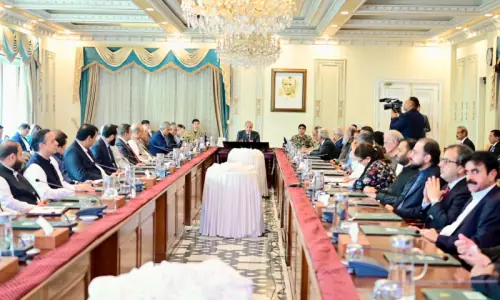
ISLAMABAD, March 14: At a roundtable conference organized by a Pakistani think tank and a Chinese university on Thursday, speakers insisted that Gwadar port be seen as a “commercial venture”, rather than a strategic or military exercise between Pakistan and China. Much of the discussion, however, focused on its strategic and political implications.
A Chinese analyst, Professor Zhuo Rong, clarified that there was ‘no threat’ to Pakistan's ownership of the port. “Gwadar will always be a Pakistani port, even 500 years from now,” he said.
To boost trade and economic links with China, however, a Karakoram pipeline and Karakoram rail link would have to be built, as the professor mentioned when congratulating Pakistan for moving forward on the Iran pipeline project.
“China wants to see a strong, stable and prosperous Pakistan - and more Pakistanis learning Chinese,” he continued. He claimed that Gwadar was an opportunity for Pakistan to prove itself a ‘role model’ for Asia, as it had been in the 1960s, when its banking and aviation sectors were influential.
Organised by the Institute of Policy Studies in Islamabad and the Pakistan Study Centre at Sichuan University, in Chengdu, China, “Gwadar: Current Status and Future Prospects” gave experts from both countries the opportunity to express their confidence in Chinese management of the port.
They insisted that China's role was strictly managerial: “If China were interested in having a strategic presence in the Arabian Sea, it could have gone with an easier option, like the Ormara Naval Base,” some said, hinting that those claiming otherwise might be trying to “undermine the potential” of the port.
Domestic politics were also brought up, as speakers criticised both the current government and its predecessor for ‘wasting time’ during the years when Gwadar management was a Singaporean responsibility. “They should have handed the port over to the Chinese earlier,” speakers said.
Khalid Rahman, the Director General of IPS, maintained that if handled with ‘wisdom and dedication’, the port project would have a significant impact on the country's development and security, and in particular on Balochistan's.
The economic and commercial implications of the Gwadar project were never ignored.
Azhar Ahmed presented a survey of its ‘historical and geo-strategic influence,’ noting that Pakistan's constant neglect of its maritime sector had had a detrimental impact on both.
“Gwadar is close to the Persian Gulf and 60 percent of the world's oil trade,” he said. “It overlooks strategic communication lines. In the event of strategic threats, Gwadar is not as vulnerable as others.”
While several reports have discussed the port's economic viability, infrastructure and connectivity threaten to derail its progress.
A lack of local expertise, competition from other regional ports, lack of government funds, and the ‘law and order’ situation in Balochistan were all mentioned as challenges to the project.