ISLAMABAD, Dec 11: The National Assembly’s Standing Committee on Law and Justice approved on Tuesday the controversial fair trial bill with a majority vote despite its opposition by the Pakistan Muslim League-N and the ruling coalition partner Muttahida Qaumi Movement.
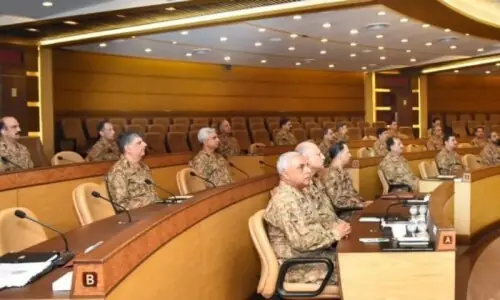
Ignoring a demand of PML-N members for incorporation of 31 amendments proposed by them into the bill, committee’s chairperson Nasim Akhtar Chaudhry of the Pakistan People’s Party announced passage of the bill with a majority vote, prompting a noisy protest by PML-N members Zahid Hamid and Anusha Rehman.
Earlier, MQM’s member S.A. Iqbal Qadri surprised the committee members when he submitted a written note expressing serious reservations over certain clauses of the bill and advising the ruling party to talk to the MQM leadership on the issue.
It is the first time that the MQM has opposed a bill that has been under discussion of the committee for many weeks. In fact, the last meeting of the committee was presided over by Mr Qadri in the absence of the chairperson and the law minister.
The federal cabinet had already approved the “Fair Trial Act, 2012” in September which the government argues will allow investigations by law-enforcement agencies and security agencies “by modern techniques and devices” in the cases related to terrorism.
The bill has become controversial because certain quarters feel that it will pose a serious threat to people’s privacy. If passed, it will authorise the state to tap people’s phone calls and intercept all other private communications in order to catch terrorists.
But the government claims that “existing laws neither comprehensively provide for nor specifically regulate use of advanced and modern investigative techniques such as covert surveillance and human intelligence, property interference, wire tapping and communication interception that are used extensively in other countries, including the US, the UK and India”.
Emails, SMSs, phone calls and audio-visual recordings will be admissible evidence while suspects will be held for six months after a warrant issued by a high court of the province on the request of the heads of five security and intelligence agencies.
Mr Qadri of the MQM told the committee that his party feared that the bill could be misused by security and intelligence agencies for political purposes. He said the bill could affect the fundamental rights of citizens as enshrined in the Constitution. His main contention was that the bill did not contain a proper definition of “terrorism” and, therefore, it provided vast powers to security and intelligence agencies to pick up a person at their will.