3
3
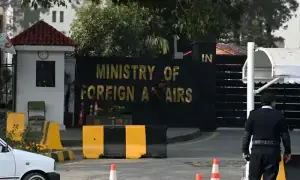
IN addressing the issue of barricades being placed on public roads, Justice Sarmad Jalal Osmany was driven to adopt an acidic tone on Tuesday in Karachi. And why not, for this has become a detestably common and inconveniencing tactic. Justice Osmany directed the bulk of his ire towards Bilawal House, the Karachi residence of President Asif Ali Zardari that has swallowed up three lanes of a much-used artery. Yet, particularly in Islamabad and Karachi, citizens are impeded in their passage across their city by bollards, barricades, walls and barbed wire ‘protecting’ the residences and workplaces of politicians, senior government functionaries, diplomats, police, army officers, etc. Some roads have been off-limits for so long that they have dropped out of the public’s consciousness — Islamabad’s Constitution Avenue or the portion of Aabpara Road serving the ISI headquarters and the CDA building are examples.
Without doubt, the threat leading the authorities to curtail access is very real. The militants demonstrably seek to strike wherever they can — any and all venues are kosher, the more high-security the better. Equally true, across the world the movement of those in high office or those who are potential targets for other reasons is accompanied by impediments in the movement of ordinary citizens. Crucially, though, such measures are not permanent. In Pakistan, by contrast, we’ve turned ‘security needs’ into a form of high art that involves increasing encroachment on citizens’ freedoms — the very citizens who continue to lose so much to the terrorists. Yet why should we blame those in high office only? Citing similar reasons, in affluent areas across cities, citizens have through mutual agreement cordoned off entire localities with barricades and have employed private security to ensure that no one of the ‘wrong sort’ gets in. While it is true that the law-enforcement apparatus has failed to control crime in the same way that it has been unable to curb terrorism, the solution does not lie in making it an ‘every man for himself’ situation. The solution lies in building pressure on the state and its mechanisms to substantially improve security.