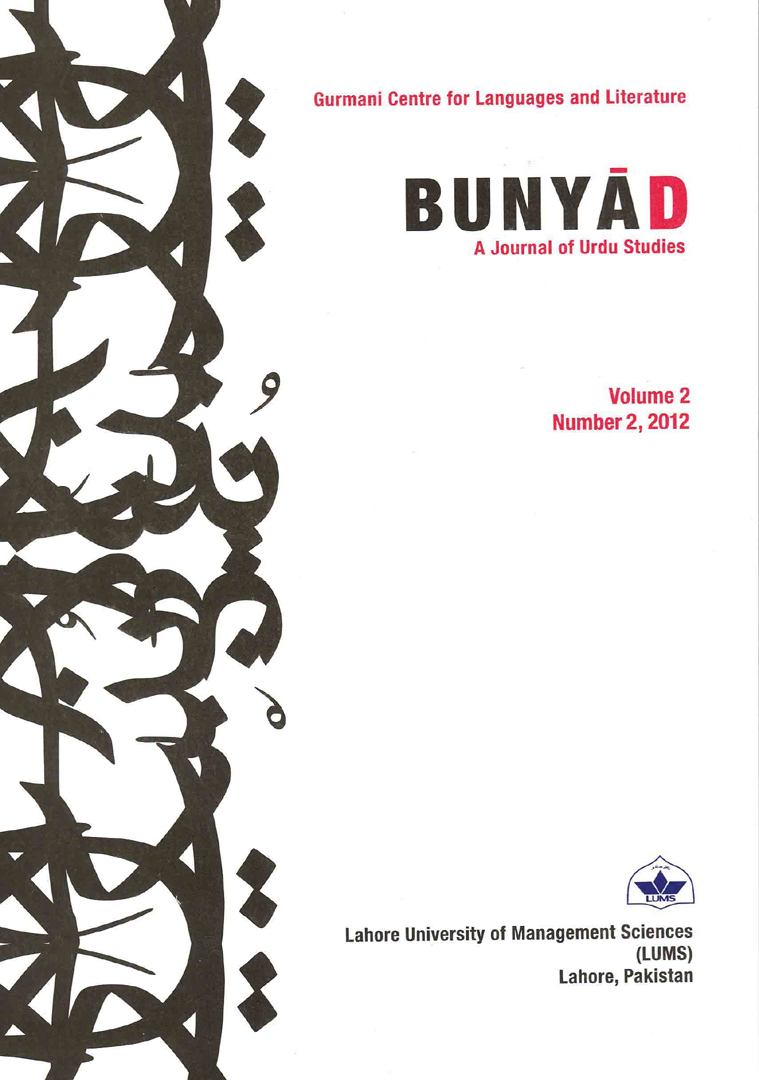
The Lahore University of Management Sciences (LUMS) publishes a bilingual (well, mostly it’s in Urdu) literary magazine called Bunyad: A Journal of Urdu Studies, edited by Syed Nomanul Haq.
The edition under review, Vol. 2 No. 2, 2012, has some very interesting and readable articles. Bunyad is an Urdu word usually understood as the ‘basis’ or ‘foundation’ for something to build on. It also means ‘to begin’. This is precisely what the magazine wishes to achieve; not in the sense that it contains articles of elementary nature but in the sense that it touches on the very basic issues pertaining to literature.
The first piece in the latest edition of Bunyad is by the literary giant of modern Urdu criticism, Shamsur Rehman Farooqi. And what, rather who, is it about? Well, none other than Mir Taqi Mir. Imagine the combination of Mir and Farooqi, a top-notch poet and a critic right out of the top drawer. Result: a quality work of criticism.
Farooqi doesn’t directly talk about Mir in his commentary. Rather, he opts for a roundabout way and starts his arguments by suggesting that finally Mir is coming back into the literary limelight. He argues that while, almost inevitably, in comparing Mir with Ghalib we tend to suggest that the latter appeals to the modern mind, it is not a valid assumption. Eventually it is history that decides who fits into modern sensibilities and who does not. We tend to air our own opinions whereas what really matters is history’s standpoint. No one knows if history, in the time to come, will declare Mir as a more modern poet than some others. In doing so, Farooqi never gets irreverent towards any of the masters. He remains as respectful towards them as he is to Mir.
Farooqi then sheds light on the abstractions found in Mir’s poetry. In that context he cites examples from ghazals by different classical poets who, before or after Mir, elevated that art to a sublime level. And Mir’s distinction too is beyond debate.
If this stuff sounds a bit heavy in terms of content, a delightful research by Imran Zafar titled “Tahreefaat-i-Kalam-i-Iqbal” provides the reader the opportunity to tackle an important subject in a relatively lighter vein. It is a critical study of the humour-laden poems inspired by Allam Iqbal’s poetry or parodies of his poems. As expected, after giving the background to such tehreefat (parodies), the first poet that the author discusses is Akbar Ilahbadi. He quotes the following lines which alter the original Iqbal version of “Saare jahan se achha Hindustan hamara”:
College mein ho chukka hai jab imtihaan hamara
Seekha zaban se kahna Hindostaan hamara
Raqbey ko kam samajh ker Akbar ye bol uthe
Hindostaan kya hai, saara
jahaan hamara
(Only after taking a college exam
We learned to pronounce Hindustan
Considering the country small
Akbar claimed the whole world is ours)
Apart from that, articles on Josh Malihabadi (by Mobin Mirza) and evolution of Faiz Ahmed Faiz’s diction and style (by Ziaul Hasan) are examples of quality criticism. Perhaps the most unique inclusion in this edition is a rare translation by Manto of a short story “The Brown Hand” by Sir Arthur Conan Doyle. The translation has been contributed by Mohammad Saeed and he should be commended for it.
The only English language piece in the magazine is by journalist Raza Rumi, on how the nautch girls (dancing girls) were portrayed in early Urdu literature. From Ruswa’s Umrao Jaan to Ghulam Abbas’s Anandi, he convincingly traces the trajectory of the dancing girls’ treatment by writers.
The reviewer is a Dawn staffer
Bunyad: A Journal of Urdu Studies (Vol 2, No. 2, 2012)
(CRITICISM)
By Syed Nomanul Haq
LahoreUniversity of Management Sciences
Price not listed