0
0

UNITED NATIONS, Sept 21: Afghanistan’s foreign minister has warned the UN Security Council that its ties with Pakistan are being threatened by shelling across the two countries’ mountainous border.
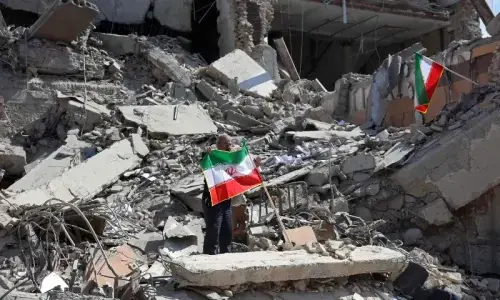
Afghanistan has for months accused Pakistan’s army of firing hundreds of rockets into the two eastern provinces of Kunar and Nuristan, targeting militant havens but also killing people and forcing Afghan villagers to flee their homes.
“The failure to end such attacks risks jeopardising Afghanistan-Pakistan bilateral relations, with potential negative consequences for necessary bilateral cooperation for peace, security and economic development in our two countries and the wider region,” Afghan Foreign Minister Zalmai Rassoul said.
Afghanistan has sent additional troops and long-range artillery to the border with Pakistan as tensions rose over the shelling.
“We reiterate our call for an immediate and complete end to these acts, which have taken the lives of dozens of Afghans, mainly civilians, while leaving many more wounded,” Rassoul said.
Pakistan has repeatedly accused Afghanistan of giving safe haven to militants on the Afghan side of the border, particularly in Kunar province, leaving Pakistan vulnerable to counter-attack when it chases them out of its own tribal areas.
Pakistan’s UN Ambassador Abdullah Hussain Haroon said his country had a robust security force along its border with Afghanistan and had recently enhanced its presence with checkpoints and regular patrolling.
“Our deployment far exceeds the number of international and Afghan forces deployed on the other side, which might also be the reason why so many attacks take place on the western side in Afghanistan,” Haroon said.
“We continue to be resolute despite the high human and economic cost of this endeavour.” Meanwhile, UN special envoy to Afghanistan, Jan Kubis, said humanitarian agencies had registered about 4,000 people from Kunar province who had been displaced by the cross-border shelling since April.
Kubis said he was “glad to hear that authorities in Afghanistan and Pakistan are already engaged in multi-level dialogue in order to resolve this situation and its root causes.”
He also told the Security Council there had been reports of uprisings against the Taliban in various areas of the country, but that this new development required greater analysis because “the drivers of violence are complex and the actors — and their allegiances — fluid”.
“Desire for local communities to have security and justice led them to taking the situation into their own hands. There is a risk of even greater fragmentation of the security environment,” Kubis said.
“Many of these localised conflicts would appear to be resistance to the Taliban, but not necessarily in support of a greater government presence.”—Reuters