0
0

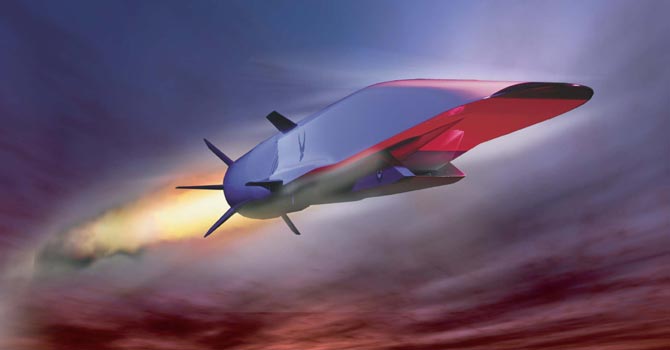
WASHINGTON: The US military plans to launch a hypersonic unmanned vehicle in a test flight Tuesday over the Pacific, with the X-51A due to reach mind-boggling speeds of Mach 6, a spokesman said.
The Waverider, which resembles a missile with a flat nose, will be dropped off the wing of a B-52 bomber off the California coast at an altitude of about 15,000 meters (50,000 feet), according to the US Air Force.
The latest test of the experimental vehicle is tentatively scheduled for 10 am local time (1700 GMT) at Edwards Air Force Base in southern California, spokesman Kenji Thuloweit told AFP.
A solid rocket booster will catapult the vehicle to a speed of about Mach 4.5 in 30 seconds before the X-51A's engine accelerates to Mach 6, six times the speed of sound or more than 7,300 kilometers (4,500 miles) per hour.
After a scheduled flight of about five minutes -- in which it is expected to reach an altitude of 21,000 meters (70,000 feet) -- the Waverider will splash down in the Pacific, the Air Force said. There are no plans to recover the test vehicle.
The X-51, at eight meters (25 feet) long, reached Mach 5 during its first test in May 2010, but the flight -- which lasted a little over three minutes -- ended earlier than planned due to a technical problem.
Hypersonic flight renders conventional turbine jet engines useless due to the extraordinary heat and pressure generated at such high speeds.
But Pentagon strategists see hypersonic aircraft as a promising technology that could dramatically bolster America's air power, comparing it to radar-evading stealth warplanes that emerged in the 1970s.
Hypersonic technology eventually could be employed for long-range bombing, reconnaissance or transporting troops, analysts say. The X-51 is one of several hypersonic projects currently under way.
In November 2011, the Pentagon successfully tested an “advanced hypersonic weapon,” a bomb.
In August 2011, the Pentagon test flew a hypersonic glider dubbed HTV-2, which is capable of flying 27,000 kilometers (17,000 miles) per hour, but the test ended in failure. WASHINGTON: The US military plans to launch a hypersonic unmanned vehicle in a test flight Tuesday over the Pacific, with the X-51A due to reach mind-boggling speeds of Mach 6, a spokesman said.
The Waverider, which resembles a missile with a flat nose, will be dropped off the wing of a B-52 bomber off the California coast at an altitude of about 15,000 meters (50,000 feet), according to the US Air Force.
The latest test of the experimental vehicle is tentatively scheduled for 10 am local time (1700 GMT) at Edwards Air Force Base in southern California, spokesman Kenji Thuloweit told AFP.
A solid rocket booster will catapult the vehicle to a speed of about Mach 4.5 in 30 seconds before the X-51A's engine accelerates to Mach 6, six times the speed of sound or more than 7,300 kilometers (4,500 miles) per hour.
After a scheduled flight of about five minutes -- in which it is expected to reach an altitude of 21,000 meters (70,000 feet) -- the Waverider will splash down in the Pacific, the Air Force said. There are no plans to recover the test vehicle.
The X-51, at eight meters (25 feet) long, reached Mach 5 during its first test in May 2010, but the flight -- which lasted a little over three minutes -- ended earlier than planned due to a technical problem.
Hypersonic flight renders conventional turbine jet engines useless due to the extraordinary heat and pressure generated at such high speeds.
But Pentagon strategists see hypersonic aircraft as a promising technology that could dramatically bolster America's air power, comparing it to radar-evading stealth warplanes that emerged in the 1970s.
Hypersonic technology eventually could be employed for long-range bombing, reconnaissance or transporting troops, analysts say. The X-51 is one of several hypersonic projects currently under way.
In November 2011, the Pentagon successfully tested an “advanced hypersonic weapon,” a bomb.
In August 2011, the Pentagon test flew a hypersonic glider dubbed HTV-2, which is capable of flying 27,000 kilometers (17,000 miles) per hour, but the test ended in failure.