0
0

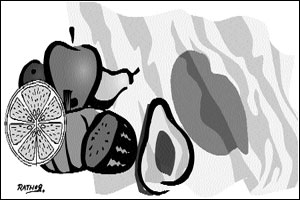 Water melon is liked and eaten all over the world but the problem with it is that its flesh is embedded by a large number of seeds and they have to be removed before or during the course of ingestion.
In order to overcome this inconvenience, two Japanese scientists produced seedless water melons more than half a century ago. Since this was a strange and fascinating innovation, it was adopted quickly in the developed world.
The technique is indeed simple and one wonders why it has not been adopted here. What they did was that they immersed the seedling of water melon in a certain dilution of colchicine for a period of 24-36 hours.
This chemical has the property to inhibit cell wall formation in between two daughter nuclei when the seedling is in active mitotic stage, which results in all the plant cells having double number of chromosomes in the plant body.
All stem, leaves and even flowers have 4n chromosomes. At the time of meiosis, reduction division takes place producing both male and female gametes with 2 n chromosomes.
When such plants are crossed with diploid plants (2n), it will produce seeds with n numbers of chromosomes. On commercial scale bumble bees are used as pollinator instead of hand pollination, which is most expensive. Such seeds will produce fruits of the same quality excluding seeds in the flesh (theoretically only 4 percent seeds are produced).
In case of seedless water melon new seed has to be produced every time. That’s why its production is more expensive as compared normal.
When the seed containing 3n number of chromosomes (triploid) is sown, it will germinate like a normal plant, producing male as well as female flowers on the same vine. Whereas, the normal plant having 2n number of chromosomes is called diploid. Both male and female flowers shall not produce viable pollens and normal gametes as the chromosomes will not pair in meiosis. As usual the pollination will take place but will result in unviable seed; however the auxins will trigger the ovary to swell to produce a normal fruit, flesh with similar or better taste.
I think that we too can produce seedless fruits or vegetables by employing the following method:
Selecting germplasm found in nature; use of colchicine; search for genetically-induced parthenocarpy and cytoplasmically controlled parthenogenesis and utilizing transgenic parthenocarpy.
In nature, there exists a great variation in number of seeds in citrus and guava fruits; it is usually unpleasant to eat such seeded fruits. Hence it is probable to select seedless plants which can be easily perpetuated vegetatively.
The seedless character in banana and grapes might be controlled genetically, cytoplasmically or by both. Genetically this character might be controlled multigenecally which may not be possible to transfer so easily.
However it is just possible that cytoplasmically inherited parthenogenesis could be transferred easily into alien plants.
With the advent of production of transgenic varieties of cotton, corn, canola and golden rice, have ushered in an era of synthesizing or altering crop plant through addition of genes from unrelated organism. It is just possible that time may come when a chromosome or a set of chromosomes are substituted or deleted to produce another genotypically or phenotypically altered organism.
Transgenically, Dr Barg and Salts have successfully produced seedless tomato. The process involves elimination of pollination consequently setting fruit without seed. The induction of parthenocarpy is economically desirable for growers, processors and consumers as well.
They produced seedless tomato with the addition of a gene from agrobacterium rhizogene called as ‘rolB’ gene (which induces enhanced auxin sensitivity) fused to an ovary specific promoter to parthenocarpic fruit development. However both of these scientists intend to encompass the application of their research for the development of seedless egg plants, zucchini, melon, strawberry and pepper.
The fruits produced by this method are characterized by:
1. Fruit size comparable or even better than, that of seeded fruits: good colour, regular shape and complete jelly fill.
2. Taste as good as or better than seeded.
3. Novelty—especially for fruits such as strawberry cherry, squash, eggplant, pepper, melon, watermelon, citrus, guava, leechi, dates and mango especially big seeded Anwar rotle, peaches, plums, apricot etc.
5. Improved taste—seedless fruits have often higher total soluble contents.
6. Facilitates eating—one relishes eating such fruits.
7. Greater reliability of crop yield under varying climatic conditions — owing to elimination of pollination thus producing higher yields.
8. Increased profitability for fruit processing industry for enabling its use due to supply of raw material for longer period as well as elimination of seed removal stage in case of tomato ketchup and tomato paste.
The development of transgenic varieties of fruits and vegetables may lead serious opposition as has been experienced in adaptation of cotton, corn and other crop varieties, as the gene inserted from fungi might have deleterious effect on the consumers as well as the environment. Thus, under previous experience we must be very careful unless they prove to be free of such encumbrances.