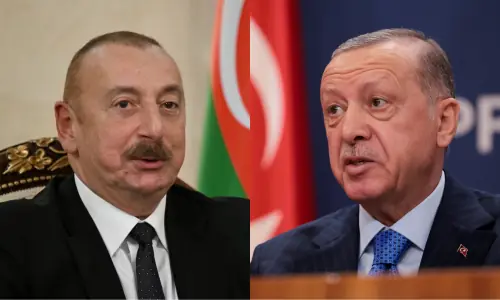
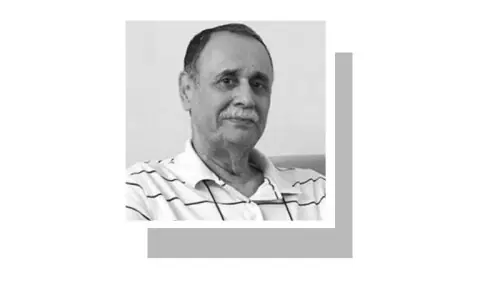
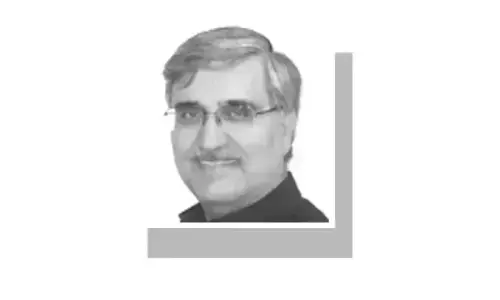
“Hasty military operations in foreign states usually bring radicals to power,” Medvedev(R), president for four years until Vladimir Putin’s(L) inauguration on May 7, told a conference in St Petersburg in remarks posted on the government’s website. — File Photo by Reuters
MOSCOW: Russian Prime Minister Dmitry Medvedev warned on Thursday that military action against sovereign states could lead to a regional nuclear war, starkly voicing Moscow’s opposition to Western intervention ahead of a G8 summit at which Syria and Iran will be discussed.
“Hasty military operations in foreign states usually bring radicals to power,” Medvedev, president for four years until Vladimir Putin’s inauguration on May 7, told a conference in St Petersburg in remarks posted on the government’s website.
“At some point such actions which undermine state sovereignty may lead to a full-scale regional war, even, although I do not want to frighten anyone, with the use of nuclear weapons,” Medvedev said. “Everyone should bear this in mind.”
Medvedev gave no further explanation. Nuclear-armed Russia has said publicly that it is under no obligation to protect Syria if it is attacked, and analysts and diplomats say Russia would not get involved in military action if Iran were attacked.
Russia has adamantly urged Western nations not to attack Iran to neutralise its nuclear programme or intervene against the Syrian government over bloodshed in which the United Nations says its forces have killed more than 9,000 people.
Medvedev will represent Russia at the Group of Eight summit in place of Putin, whose decision to stay away from the meeting in the United States was seen as muscle-flexing in the face of the West.
Putin said previously that threats will only encourage Iran to develop nuclear weapons. Analysts have said that Medvedev also meant that regional nuclear powers such as Israel, Pakistan and India could get involved into a conflict.
As president, Medvedev instructed Russia to abstain in a UN Security Council vote on a resolution that authorised Nato intervention in Libya, a decision Putin implicitly criticised when he likened the resolution to “medieval calls for crusades”.
Medvedev rebuked Putin for the remark, and some Kremlin insiders have said the confrontation over Libya was a factor in Putin’s decision to return to the presidency this year instead of letting his junior partner seek a second term.
Russia has since accused Nato of overstepping its mandate under the resolution to help rebels oust long-time leader Muammar Gaddafi, and has warned it will not let anything similar happen in Syria.
Since Putin announced plans last September to seek a third presidential term and make Medvedev prime minister, Russia has vetoed two Security Council resolutions condemning Assad’s government, one of which would have called on him to cede power.
Russia’s G8 liaison Arkady Dvorkovich said Russia will try to influence the final version of the G8 statement at a summit in Camp David this weekend to avoid a “one-sided” approach that would favour the Syrian opposition.
“In the G8 final statement we would like to avoid the recommendations similar to those which were forced upon during the preparations of the UN Security Council resolutions,”
Dvorkovich said. “A one-sided signal is not acceptable for us.”
Russia successfully managed to water down the part of the statement on Syria at a G8 summit in France in May 2011, removing the calls for action against the regime of Syrian President Bashar al-Assad.
“We believe that the United Nations is the main venue to discussing such issues,” Dvorkovich said.
LAST APPEARANCE The G8 summit is likely to be the last appearance among all the leaders of industrialised nations for Medvedev, who embraced US President Barack Obama’s “reset”, improving strained ties between the nations.
Dvorkovich said Putin’s absence from the summit, the first time a Russian president has skipped one, would not affect the outcome: “All the leaders, I saw their reaction, are ready to comprehensively work with the chairman of the government (Medvedev).”
Dvorkovich said that at a bilateral meeting with US President Barack Obama, Medvedev will raise opposition to attempts by some US lawmakers to introduce legislation which will address human rights violations in Russia.
Such legislation could take a form of the so-called Sergei Magnitsky bill, named after the Russian lawyer who died in prison in 2009. The Kremlin human rights council says he was probably beaten to death.
The bill would require the United States to deny visas and freeze the assets of Russians or others with links to his detention and death as well as those who commit other human rights violations.
“New legislation which will address new political issues as imagined by some US congressmen or senators is unacceptable,” Dvorkovich said, promising a retaliation.