0
0

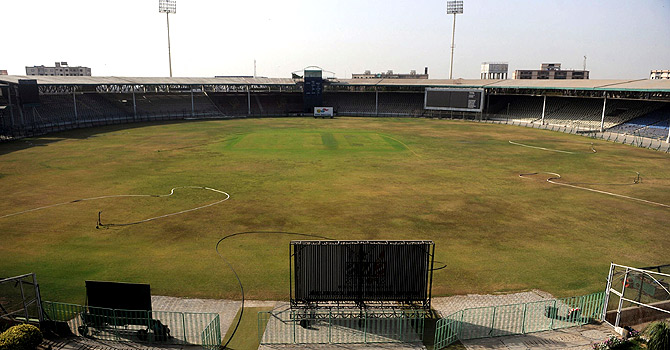
KARACHI: Karachi's National Stadium was once a dusty, sweaty hell for visiting cricketers, a cauldron of heat and noise where Pakistan went unbeaten in Tests for more than 45 years.
But now, three years after international sides stopped coming to the country in the wake of a deadly militant attack on a Sri Lankan team bus, the stands are silent, deserted and rusting with disuse.
It is a scene repeated in stadiums across Pakistan. Since the gun attack in Lahore, the country has not hosted a full international in any sport, barring a short series of hockey friendlies against lowly China.
Last month it organised a visit by the Bangladesh cricket team, only to have it postponed a week later over security fears, to the dismay of Pakistani officials.
And Pakistan's announcement on Wednesday that Canada may visit this year was quickly played down by Cricket Canada chief Doug Hannum, who called it a “potential tour” and said no formal talks had taken place.
Pakistan's 180 million people are well known for being cricket-mad but the nation also boasts a proud history in field hockey -- three Olympic golds, four World Cups and three Champions Trophies -- and squash, where the Khans, Jansher and Jahangir, ruled the world in the 1980s and 1990s.
In 1994 Pakistan even boasted the unique distinction of being world champions in cricket, hockey and squash at the same time.
Even the aftermath of the September 11, 2001 attacks on the US did not deter foreign teams: Pakistan hosted arch-rivals India -- considered the biggest target for militants -- for cricket tours in 2004 and 2006, and staged the World Open squash tournament in 2003 and Champions Trophy hockey in 2004.
But when gunmen attacked the Sri Lankan team bus during the third cricket Test in Lahore in March 2009, killing eight people and wounding seven players, Pakistan was cast into sporting purdah.
It was no longer true that sports were not a target for militants and ever since, teams have been unwilling to come.
For three years, Pakistan have held their “home” cricket series in neutral countries, mostly the United Arab Emirates. All their Davis Cup tennis matches and hockey fixtures have been played away from home.
Ehsan Mani, former president of the International Cricket Council (ICC), believes the Pakistan Cricket Board (PCB) are going the wrong way about seeking to end their isolation.
“The Bangladesh team not coming to Pakistan is a setback,” Mani said.
“But I would say that the PCB's strategy is totally wrong as they are, like, begging teams to come, which is wrong.”
Mani said Pakistan needs to get the ICC to set security guidelines. But he added that even if Bangladesh had come, others were not likely to follow.
“I can't speculate whether Bangladesh Cricket Board wanted to send the team or not, but Bangladesh's visit would not have convinced England or Australia,”he said.
The situation means talented young players like Umar Akmal, Azhar Ali, Wahab Riaz and Asad Shafiq -- who between them have 50 Test caps, 95 one-day and 39 Twenty20 internationals -- have yet to play before their home crowds.
But most dangerous are the financial implications.
“PCB would feel the financial pinch soon,” Tauqir Zia, a former PCB chairman, told AFP.
“Their expenses per year are 1.6 billion rupees ($17.6 million) and this cannot be borne until you earn by hosting cricket. Otherwise you have to go to the ICC and ask for funds.”
Hockey survives on millions of rupees in government grants, while football is supported by international body FIFA through the Goal development scheme.
For former Pakistani Test fast bowler Jalal-ud-Din, the key to Pakistan coming in from the cold is wooing the old enemy next door: India.
“Cricket revival, I believe, is related to India because they are the super powers,” he said.
“PCB must form a team of players and diplomats and send it to various countries in order to convince them to tour.”
Jalal also blamed poor governance in the PCB, saying that under former chairman Ijaz Butt “our relationship with other countries worsened and we are paying for that”.
When a spot-fixing scandal broke during Pakistan's disastrous 2010 tour of England, Butt incensed the hosts by accusing them of throwing a one-day international at the Oval. He later apologised and retracted the allegation.
With Pakistan's security situation still unstable, it seems the wait for top-level international competition will go on, both for the country's sports fans and its under-used stadiums.