0
0

PALMERSTON NORTH, New Zealand: Scientists have long accepted that gas from farm animals is a major factor in climate change, but how do you stop cattle and sheep from doing what comes naturally?
That's the question consuming researchers in New Zealand who hope that by measuring every belch and bleat of their sheepish subjects they can come up with a solution.
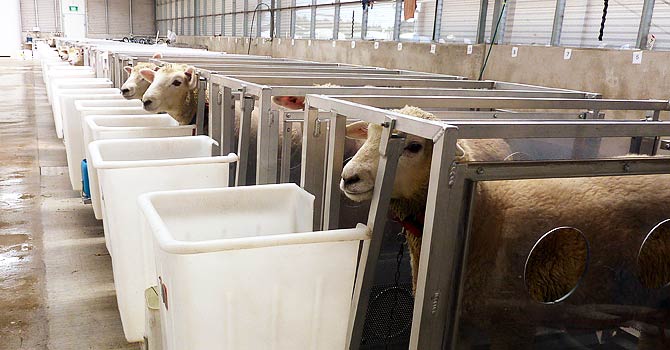
Researcher Peter Janssen says the project, in which the animals are kept in perspex boxes so that their emissions can be measured, has the potential to make a real difference in the fight against global warming.
“The renewed emphasis on climate change, plus new technologies, have given us hope that we can do something that wasn't possible before,” said Janssen, who is working on a vaccine to stop livestock producing methane.
Global livestock numbers are being driven higher due to increased demand, particularly for beef and dairy products as a result of human population growth, leading to increases in emission levels.
The UN estimates 18 per cent of the global greenhouse gas emissions blamed for climate change come from livestock.
But the figure is even higher in New Zealand, where about 35 million sheep and eight million cows account for half the greenhouse gas emissions in an economy heavily reliant on primary industry.
In a nation which prides itself on its “clean, green” image, New Zealand is keen to minimise the problem and has established a NZ$50 million ($41 million) programme aimed at curbing agricultural emissions.
“(It) is probably the largest and certainly the most comprehensive in the world,” said Janssen who is the principal investigator at the New Zealand Agricultural Greenhouse Gas Research Centre.
The problem is the animals are ruminants, meaning they partially digest their food by fermenting it in a compartment of their stomach before regurgitating it, along with copious methane, so it can be chewed again as cud.
As part of the programme, scientists house cattle and sheep in perspex boxes for two days at time to find why some tend to produce less gas than others and measure how different foods affect gas levels.
The centre in the North Island town of Palmerston North uses genome sequencing - determining an animal's hereditary information - to try to minimise the large amounts of methane gas that sheep and cows naturally produce.
“New technologies, particularly in genome sequencing, have allowed us to understand methane microbes in a way that was just not possible in the 1960s and 1970s,” Janssen said.
“We can now identify those organisms and target them specifically to work on vaccines for inhibitory molecules that target only methane-producing microbes.”Dairy NZ sustainability spokesman Rick Pridmore, whose organisation works with scientists at the Palmerston North centre, said not all attempts to reduce agricultural greenhouse gases in New Zealand had gone down well with farmers.
He said that in 2003 the government tried to address the issue by imposing an annual research levy on livestock farmers but scrapped the idea after a backlash over a policy that was widely mocked as a “fart tax”.
Pridmore said while the title was a misnomer - 90 per cent of the methane from livestock comes from burps, not flatulence - opposition to the proposal among farmers was real.
“Even the public didn't get it,” he said. “In New Zealand, I think it was probably fair to say we were sceptical about climate change.
“But that's all changed in the last five years or more, I think farmers are on board now.”The major goal, described as a “silver bullet” by the dairy industry, is the quest for a vaccine that will prevent livestock generating methane altogether.
Pridmore said a low-cost vaccine would not only help the environment by reducing the amount of methane released into the atmosphere but increase digestive efficiency in livestock, meaning they required less feed.
“That's called a silver bullet and right now I would say that silver bullet is probably about 15 years away,” he said.
“Once it comes in, I think every farmer would want to use it.”