IT is always recommended not to perform with great efficiency something that ought not to be performed at all. Imagine a country that first lets problems escalate into disasters and then devotes enormous resources to managing their consequences instead of permanently resolving them. In a PowerPoint-studded press briefing, soon after Eidul Azha last month, a senior minister of the Punjab government announced that the province had achieved a historic milestone by disposing of record-breaking 376,000 tonnes of animal waste and solid refuse,surpassing the 2025 record of 357,000 tonnes. The press briefing was loaded with praise for the Suthra Punjab programme and the leadership of the chief minister.
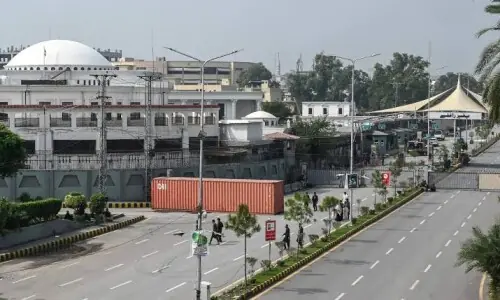
To execute this massive operation in the extreme summer heat, the Punjab government deployed over 184,000 sanitation workers and 40,000 vehicles that covered over six million kilometres in this operation. The government distributed 12m biodegradable waste bags, which were used by citizens to pack sacrificial remains — for pickup from their doorsteps. Because large disposal trucks cannot navigate narrow residential streets, the Punjab government created a three-tier waste transport system. Small vehicles picked up the bags from doorsteps and local waste drums andoffloaded them at thousands of temporary collection points, or TCPs. Mechanical loaders and excavator lifters were then used to scoop the consolidated waste out of the TCPs and pack it into large dumper trucks. The heavy trucks transported the waste to one of the 141 engineered landfill sites across Punjab’s districts.
The entire process was digitally tracked using GPS telemetry to count exact trips. Workers had to submit geo-tagged, time-stamped photographs of the collection points before and after they were cleared and the trucks had to pass through RFID digital weighbridges at the landfills to verify that the waste lifted from the streets was actually deposited at the landfills. A special cash award of Rs10,000 was announced for each sanitation worker.
Not to be left behind, the Sindh Solid Waste Management Board, focusing heavily on Karachi, reported the safe burial and disposal of 81,525 tonnes of offal during the Eid operation. In a press briefing, the Karachi mayor, stated that 99 collection points were established across the metropolis, and 23,415 sanitary workers participated in the operation. He added that 9,326 machinery units and 341 large dumpers were deployed to support the municipal teams. Smaller vehicles collected offal from streets and neighbourhoods, brought it to collection points, from where dumpers transported it to nine especially prepared trenches at landfill sites.
Clean-up operations during Eid could have been managed better.
The elaborate animal waste management operations showcased in Punjab and Sindh should never have been necessary. They were the predictable consequence of a failure to adopt sensible preventive measures. Creating and collecting millions of tonnes of highly perishable organic matter from homes and streets, only to deploy thousands of workers and hundreds of vehicles for emergency clean-up operations and dumping at the landfills would be questioned, not just in the Western world but also in most Muslim countries.
Saudi Arabia, Turkiye, the UAE and Qatar strongly prohibit slaughtering animals in public spaces, parks, homes or streets. Animals can only be sacrificed in state-of-the-art municipal abattoirs under strict veterinary supervision. The blood, bones and offal from these automated facilities are not sent to landfills, but channelled and subjected to high-temperature steam cooking and drying. This process sterilises the waste and separates it into animal fat (tallow) and protein meal. The protein meal is exported or used locally for non-ruminant animal feed and organic fertilisers, while the fats are utilised in industrial manufacturing (like soaps and lubricants). The leftover digestate is converted into high-grade agricultural compost.
Why must we, every year, create an entirely predictable public emergency, only to celebrate the logistical feat of picking, carrying and stacking our landfills with record-breaking millions of tonnes of precious animal waste?
Lost in a haze of environmental jargon, conferences and foreign funding, we cannot even recollect the five fundamental ‘R’s of environmental sustainability — Refuse (do not do, if it can be avoided), Reduce, Reuse, Repair and Recycle. It is impractical to collect, transport and dump a precious resource that could yield far greater value than the expenditure we so proudly incur on it. Will Pakistan celebrate the 2027 Eidul Azha in a saner and more environment-friendly manner?
The writer is an industrial engineer and a volunteer social activist.
Published in Dawn, June 15th, 2026