



 0
0

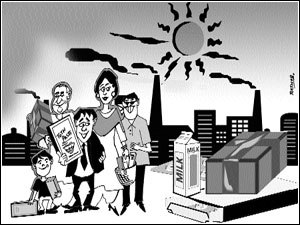 Packaging, which has assumed great importance, is capable of selling anything in the right, attractive and fanciful array. In the process of exporting products from one country to another, or inter-city transportation, the mode adopted is either by land, sea or air.
For this reason, the packing has to withstand the rigours of journey. Upon reaching its destination the products are put up for sale through stores or by direct procurement to consumers, and the right packing makes a difference. A product appearing in an attractive and durable packing with the description of what is inside has more potential and appeal for the consumers.
Technology: The progress in science and technology has changed the process, and also the lifestyle. Packing has become a technology. There are various materials available for packaging, from paper to plastics as well as fibre, polythene, polyurethane foams etc,.
Perishable and non-perishable items such as milk, which once was sold in pots and pans is now available in tetrapack and polythene bags. Meat, vegetables too, are retailed in super markets in various packages and in different weights. Bedsheets, garments like shirts and trousers are now available in attractive packages in retail outlets. Often a consumer does not bother to look inside, but rather reads the contents on the pack, and rushes away after making the payment. In Europe and America, bedsheet sets are sold in packets with clear printing of the size and material used in it.
Garments: Garments do not need much packaging as invariably all clients are eager to check the material, size and the style. But when exporting, this too, has to be packed individually or in groups in polythene bags, printed with designs on it and specification, meeting the buyers’ requirement. The bags are then put in corrugated cartons which are either shipped by air, or by sea.
Furniture: Lot of care has to be taken when shipping the furniture, mostly wooden. With the change in technology, plastic and metal is also being used in furniture making. Care is taken that it is not damaged during transit. Wooden furniture is exported in dismantled form which is then re-assembled to fit in homes. This furniture can be unscrewed again and again in case of shifting from one place to another. Korea and Japan have made much stride in exporting such furniture, while Pakistan still has to go a long way in learning the techniques. Women entrepreneurs are more capable of learning it in short time, perhaps the EPB can arrange training courses in this segment. There exist, lots of potential for the export of shesham, carved, and antique furniture. The Multani and Chinioti furniture with brass and coppers pieces fitted in it can be attractive and need to be developed. Women, with the taste and choice of furniture for homes and offices, can contribute to the development in this arena.
Handicrafts, jewellry, gift items: These are fragile goods and need lot of care and expertize for packing and display. These are high-priced goods, and need attractive and durable packaging. These products do not come under essential goods but depend more on the consumer preference and spending, and as such these require promotion work for marketing. Competition is high as most developing countries produce handicrafts and jewellry.
Standards: There are standards for packaging. In our country, the Pakistan Standards Institution has done great deal of work in developing and guiding the exporters to meet the standards.
Packaging institute: The EPB had set up a Pakistan Design Institute (PDI) at Karachi, and within the PDI a packaging department too, was operating, which later was upgraded to a separate Packaging Institute. But unfortunately, after its successful operations, both the PDI and the Packaging Institute were shut down.
Organizations here are set up with huge investments and enormous efforts but are wrapped up, abruptly. Organizers fail in maintaining such organization. Similar, is the case with the Textile Industry Research Development Centre (TIRDC) working under the Ministry of Industries. The TIRDC came into being with the help of the UNDP. Foreign experts were brought to Pakistan, along with machine and equipment through the UNDP aid. But it too, faced the fate of closure as the government could not keep it functioning. Though, it could have been sold to the private sector but no effort was made in this regard.
After the closure of the PDI, the EPB was approached to sell the same to a private party, but the request went unattended. It seems that the vested interest do not want organizations like the PDI or the ‘packaging institute’ to function for reasons known to them.
Designing and printing: With the advancement in computer, graphics designing and printing have given numerous options by producing good packages with beautiful design in different colours. It is necessary that such available facilities be utilized to produce excellent packages with a large number of variations and choices. Modern printing techniques offer gravure and flexographic printing. It is gainfully utilized in the case of packing candies, sweets, chocolates and biscuits. It can very well be utilized for a number of other export products, as well.





























