
Celebrating the Sadeh festival

Published January 31, 2012

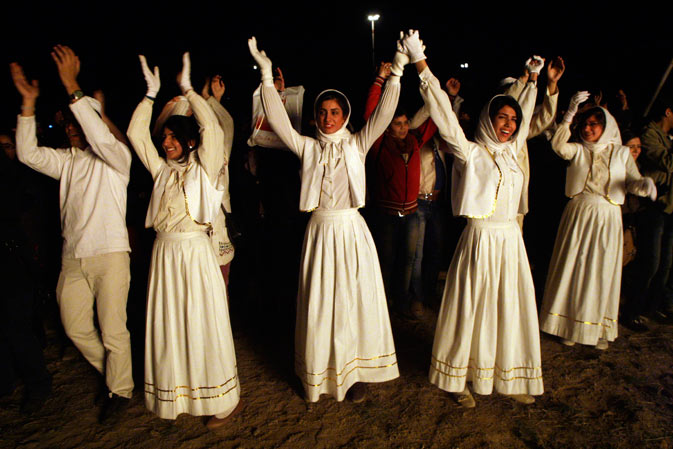
This gallery displays the celebration of Zoroastrians ancient mid-winter Sadeh festival, outside the capital Tehran, Iran.

Sadeh, celebrates the discovery of fire and its ability to banish the cold and dark, and it is held in the frigid depths of winter.

Sadeh was the national festival of ancient Persia when Zoroastrianism was the dominant religion, before the conquest of Islam in the 7th century. Now it is mostly celebrated just in the homes and temples of Iran's about 60,000 remaining Zoroastrians.

Zoroastrians once numbered in the millions but were persecuted and forced to convert after Muslims rose to power in Iran. A small number fled to India and their descendants became known as Parsis, or people from Persia. — Photos and text by AP


Opinion

Geopolitical shift in ME

Geopolitical shift in ME

A prolonged conflict will have far-reaching implications for regional geopolitics, sharpening the divisions among Gulf countries that are directly affected by the tensions.

Editorial

Unyielding stances
Updated 13 May, 2026

Unyielding stances

Every day that passes without clarity on how and when the war will end introduces fresh intensity to the uncertainty roiling global markets and adds to the economic turmoil the world must bear because of it.
Gwadar rising?
13 May, 2026

Gwadar rising?

COULD the Middle East conflict prove to be a boon for the Gwadar port? Islamabad’s push to position Gwadar as a...
Locked in
13 May, 2026

Locked in

THE acquittal of as many as 74 PTI activists by a Peshawar court in a case pertaining to the May 2023 violence is a...
Bannu attack
Updated 12 May, 2026

Bannu attack

The security narrative and strategy of the KP government diverges considerably from the state’s position.
Cotton crisis
12 May, 2026

Cotton crisis

PAKISTAN’S cotton economy is once again facing a crisis that exposes the country’s flawed agricultural and...
Buddhist heritage
12 May, 2026

Buddhist heritage

THE revival of Buddhist chants at the ancient Dharmarajika Stupa in Taxila after nearly 1,500 years is much more ...