0
0

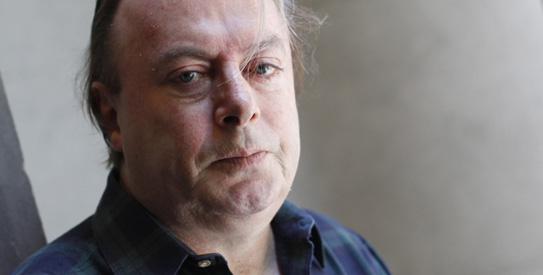
WASHINGTON: British-born journalist and atheist intellectual Christopher Hitchens has died at the age of 62 after a battle against cancer of the esophagus, Vanity Fair announced on its website early Friday.
Hitchens, who began his journalistic career in Britain before moving to the United States where he enjoyed great success, was diagnosed with the disease in June 2010, and had documented his declining health in his Vanity Fair column.
In announcing his death, Vanity Fair described the writer as “incomparable critic, masterful rhetorician, fiery wit, and fearless bon vivant.”
Hitchens was diagnosed with cancer soon after the publication of his memoir, “Hitch-22,” and later underwent chemotherapy.
His “matchless prose” had appeared in Vanity Fair since 1992, when he was named contributing editor, the magazine said in an online article headlined: “In Memoriam: Christopher Hitchens, 1949-2011.”
Vanity Fair said Hitchens died with friends at his side at the MD Anderson Cancer Center in Houston, Texas.
“May his 62 years of living, well, so livingly console the many of us who will miss him dearly,” the magazine said.
“At the end, Hitchens was more engaged, relentless, hilarious, observant, and intelligent than just about everyone else, just as he had been for the last four decades.”
The writer had written in the June 2011 issue of the magazine: “My chief consolation in this year of living dyingly has been the presence of friends.”
In the past 12 months he had written about the United States's troubled political relations with Pakistan in the wake of Osama bin Laden's death, and on the future of democracy in Egypt following the Arab Spring uprisings.
As his health deteriorated he also chronicled cultural issues, writing a profile of the American writer and novelist Joan Didion, and an essay on the Private Eye retrospective at the Victoria and Albert Museum in London.
In the past decade Hitchens had become as well known for his confrontational style of debate, as for his writing, and he had clashed with such well-known figures as Henry Kissinger, who he branded a “war criminal.”
Although he ended his writing life on the political right-wing, the writer started out on the left, working for the International Socialist magazine and later the New Statesman in London, where he fiercely opposed the Vietnam War.
But after the September 11 attacks in the United States a decade ago he embraced a far more interventionist foreign policy and supported the Iraq war, and denounced what he called “fascism with an Islamic face.”