0
0
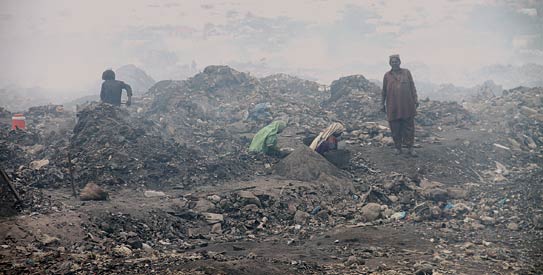
KARACHI, Oct 2: While no environmental checks exist at the officially designated largest waste dumping site in the city where burning of discarded material in the open by rag pickers keeps filling the air with toxic gases and chemicals, experts say that the issue can be resolved by setting up cost-efficient landfills on scientific lines that may also be used to produce electricity and gas.
The government-designated waste dumping sites of Jam Chakro, spread over 500 acres near Surjani Town and Gond Pass near Hub River Road, with an area of 300 to 400 acres are looked at by many experts as ‘a recipe for an environmental disaster’. They lack provision for waste disposal on a scientific basis, the environmentalists explain.
“They are simply waste-dumping sites that should be looked at as a recipe for an environmental disaster as no arrangements have been made for the safe disposal of waste,” said Dr Moinuddin Ahmed, botanist and environmentalist teaching at the Federal Urdu University for Science and Technology.
The establishment of a scientific landfill site, according to Dr Ahmed, doesn’t require huge funds. “A cost-efficient landfill site could easily be designed and established. Landfill sites have provisions for waste-segregation, treatment, recycling and generation of electricity and gas,” he said, adding that a scientific survey was necessary before designating a place as a landfill site to avoid groundwater contamination.
A landfill site is used to dispose of non-recyclable waste usually in the form of ash collected from incinerators where the waste is burnt under expert guidance, according to him.
“The practice of burning waste in the open, even if the waste comprises only paper, is against the basic environmental norms,” he added.
Living on dumps
The road leading to the Jam Chakro waste-dumping site was found strewn with refuse during a visit to the area. Smoke was billowing up from garbage dumps, while rag pickers in groups were setting fire to them in order to pick metal and other valuable materials from the ashes.
The staff deputed at the weigh station told Dawn that between 200 and 250 trucks arrived at the site from different town municipalities to dump waste there on a daily basis.
According to sources, the Jam Chakro waste disposal site was a foreign-funded project and part of the site was developed to generate methane gas, but the project failed to take off, mainly due to lack of government interest, that helped some influential people living nearby to take control of the land and charge rag pickers for letting them operate.
Dozens of rag pickers live along with their families at the waste dumping site amid filth, flies and large number of stray dogs.
They said they were forced to live and work in filth as they didn’t have any other job skill. Each individual earns between Rs100 and Rs150 on a daily basis, depending upon the kind of valuable they get hold of.
“Each family gives about Rs200 to the landlord a month to do business and live in peace here. Besides, a small amount is paid to the driver of refuse vehicle to unload the waste at a place within our reach,” one of them said.
The waste was burnt to separate the valuables from ashes, he said. “We find iron, silver, copper, wood, bones and sometimes even gold from the waste.”
They didn’t show much interest in paper and polythene bags, a major component of the waste and environment pollutant, when asked about it.
Health hazards
Pointing out the health hazards caused by burning waste in the open, Dr Nasiruddin Khan, a senior Karachi University faculty member teaching at the university’s chemistry department, said that the toxic chemicals released during burning include nitrogen oxides, sulfur dioxide, volatile organic chemicals and polycyclic organic matter while burning plastic also released heavy metals and toxic chemicals such as dioxin, a major environmental contaminant.
“People who are exposed to these air pollutants can experience eye and nose irritation, breathing difficulty, coughing, and headaches. People with heart disease, asthma, emphysema, or other respiratory diseases are especially sensitive to air pollutants. The chance of human health effects occurring depends mostly on the concentration of air pollutants in people’s breathing zone,” he said.
Dr Khan was of the opinion that though burning waste in the open diluted its effects to an extent, it was like poisoning the environment slowly. “The toxic gases being released from the burnt waste are gradually poisoning the whole environment. They are likely to affect us more when the wind direction changes towards the city.
“Also we must not ignore the damage of soil contamination at the waste dumping sites,” he observed.
Research work
Dr Nasim A. Khan, vice chancellor of Hamdard University, said his institution did not receive a response from the Sindh government to our plan for initiating a research project on the waste at Jam Chakro.
“We had made a contact three years ago. The plan was to get details and regulate the kind of waste being dumped at the site and its possible utility by using different technologies.”
In the absence of government authorisation, however, the university couldn’t initiate any research project at the site, he said, explaining that the official permission was mandatory to seek a bank loan for research.
Replying to Dawn queries, city government district officer for solid waste management Najeeb Ahmed said that the department’s repeated efforts to remove rag pickers from the site had ended in failure.
“It’s an open area and under constant encroachment. We even complained to police to remove pickers, yet I haven’t received a positive response from them.”
Funds
Mr Ahmed said: “There is also an issue of funds. In foreign countries, about 60 to 75 per cent of the municipality’s budget is spent on managing solid waste. However, the city district government of Karachi spends less than one per cent on it,” he said.
He said he had no data on the industrial waste being generated in the city or the nature of it, though some industries were managing it on their own.
According to senior city government officials, the city lacks a proper system for solid waste disposal and there is no reliable data about how much and what type of solid waste the city produces on a daily basis. Keeping in view international specifications, it is estimated that the city generated about 9,000 tonnes of solid waste on a daily basis.
A random analysis carried out by some Chinese experts some years ago showed that 22 per cent of waste comprised paper, five per cent metal and three to four per cent glass. “Fifty per cent of the solid waste, however, goes into the drains.” Part of the rest is dumped along the roads and on the vacant plots across the city while part of it, without any segregation, ends up at what the government had designated as ‘landfill sites’ in the 1990s. Part of the medical waste, officials claim, is burnt in the two incinerators of six to seven tons capacity installed at Mewashah and the ash is later dumped at the ‘landfill sites’.