In the orgy of bloodshed that this country is going through, there is one death that can’t be blamed on the militants or the military or drones. Hasan Dars didn’t die at the hands of dacoits, nobody abducted and tortured him. There was a car accident, there were heartless police officers who couldn’t make up their mind whether it was a part of their job to help a car crash victim or not.
There is something about the death of a young, beautiful poet in his prime that makes one reach for the clichés that the poet himself fought all his life. Tragic, we often say, or untimely, as if there is such a thing as a timely death. “Hassu’s demise is not tragic,” a common friend called to say. “But his death has made all our lives tragic.”
People of Sindh saw Hasan give his first public recital in 1987, at a literary gathering of Sindhi Adbi Sangut. Shaikh Ayaz, the doyen of Sindhi poetry, after his long silence through the Zia years, was making a rare public appearance. Hasan read his epic poem “Nange Sarmad je Hazoor” (In the Court of Naked Sarmad). And immediately it was decided that he was the rightful heir to Ayaz. For the next 23 years, Hasan became a legend of sorts. Students framed his poems and hung them in their hostel rooms; every new piece of poetry he wrote was considered an event. Nobody knows how and when it was decided, but for all practical purposes he was crowned Sindh’s national poet. And he never even published a single collection of his work.
As a poet Hasan wasn’t just liked or loved, he was worshipped. Grown men adored him, married women were ready to ditch their beloved families for a few hours of his company; there were times when pistols were drawn to decide who will get to host Hasan for the evening.
Hasan was a one man travelling mushaira, a rock star always on the road, a fakir with a taste for finer things in life. All he had to do to start a party was to drive into town and people would start pouring out. He was the centre of a league of men who sat by a lakeside or in a smoke-filled room reciting poetry all night, recounting stories of lost comrades who spent half their lives underground. The cult was tentatively called Qatilan-i-Shab, or assassins of the night, its sole aim to wage a war against time, against sleep, against predictability. And when the sun started to come up, it would always be Hasan reciting his new poems. Sometimes he would recite one line and his audience would recite the next one. It was always his voice but there was something about his diction and his stylish rendering that the audience believed the illusion that it was an act of collective creativity. Since there was never a published book to be read, his poetry travelled seena-ba-seena, from heart to heart.
He was a proud flâneur, stopping only to spend the night with a group of friends. He was like those Sindhi gents you see spending all day in a chai khana. City dwellers often wonder why they aren’t more productive, why they don’t do something more with their lives? As far as Hasan was concerned, what could be more productive than talking to one’s friend, watching the world go by, and composing poems?
He was always on a mission to show his city friends that side of life. His invitations always arrived with promises of moonlit nights on Keenjhar Lake and new poetry.
Hasan was a bridge between Sindhi and Urdu intellectuals, writers and well-read youth from both sides of the ethnic divide, especially at times of ethnic strife in Sindh. If he was reading for friends who didn’t understand Sindhi, he would patiently explain every line he recited. “Karachi, we are your sunflowers and you are our Sun,” reads one of his poems about the city. There are many Karachi residents who only saw Sindh on their travels with Hasan.
And although he loved listening to and reciting poetry, Hasan had no interest in being among the literati. His circle of friends included professional thieves, outlaws on the run, intellectuals, prostitutes, fakirs and politicians.
Hassan had a passion for horses. When he started a project to raise a breed of local horses his friends managed to persuade him to apply for a small grant. “How will your community benefit from this project?” he was asked. “I don’t know about my community, but I can bet the community of horses will definitely benefit from this,” he replied.
In one of his poems, Hasan writes:
In the heart of every man, there is a horse leaping
In the heart of every man, there is a piece of sea
And every sea has a shore
On every shore is the eternal wait.
Rest in peace, Hasan. Horses and humans, we all will miss you.
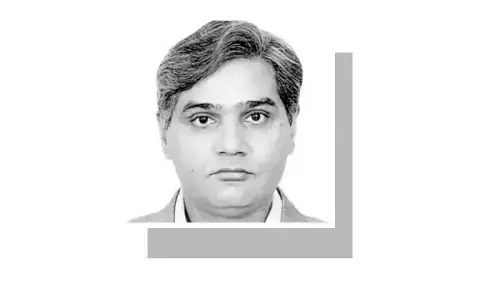
Mohammed Hanif is the author of A case of Exploding Mangoes; Hasan Mujtaba is a journalist and poet based in New York.
This article appeared in the May 26, 2011 issue of Books & Authors.