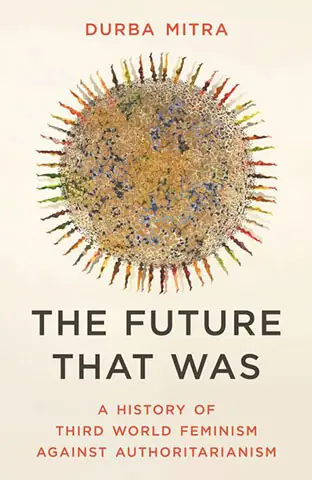
The Future That Was: A History of Third World Feminism Against Authoritarianism
By Durba Mitra
Princeton University Press
ISBN: 9780691233604
352pp.
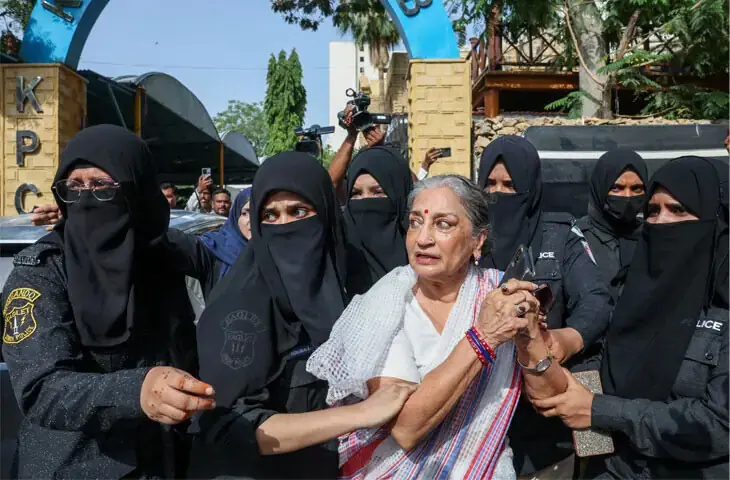
On May 5, 2026, police in Karachi detained Aurat March organiser Sheema Kermani along with six other fellow activists, as they arrived to hold a press conference. This recent event is not new in Pakistan’s history against women’s activism. The state has been using multiple forms of resistance to discourage participants from organising protests on March 8 (International Women’s Day) every year since 2018 — the year when Aurat March demonstrations were initiated by women’s rights activists.
Some of the restrictions include administrative barriers, such as the requirement to obtain a No Objection Certificate from city authorities, who routinely withhold or delay it; police violence against protesters; and the refusal or delay of permits for public gatherings.
In 2019, the provincial assembly in Khyber Pakhtunkhwa adopted a resolution against the Aurat March and labelled its demands as “shameful and un-Islamic.” In terms of public backlash, there have been reports of petitions being submitted before the courts to ban the march, along with blasphemy complaints and police cases filed against organisers over doctored videos.
These repeated attempts to restrict the Aurat March highlight the relationship between feminism and state power that Durba Mitra examines throughout her book The Future That Was: A History of Third World Feminism Against Authoritarianism.
A recent book documents how women in the Global South utilised knowledge production and built transnational networks to challenge authoritarianism, patriarchy and neocolonialism
It illustrates what Durba Mitra argues: women claiming public space and a state using force to stop them. The authoritarian state in the post-colonial ‘Third World’ often resorted to violence and detention to bar women from seeking their rights; the same phenomenon can be observed in the resistance against Aurat March participants in Pakistan.
This book was published in March 2026 to commemorate 50 years since the first UN International Women’s Year in 1975. The author explores the history of ‘Third World’ feminism in the face of state authoritarianism and global economic inequality in the 1970s and the decades that followed, leading women to collaborate across borders to secure their fundamental rights.
A significant contribution of the book is its examination of how global economic inequality and neocolonialism gave rise to authoritarian governments in postcolonial states, and how women in the Global South challenged authoritarian state repression. The key factors that led to the emergence of authoritarian states in the ‘Third World’, argues Mitra, were the new development programmes and debt infrastructure spearheaded by institutions such as the World Bank and International Monetary Fund (IMF).
These programmes exacerbated global inequality. In response to that, there emerged reactionary politics in the form of religious populist movements, such as some parts of the Iranian Revolution in 1979 and even Pakistan’s ‘Islamisation’ in the 1980s, although the latter was more top-down. Some states employed authoritarian, patriarchal laws that denied women fundamental citizenship rights.
The United Nations introduced International Women’s Year in 1975 and then the UN Decade for Women from 1975 to 1985 — all this to expand research on women around the globe. Mitra calls this a very important feat for women and argues that the “international research on women as we know it would not exist” if it were not for these two events.
However, Global South women also faced the burden of aligning their research work to the international development paradigms to get funding. ‘First World’ women, on the other hand, dominated global research on women and attempted to depoliticise the theories developed by ‘Third World’ women against neocolonialism and global economic inequality.
In response, women in the Global South initiated a transnational solidarity project of knowledge production to document their experiences and get their voices heard. One example is women’s participation in international conferences across Asia, Africa and Latin America, which happened with the backdrop of nationalist politics and imperialism. Another example of transnational solidarity was the creation of the Association of African Women for Research and Development (AAWORD), as a pan-Africanist organisation to decolonise research in Africa and challenge Western methods of research deployed in African societies.
Women from the Global South also created Development Alternatives with Women for a New Era (DAWN) as a transnational feminist network, connecting scholars and activists to challenge conventional development methods and to push for gender justice. Through all these platforms, ‘Third World’ women expressed solidarity with each other against patriarchal and neocolonial oppression.
Another profound contribution is the book’s organisation around genres of knowledge production. These include the conference, the report, the organisation, the book, and the protest. These genres highlight the ways in which ‘Third World’ women used various avenues to produce knowledge rooted in their experiences of authoritarianism and neocolonialism. By discussing these, she shows the challenges and promises of feminist thought in the Global South.
The order of these genres highlights how each form of knowledge-making process generated the conditions for the next. For example, the chapter on the book (research) is followed by the one on the protest. Through this order, she explains that women’s transnational research networks of the 1970s and 1980s were foundational to their taking to the streets against authoritarian states, since that research not only documented abuse but also provided knowledge, setting the case for protests.
Women employed protests, research, legal advocacy, and knowledge production to challenge authoritarian governments that restricted women’s rights. Through this work, these women laid bare the equality promises made during anti-colonial struggles. For example, women stood alongside men during anti-colonial struggles and were promised equal citizenship, but this promise failed after independence, with laws that made women’s status subservient to that of men. One example of women’s response to those failed promises is their protests against the authoritarian family laws in countries such as Algeria, Morocco and Pakistan.
At the end, Mitra leaves readers with three key lessons from ‘Third World’ feminist history: One, ‘Third World’ feminism was essentially anti-authoritarian; two, transnational collaboration was integral to the feminist project; and three, feminist knowledge infrastructures are fragile, since many of the institutions built by earlier generations have been threatened by authoritarian governments. The opposition to women’s current activism in Pakistan is a depiction of Mitra’s analysis: even after decades of organising, feminist gains remain vulnerable to authoritarian political structures.
One of the limitations of this book is its emphasis on the struggles of elite, educated, upper-caste women in Pakistan, India and other ‘Third World’ countries, paying little attention to the initiatives taken by other grassroots or feminist rural movements. However, Mitra acknowledges that these elite movements challenged many forms of state oppression, but failed to address religious, caste and minority oppression.
It is also worth noting that elite women had access to political and economic infrastructure through which they could influence the knowledge-making process, while rural feminist movements did not have access to these options. Still, it would have been significant to note how the exclusion of their voices affected the overall feminist project in the ‘Third World.’
Overall, Mitra tells the story of how women from the Global South built a global movement out of very little: no funding, no institutional backing and, often, no safety. This book also reminds readers that this story is not finished.
The Aurat March activists in Pakistan are raising the same demands today as those raised by ‘Third World’ women for over half a century: that women be heard, be free to organise, and be treated as full citizens.
The reviewer is a graduate student of political science at San Diego State University in California, USA
Published in Dawn, Books & Authors, August 16th, 2026