This was not the first collaboration on Pashto language on the two sides of the Durand Line. In 1942, some 25 language experts on both sides of the border had agreed to resolve a few differences regarding the Pashto script.
And more recently, scholars in Peshawar and Kabul held several meetings to adopt a unified script. In the 1990s, the Pashto Academy of the University of Peshawar arranged a Pashto language workshop attended by Afghan and Pakistani language experts in which a unified Pashto script was adopted.
Alphabets in Pashto have origins in Hindi, Persian and Arabic but the language also has its own distinct sounds for which Pakhtun scholars have framed phonetic symbols.
As many as 70 Pashto accents are spoken in Pakistan and Afghanistan. As a result, several words and phrases have different pronunciations; this variance also exits in the script which creates problems for non-Pashto speakers.
During the 1800s, the entire Pashto-speaking belt, from southern and eastern Afghanistan to the right banks of river Indus in present-day Khyber Pakhtunkhwa, together with the province of Balochistan, was part of the Kingdom of Afghanistan. Today, Pakhtuns are scattered over many regions and thus have been unable to adopt a unified grammar and script.
In the early 19th century, some officers in the British India East Company showed interest in learning Pashto due to the region’s geo-strategic importance. A British Army officer Henry George Raverty wrote A Grammar of the Pushto Language of the Afghans in 1855 and also compiled a comprehensive Pashto to English dictionary in 1860 that spread over 1,100 pages.
British scholars identified two dialects, the hard Yousafzai and the soft Kandahari and officially recognised the former as the standard dialect for spoken and written expression. Ever since, Afghan scholars have had reservations about it.
Pashto is a rich language, yet the history of its origin and its people has not been documented nor has a standard script for spoken and written expression been implemented. This attitude has given rise to many linguistic and literary issues. Speakers of the Kandahari dialect stress that their dialect and grammar syntax should be recognised as standard while some Afghan scholars recognise three dialects of Pashto.
In the absence of a central Pashto language authority, Pashto readers and listeners face great difficulties in understanding the language as different media outlets, both electronic and print, have adopted their own regional dialects. And if a non-Pashto speaker has learnt the Kandahari Pashto dialect and goes to Peshawar, he will be incomprehensible as Pakhtuns in the city are not familiar with this accent.
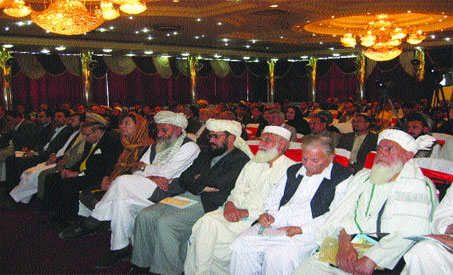
Among those who spoke at the ‘Asanah Pashto’ seminar was former Afghan Interior Minister Ali Ahmed Jalali, who said that it was in the interest of media outlets to adopt a unified script. Abdul Ghafoor Liwal, eminent Pashto writer and director at the Afghanistan Regional Studies Centre said that if language experts from Pakistan and Afghanistan coordinate, many linguistic problems could be resolved.
Professor Dr Rajwali Shah Khattak, poet, critic and director of the Centre of Pashto Language and Literature at the University of Peshawar, said that framing an authentic functional Pashto grammar was the need of the hour and that Pakhtun language scholars should join hands to work for the promotion of the language. He said that unless serious efforts are made to adopt a joint script and grammar, Pashto would remain dormant and never make any substantive strides at a global level.
The Afghan Cultural Society agreed to translate all Dari official letters into Pashto and save them electronically and on compact disks. Senior Afghan scholars Abdullah Bakhtanai Khidmatgaar, Mohammad Akbar and Professor Fazal Hussain Sameem as well as Pakistani experts Professor Dawar Khan Daud, Dr Iqbal Nasim Khattak and Mushtaq Majrooh presented their research papers at the seminar.
The writer is an English language teacher and writes on art and culture