0
0

We’ve all sat through literature classes reading poems that have left us playing guessing games about their meaning, or worse, thumbing through a poetry made-easy book.
“Why can’t the poet use easier words to say what he means,” a student often grumbles. While it isn’t always bad to have a student fumble for the dictionary, humour can often replace hard words and convey a meaning far more powerfully. But how often do students get a chance to finish a poem struggling to control their laughter? Not all humorous poetry is of the calibre to make it to the literature classroom.
The poetry of Ogden Nash, however, not only lets readers guiltlessly snicker, but was also of the standard to be published in America’s prestigious The New Yorker magazine. And while his poems might not teach you a new word from Merriam Webster’s Dictionary, they will definitely help you understand how to make a new word from two old ones. Because when Nash had a meaning with no word for it, he invented a new word, and did it with such genius that you wouldn’t have to guess its meaning.
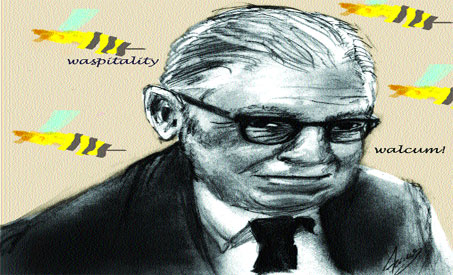
Consider Nash’s “Creature” poems, often only a couple of terse lines centred on a single wittily coined word. In the poem The Wasp, Nash talks about how the wasp “throws open its nest with prodigality,” but how he still distrusts its “waspitality.” In such a short poem, Nash wastes no words and joins the word ‘wasp’ with ‘hospitality’ to make “waspitality”.
In another poem, The Shrimp, Nash pities the shrimp who, plagued by its translucence, cannot get a glimpse — or even a smaller glimpse — a “glimp” of his female shrimp. This new word works wonderfully because the skipping of the “se” from the word “glimpse” makes “glimp” the teeniest of glimpses, and then of course it sounds right in the poem because “glimp” rhymes with shrimp.
Reading these poems, one cannot help but realise that playing fun games with the reader can help the latter not only understand what the writer is saying, but also enjoy it. Nash does not just write about ants and ticks and flies, in fact his poems on human beings are just as witty with inventive wordplay. By poking fun at various qualities we universally possess but think are too superior to talk about, he does us great service.
Babies are always being pampered by adults with some kind of cream or powder, and so in the poem Ode to a Baby, he decides that “a bit of talcum” is always “walcum”. The poem would have rhymed just as well if he had said “welcome” but the change in the spelling also reminds the reader of the way children pronounce words when they initially learn to talk.
In A Caution to Everybody, Nash begins with the serious matter of how the great auk (penguin) became extinct because it forgot how to fly and could only walk. In parallel, Nash thinks that human beings are being just as foolish when it comes to mimicking the ways of others and forgetting what they are naturally inclined towards.
In this case, the human being “forgot how to walk and learned how to fly before he thinked.” Don’t get him wrong, Nash is not saying that we should give up flying, but he is alluding to a great many inventions which required great intellect to invent, but resulted in little benefit to mankind because they went against the nature of man.
He’s also making a sneaky comment about the English language. To say that the past tense of the verb “think” is “thinked” is very logical. But human beings, for whatever reason, are not very logical, and hence in English the past tense of “think” is “thought”. And this lack of logic is reflected not just in illogical inventions, but also in the lack of logic in the English grammar. This is every student’s dream come true to have a poet who writes poems using grammatically incorrect words with a flourish.
So before you think that poetry is your greatest “frenemy”, remember that there is Ogden Nash, who mocks sacred rules of grammar and spelling and makes literature easier to understand — not to mention more fun.