INTERNATIONAL trends show that when the economy of a country is in shackles, large industries face most of the problems while small or cottage industries develop in adversity.
The small-scale industry of Pakistan is the largest employer in the manufacturing sector.
It is labour-intensive, employing about 81 per cent of the total labour force. It is a disappointing fact that there are few statistics available about the small and cottage industries, with a majority being of the informal variety, disorganised and unregulated.
It is a misconception that small industries remain small but there are many success stories where they have ended up as macro-enterprises.
In rural areas, where most of the population lives and the majority is earning its livelihood through this industry, this trend is declining. Children of blacksmiths, peasants and carpenters seek opportunities in urban areas.
A labour drain, therefore, is jeopardising not only this industry but our culture as well. We don’t seem to find hand-woven fabric, embroidered rugs and other handicraft in the lofty shopping malls of Lahore, Islamabad and Karachi.
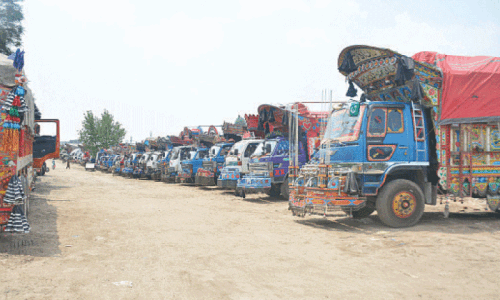
Handicraft is considered the souvenir of Pakistan and is found in remote areas. Such art seems to be fading away due to workers not being able to make enough profit. Their hard work doesn’t pay off.
The finance for these industries comes through the owner’s private savings and credit is seldom given by financial institutions.
There is a lot of potential in Pakistan for the progress of this industry and we can improve our economy through it.
The government should offer incentives to labourers and establish proper institutions for training so that they give their best.
Improvements can be made through easier availability of loans on soft terms. Marketing facilities should also be improved.
Small-scale and cottage industry should be encouraged as opposed to establishing new large-scale industries in urban centres, where the infrastructure is already strained.
It is imperative to develop the cottage industry on modern lines as it is intertwined with our cultural heritage and improvement in the economy along with the increase in foreign exchange.
FAKIHA HASSAN RIZVI Lahore